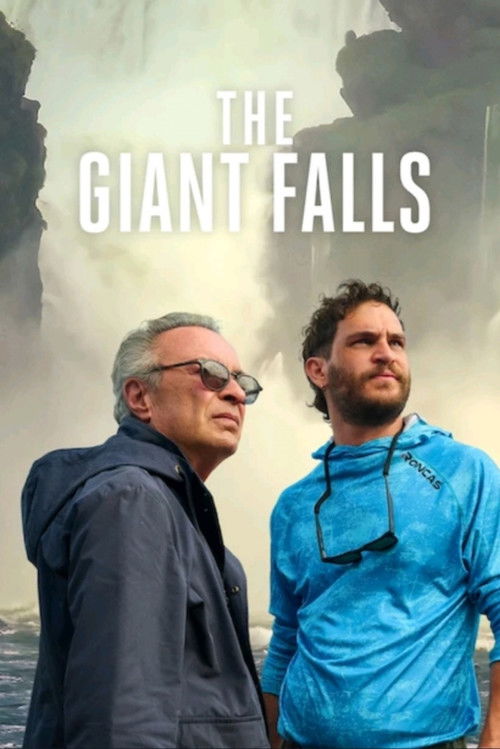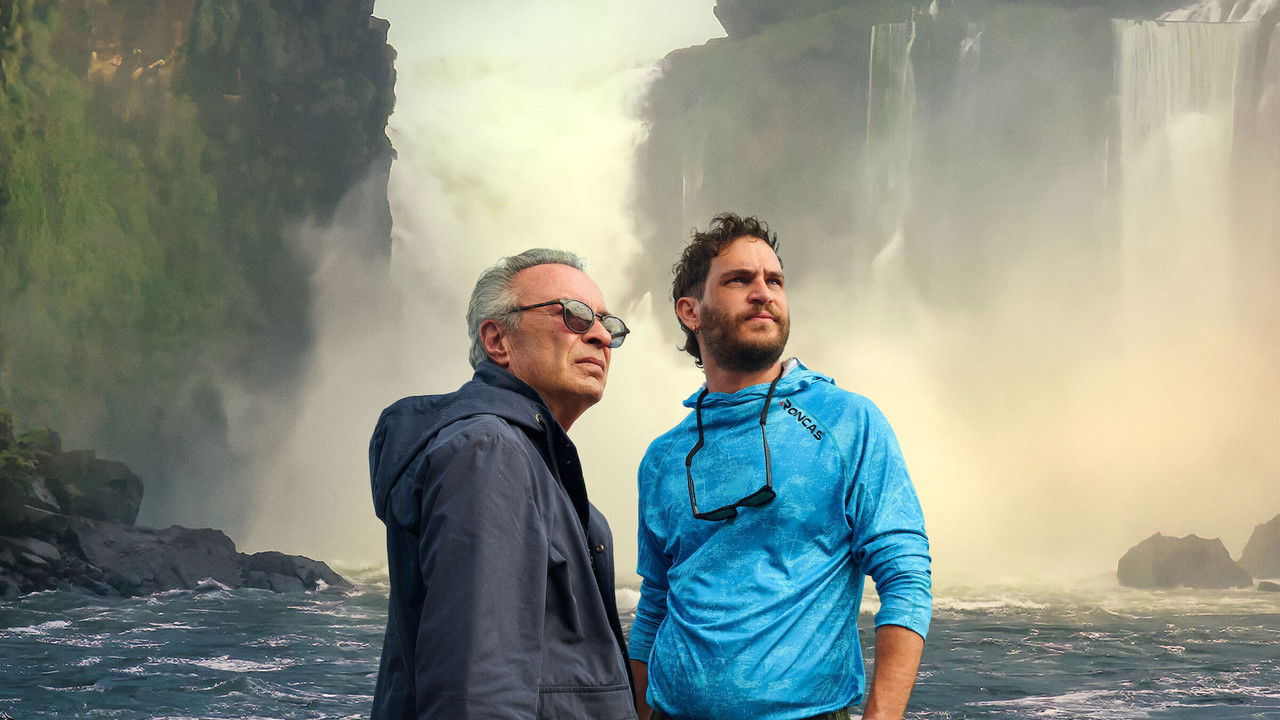
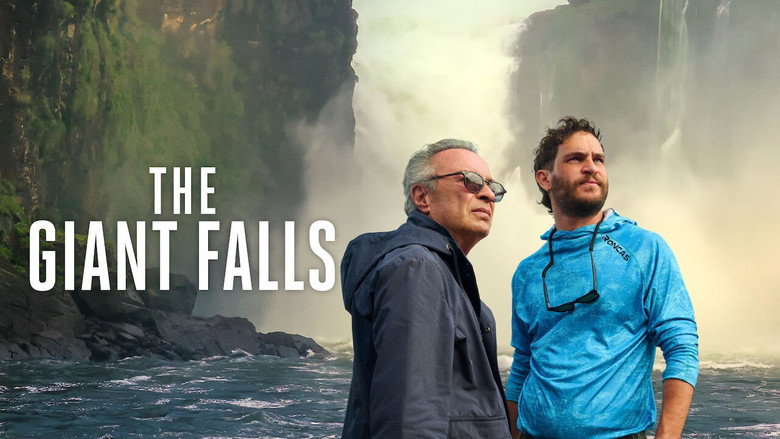
Movie poster for The Giant Falls (2026)

The Giant Falls

2026
1h 42m
+13 · Spanish
Search on Netflix

Overview

Follows Boris, a charismatic tour guide who unexpectedly reunites with his estranged father Julián. Their tense and emotional encounters explore past wounds and the possibility of forgiveness.

Cast

12 people

Reviews

4 min read

The Falls Speak Louder Than Words

I’ve seen this story before. The prodigal father, the wounded son, the reckoning that arrives just in time for a deathbed reconciliation. It’s the kind of narrative that feels like it was handed down from some ancient storytelling playbook—because it was.

What’s interesting about The Giant Falls isn’t the plot itself, but how it tries to dress up that familiarity in the grandeur of Iguazú Falls, as if the sheer force of nature could wash away the clichés.

And for a while, it almost works.

The film follows Boris (Matías Mayer), a tour guide in the shadow of Iguazú, whose life is upended when his estranged father Julián (Oscar Martínez) reappears after decades of absence. Julián is dying, and he wants forgiveness. Boris isn’t sure he’s ready to give it.

What unfolds is a series of tense, emotionally charged encounters—some raw, some strained—that oscillate between catharsis and contrivance.
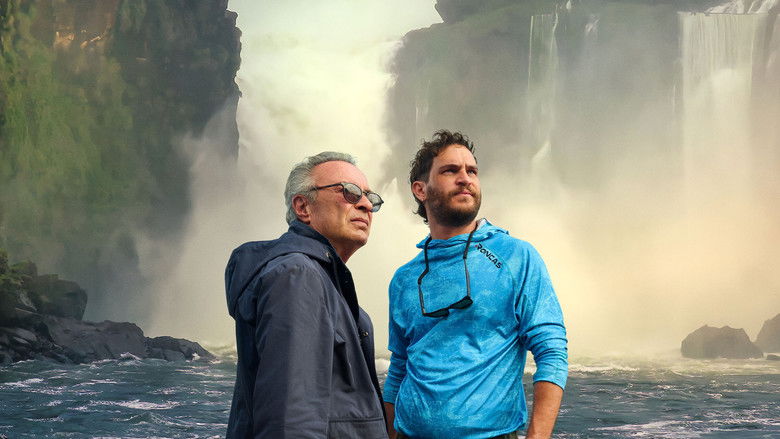
A misty, wide shot of Iguazú Falls, the water roaring like an unanswered question.

The setting is the film’s greatest asset. Iguazú is a character, one that dwarfs the human drama unfolding in its presence. The camera lingers on the falls—endless, thunderous, indifferent—and for a moment, you forget you’re watching a father-son melodrama.

The water doesn’t care about Julián’s regrets or Boris’s resentment. It just is. That contrast is where The Giant Falls comes closest to something transcendent.

The problem is that the script keeps pulling us back into the same old grooves.

Take the scene where Julián, weak and frail, sits on a bench overlooking the falls, trying to explain himself to Boris. The dialogue is heavy-handed—“I wasn’t a father, I was a ghost”—but the setting almost saves it. Almost.

Because then the camera cuts to Boris’s face, and we’re supposed to feel the weight of the moment. But Matías Mayer’s performance doesn’t quite sell it. His expressions are muted, his reactions too controlled.

It’s as if he’s reciting lines rather than living them. (I’ve seen this trick before: the actor who plays the wounded son with restraint, as if emotional understatement equals depth. Sometimes it does.

Here, it just feels like hesitation.)

Oscar Martínez, on the other hand, is magnetic. Julián is a man who has spent his life running from his failures, and Martínez plays him with a quiet, weary charm. There’s a scene where he tries to reconnect with Boris by sharing a childhood memory—something about a dog, I think—and for a brief moment, you see the man he might have been.

It’s a small grace note in a film that too often relies on big, sweeping gestures.
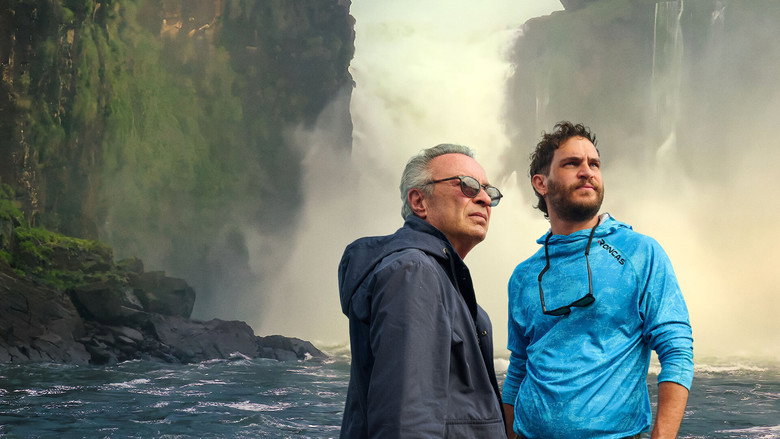
Julián and Boris sit on a bench, the falls roaring behind them, the tension between them as palpable as the mist.

The supporting cast fares better. Inés Estévez, as Julián’s long-suffering sister Leticia, brings a lived-in warmth to her role. She’s the one who actually feels like a real person, not a plot device.

There’s a moment where she confronts Julián about his absence, and her anger isn’t performative—it’s the kind of anger that comes from years of carrying someone else’s burden. It’s the most honest scene in the film.

But then the script undercuts it. Leticia’s arc is resolved too neatly, her forgiveness too easily given. It’s as if the film is afraid to sit with the messiness of real reconciliation. (Maybe it’s intentional. Maybe it’s not. Either way, it feels like a missed opportunity.)

The biggest flaw, though, is the moral framing. Julián is positioned as a tragic figure, a man who made mistakes but deserves sympathy. But the film never fully grapples with the consequences of those mistakes.

Boris’s pain is treated as a hurdle to be overcome, not a wound that might never heal. There’s a moment near the end where Julián asks Boris to help him die, and the film treats it as the ultimate act of love. But is it?

Or is it just another way for Julián to avoid facing the full weight of what he’s done?

I kept thinking about the falls. The way they drown out everything else. The way they make human voices seem small, insignificant. The Giant Falls wants to be that kind of force—something vast and overwhelming, something that puts our petty grievances into perspective.

But it keeps getting tangled in its own sentimentality.
A close-up of Boris’s face, half-lit by the golden hour, his expression unreadable as the falls roar in the background.

In the end, it’s a film that’s easy to admire but harder to love. The performances, especially from Martínez and Estévez, are worth watching. The setting is breathtaking. But the story feels like it’s been told a hundred times before, and this time, the falls aren’t enough to drown out the familiarity.

I left the theater thinking about my own father. Not because the film moved me, but because it made me realize how rarely these stories actually surprise us. We know how they’re supposed to go.

The question is whether we’re willing to sit with the parts that don’t fit the script. The Giant Falls isn’t. And that’s its real failure.

Audience Opinions

Audience 5.7/10
"A touching but familiar father–son melodrama enriched by Iguazú’s beauty and seasoned actors, undermined by a clichéd script and uneven lead work."

Emotional family themes, the imposing Iguazú Falls backdrop, and committed turns from Oscar Martínez, Inés Estévez and other supporting players give this story of abandonment and forgiveness some weight. But the plot follows a very standard estranged-father arc, the writing leans on contrivances and underwritten characters, and Matías Mayer in the lead does not fully sell the character’s inner turmoil.

What viewers praise
  • Compelling veteran performances Oscar Martínez and Inés Estévez bring nuance and credibility to damaged, complicated characters.
  • Emotional family themes Parental absence, resentment, and the difficulty of forgiveness prompt reflection on father–child relationships and past wounds.
  • Powerful Iguazú setting Sweeping shots of Iguazú Falls and the surrounding landscape are a major draw and add poetic contrast to the tense family story.
Common complaints
  • Clichéd storyline An absent father returning at the end of his life is a generic, predictable, overly familiar narrative.
  • Inconsistent lead performance Matías Mayer’s Boris is stiff or limited, especially next to the more seasoned cast around him.
  • Heavy-handed writing Dialogue and situations are forced or artificial, and the script tries too hard to manipulate emotions.
  • Shaky character perspective Framing the remorseful father as a quasi-victim makes the moral stance and final choices uncomfortable or unconvincing to some.
Recommended for
Parent–child drama fans Oscar Martínez followers Latin American melodrama watchers Forgiveness and redemption stories Scenic character-driven dramas

Full Plot (Spoilers)

Spoiler warning

This section contains the full plot, including major story reveals. Overview above stays spoiler-free.

Buzz & Rumors

Public reports

When Giants Don’t Misbehave: The Surprisingly Low-Drama Saga Behind The Giant Falls

For a Netflix melodrama about decades of resentment and emotional trauma, The Giant Falls (aka El último gigante) is shockingly light on real-world chaos. We went digging for the messiest gossip behind this 2026 Argentine tearjerker—and discovered a production so chill it’s almost suspicious. latestnetflix.com's take is that but don’t worry, there is some orbiting tea to sip.


On-Set Drama (Or Lack Thereof)

  • The movie was shot in Puerto Iguazú, Misiones, using Iguazú Falls and the surrounding national park as its main backdrop, wrapping principal photography in a tight late‑May to early‑June 2025 window—no reports of shutdowns, walkouts, or diva behavior bubbled up from local coverage or cast interviews. - Instead of leaks about screaming matches, we got posts about team spirit. Netflix Argentina promoted the movie with a feature on how proud they were of the “compañerismo del elenco” (cast camaraderie), praising how well everyone got along on and off camera. - Local outlets in Misiones highlighted that the production injected around $3 million into the regional economy—meaning the loudest drama may have been hotel owners arguing over who loved this shoot more.

Cast Feuds & Tea: History, Not Set Life

  • Inés Estévez (Leticia in the film) comes with serious tabloid backstory—just not from this job. Argentine outlets have spent years chronicling her turbulent relationship and public disputes with ex-partner Fabián Vena over the upbringing of their adopted daughters, plus her polarizing comments on pandemic mask use. None of this is linked to The Giant Falls, but it does mean one of the movie’s emotional anchors knows her way around a headline. - Lead legend Oscar Martínez has also stirred the pot before. In a much‑quoted 2021 interview, he said he doesn’t miss living in Argentina and called the country “tóxica” (“toxic”), a quote that still resurfaces whenever he fronts a new local release. These older comments floated back into circulation as he promoted The Giant Falls and discussed themes like death, regret and cultural stagnation in new interviews. - Despite these individual backstories, every press appearance about The Giant Falls has been aggressively wholesome: Martínez and co-star Matías Mayer doing joint interviews, calmly dissecting father‑son dynamics and acting methods instead of trading barbs.

Romance Rumors: Fans Try, Reality Says No

  • Matías Mayer became a low-key media darling around the release, thanks to a profile revealing his passion for astrology and the fact he opened a restaurant in Madrid—very “soft bohemian lead actor energy,” but nothing resembling a cheating scandal or co-star fling. - Social content pairing Mayer with Yoyi Francella (who plays a supporting role and also hosts a popular show on Luzu TV) shows them joking and vibing through promo duties. Some viewers in comments and TikToks speculate about “chemistry,” but there are no credible reports of an on-set romance—so any shipping stays firmly in fan‑fiction only territory. - Off-screen, the biggest relationship story in the orbit of the film is actually about Francella’s family: in 2024–2025, her parents—iconic actor Guillermo Francella and Marynés Breña—went through a very public separation after roughly 36 years together. Yoyi was one of the first from the family to address the breakup, becoming tabloid fodder long before The Giant Falls promo tour. Still, that’s splash-over gossip, not a scandal born on this set.

Scandals & Controversies: Nada at the Falls

  • No casting feuds, no “problematic script” discourse, no firing mid‑shoot. Critics described the film as familiar and melodramatic, but no one mounted a campaign to cancel it. - Thematically, the movie deals with euthanasia, abandonment and forgiveness, yet there’s been no major culture-war pile‑on; coverage mainly calls it a moving if conventional family drama. - Unlike other Netflix productions, there are no whispers of lawsuits, unpaid crew, or exploited locations. Local coverage leans almost promotional: beautiful Iguazú, strong performances, emotional story, everyone go home happy.

Wild Trivia & Behind-the-Scenes Nuggets

  • The Falls as a Character: Both critics and regional outlets note that Iguazú Falls isn’t just scenic wallpaper—it’s treated as an emotional metaphor. Latinx film commentary points out that the roaring water mirrors the violence and weight of unresolved family pain. - Netflix’s Argentine Power Play: The movie is part of Netflix’s broader “Made in Argentina” push, announced alongside a slate of local productions and the opening of a shiny new Buenos Aires office in 2026. The streamer explicitly framed titles like El último gigante as proof they’re investing heavily in Argentine stories and talent for 2026–2027. - Economy Booster: A regional report emphasized just how much the shoot pumped into Misiones: about $3 million in local spend on hotels, catering, extras, logistics and services while the production occupied Iguazú and its surrounding areas. For once, the headline was “Film Rescues Local Economy” instead of “Film Wrecks Local Reputation.”
  • Director’s Midlife Confessional: Interviews with director Marcos Carnevale describe The Giant Falls as one of his most personal works, born out of his own reflections on entering the “third act” of life and confronting mortality and unfinished emotional business. Not gossip—but a pretty juicy emotional origin story.

Final Word:

If you came here looking for leaked sex tapes, secret babies, or a DeuxMoi blind item about Iguazú‑set hookups, this one’s going to disappoint you. The Giant Falls is that rare streaming drama where all the toxicity is on-screen and the off‑screen story is mostly: experienced actors, a scenic shoot, Netflix money, and cast members whose messiest chapters happened long before the cameras rolled.

Entertainment rumors and trivia aggregated from public reporting. Treat speculation as unverified unless a cited source confirms it.

More titles in the same genres and with the same cast.