Movie poster for Noah Kahan: Out of Body (2026)

Noah Kahan: Out of Body

2026
1h 36m
R · English
Director: Nick Sweeney
Play trailer
Search on Netflix

Overview

After rocketing to global fame, singer-songwriter Noah Kahan returns to his Vermont roots to get back in tune with himself.

Trailer

Official

Cast

Reviews

4 min read

The Boy in the Mirror

I didn’t expect to cry in the first ten minutes. Not because the film is manipulative—it’s not—but because Noah Kahan is sitting on a bed in a dimly lit hotel room, staring at his own reflection in a handheld mirror, and the way his face crumples isn’t performative. It’s the look of someone who’s just realized he’s been lying to himself for years.

The camera doesn’t flinch. Neither do I.

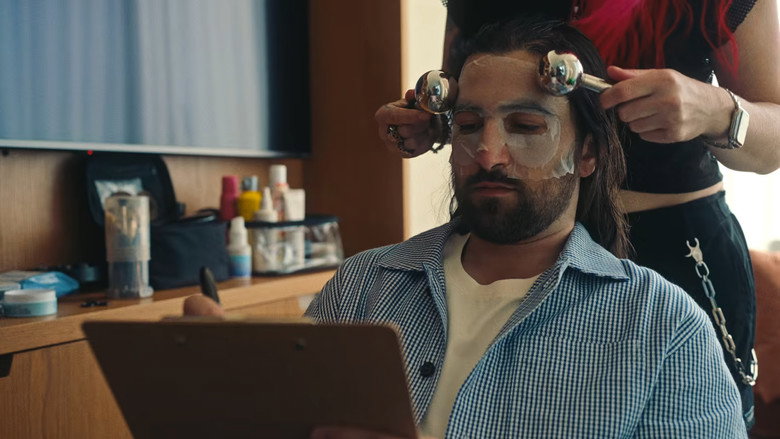
Noah Kahan sitting on a bed, holding a mirror, his expression raw and unguarded

Noah Kahan: Out of Body is a documentary about a man trying to outrun his own shadow. The shadow isn’t fame—though that’s part of it—but the version of himself he constructed to survive it. Director Nick Sweeney, working with a crew that includes Kahan’s high school classmates (a detail that feels both intimate and slightly unnerving), captures something rare in music docs: not the making of an album, but the unmaking of a person.

The film’s greatest trick is making you forget you’re watching a star. By the end, you’re not sure if Kahan is one.

The structure is deceptively simple. We follow Kahan as he returns to Vermont after a whirlwind rise to global fame, a journey that’s less about nostalgia and more about excavation. The film’s emotional spine is his relationship with his father, Josh, who suffered a traumatic brain injury when Kahan was 13.

That accident didn’t just change Josh—it fractured the family, leaving Noah to navigate adolescence while his father became, in his words, “a different person.” The doc lingers on these moments with a patience that borders on uncomfortable. There’s a scene where the two of them sit in a living room, playing Cat Stevens’ “Father and Son” on acoustic guitars, and the camera catches the exact second Kahan’s voice cracks.

It’s not the song that does it. It’s the way his father looks at him—like he’s still trying to figure out who this man is.

Noah Kahan and his father playing guitars together in a warmly lit room

What makes Out of Body more than just a therapy session on film is its refusal to tidy up the mess. Kahan’s struggles with body dysmorphia, depression, and the pressure of sudden fame aren’t presented as obstacles to overcome but as ongoing negotiations. There’s a moment where he’s backstage before a massive show, hyperventilating, and his wife, Brenna, talks him down.

It’s not dramatic. It’s mundane. That’s the point.

Mental health isn’t a plot twist; it’s the air he breathes. The film’s most devastating sequence isn’t a breakdown—it’s Kahan standing in front of a mirror, pinching his stomach, and saying, “I don’t know if I’ll ever feel comfortable in my own skin.” The honesty is brutal because it’s not performative. It’s just true.

The Vermont setting is a character. The film’s visual language leans into the cozy and the claustrophobic in equal measure. Wide shots of snow-covered fields contrast with tight close-ups of Kahan’s face, his expressions flickering between exhaustion and something like relief.

The sound design is equally deliberate—subtle, almost ASMR-like in its attention to small details: the crunch of boots in snow, the hum of a guitar amp, the way a voice cracks when it’s trying not to. It’s the kind of film that makes you lean in, not because it’s loud, but because it’s quiet.

And then there’s the music. Not as a soundtrack, but as a lifeline. Kahan’s songs—“Stick Season,” “Northern Attitude,” the heartbreaking “Paul Revere”—are woven into the film not as promotional clips but as emotional punctuation.

When he performs “Father and Son” with his dad, it’s not a duet. It’s a conversation. The lyrics—“How can I try to explain? / When I do he turns away again”—land differently when you’ve just watched Kahan describe the years of silence that followed his father’s accident.

The music made him famous. It’s how he survived.
Noah Kahan performing on stage, bathed in warm light, his face a mix of intensity and vulnerability

The film’s biggest gamble is its refusal to offer resolution. There’s no triumphant third act, no moment where Kahan “overcomes” his demons. Instead, there’s a quiet acceptance.

In the final scenes, he’s back in Vermont, sitting with his family, laughing. It’s not a happy ending. It’s just life.

The camera lingers on his face, and for the first time, he looks at peace. Not because he’s fixed, but because he’s stopped pretending he needs to be.

Out of Body isn’t for everyone. If you’re not already invested in Kahan’s music or the kind of raw, introspective storytelling that feels like eavesdropping, it might leave you cold. But for those who’ve ever felt like they were performing a version of themselves—whether on stage, in a family, or just in the mirror—it’s a gut punch.

Not because it’s sad, but because it’s real.

I keep thinking about that moment with the mirror. The way Kahan holds it, like it might shatter if he grips it too hard. The way he looks at himself, not with disgust, but with something like recognition.

That’s the film in a nutshell: a man holding up a mirror and finally seeing himself clearly. It’s not pretty. But it’s honest.

And in a world of curated personas, that’s enough.

Audience Opinions

Audience 8.2/10
"A disarmingly intimate portrait of Noah Kahan that hits hard emotionally through its candor about mental health, family, and sudden fame."

The film lands as a deeply personal, often therapeutic experience—raw, honest, and relatable, especially around body image, depression, and growing up in a fractured family. The grounding in Vermont, scenes with family, and performance moments create warmth and community that strengthen the heavy material and even convert newcomers into fans. The intensity of the subject matter and the focus on Kahan's inner world can feel exhausting or less compelling for those not already invested in his music or in mental health narratives.

What viewers praise
  • Unfiltered vulnerability The documentary openly tackles depression, body dysmorphia, and self-doubt in a way that feels unpolished and truthful rather than staged.
  • Highly relatable struggles Anyone dealing with body image issues, disordered eating, or divorced parents can recognize their own experiences in Kahan's story.
  • Emotional catharsis Watching it can feel like a 90-minute therapy session—crying throughout but coming away feeling seen and less alone.
  • Grounded sense of place The return to Vermont, time with family, and small-town details give the film a cozy, lived-in texture that contrasts its darker themes.
  • Strengthened connection to the music Seeing the relationships and experiences behind specific songs deepens appreciation of the lyrics and makes repeat listening more powerful.
Common complaints
  • Emotionally heavy viewing The sustained focus on anxiety, depression, and painful family memories can feel overwhelming and leave you drained.
  • Fan-centric appeal Those not already interested in Noah Kahan or his style of songwriting can find the introspective focus less engaging.
  • Lingering on tough moments The film dwells a bit long on certain difficult conversations and themes, making the pace feel slow in spots.
Recommended for
Noah Kahan devotees Modern folk-pop listeners Mental health story seekers Emotionally intense documentary fans Character-driven music docs crowd New England vibes enjoyers

Full Plot (Spoilers)

Spoiler warning

This section contains the full plot, including major story reveals. Overview above stays spoiler-free.

Buzz & Rumors

Public reports

Noah Kahan: Out of Body — Tears, Poop-Gate & The Surprisingly Messy Truth Behind Netflix’s Softest Boy

When Netflix promised an “intimate” Noah Kahan doc, nobody expected we’d end up talking about fan poop, father-son sob-fests, and a tiny Vermont film crew dredging up a decade of family trauma. latestnetflix.com's take is that Grab your flannel and emotional-support tissues — here’s the real tea behind Noah Kahan: Out of Body.


On-Set Drama (The Feelings Kind, Not the Diva Kind)

  • Director Nick Sweeney says nothing was off the table while shooting — “Nothing was off limits. Like, absolutely nothing” — because Noah refused to draw any lines about what the cameras could or couldn’t see. Translation: your fave willingly signed up to be emotionally strip‑mined on Netflix. - The crew was tiny and weirdly personal: two of the filmmakers were literally Noah’s old high school classmates, which meant they could walk into family homes and tense conversations without anyone stiffening up for “the industry”. Cozy… and also terrifying. - Editing apparently left a mountain of raw pain on the cutting-room floor. Sweeney admitted they had enough material to make “a whole ’nother film,” but had to shave it down to “the truly essential stuff”. Fans are already fantasizing about a bonus “even more unhinged feelings” cut.

Scandals & Controversies: Welcome to Poop-Gate

  • Outside the doc but fully part of the Out of Body era lore: Poop-Gate. At the opening stop of his stadium tour at Citizens Bank Park in Philadelphia, a TikTok went viral that appeared to show human feces near the seats after the show. TMZ noted they hadn’t independently verified what the mystery substance actually was, but the internet did what the internet does. - Noah hopped onto X to beg fans to stop, uh, losing control at his concerts. He joked, “I’ve pooped my pants as much as the next 29 year old,” and pleaded with people to use the bathrooms out of respect for venue staff “with a 1000 yard stare” after cleaning up. Not exactly the glamorous stadium-rock image, but incredibly on-brand for a guy whose breakout hit is literally about seasonal depression.

Family Trauma: The Scene That Broke the Crew

  • If the doc wrecked you, you’re not alone. Noah’s father Josh suffered a traumatic brain injury in a bike accident when Noah was in eighth grade, an incident that changed his personality and the entire family’s trajectory. Out of Body dives straight into that wound. - The most devastating sequence? Noah and his dad sitting together at home in Vermont, performing Cat Stevens’ “Father and Son” on acoustic guitars. Director Sweeney says the moment was so raw that the camera slipped out of focus as someone wiped away tears. Viewers, critics, and probably Netflix executives: also blurry. - Noah calls the conversations about his dad “revelatory,” and says watching the film is “incredibly therapeutic” but also “really difficult” because he has to relive that pain. Basically, it’s less “tour diary” and more “complete psychological audit.”

Romance Rumors: The Brenna Era, Confirmed on Camera

  • Anyone still hanging onto those “Did he and Brenna break up?” Reddit threads can log off. The doc and press around it officially cement wife Brenna Nolan as very much present and very much ride-or-die. - The two got engaged in July 2023 on a trip to Cabo — a moment Noah calls “one of the best days of my life” — and married in an intimate Vermont ceremony in August 2025. - In Out of Body, Brenna tells the crew she “always had a feeling” Noah would make it, and the doc shows her grounding him when he’s spiraling about the music and his creativity right before huge shows. Fans have basically adopted her as the emotional emotional-support human of the Kahanverse.

Leaks, Cuts & The Zuza Mystery

  • Hardcore viewers spotted the name Zuza Beine in the closing credits under “In Loving Memory Of,” kicking off a wave of emotional posts and speculation. Variety notes that Zuza is featured in the film, and much of the doc focuses on how Noah’s music intersects with fans’ mental health struggles. - A viral Instagram reel from Zuza’s family says she was “the original fan in the family” and appears in the doc, with the implication that some of the footage around her story was reshaped or trimmed in the final cut. Not a scandal — more a heartbreaking layer that fans now watch for on rewatches.

Wild Trivia: The Body Image Bombshell

  • Kahan had already built a career on sad-boy honesty, but even fans weren’t ready for this level of candor. The doc reveals his long-running struggle with body dysmorphia and disordered eating — something he’d only brushed up against in his songs before. - Reviews and interviews highlight scenes where Noah talks bluntly about his distorted self-image, his fixation on how he looks onstage, and the quiet shame around it — especially as a man from a rural background where these topics are rarely discussed. Critics have called it one of the most important parts of the film’s legacy.

Bottom line: there’s no screaming match on set, no secret villain producer, no surprise lawsuit. The drama of Noah Kahan: Out of Body isn’t in feuds — it’s in the emotional gore: poop-gate memes, open-heart surgery-level family therapy, and a folk star willing to put his most unflattering truths on Netflix, up close and unfiltered.

Entertainment rumors and trivia aggregated from public reporting. Treat speculation as unverified unless a cited source confirms it.

More titles in the same genres and with the same cast.