

Cristela Alonzo
Self

Cristela seeks joy through various experiences - outdoing her old bully, overdoing spa treatments, and taking her first family vacation - while teaching everyone to embrace life's pleasures.
Official
I’ve seen Cristela Alonzo’s stand-up before—enough to know she’s funny, sharp, and unafraid to talk about money, race, and the absurdity of trying to fit into spaces that weren’t built for you. But Upper Classy, her 2025 Netflix special, isn’t just another hour of comedy. It’s the final chapter of a trilogy, and like all good finales, it lands with something deeper than punchlines.
It lands with permission.

Alonzo has spent the last decade turning her life into material, and in Upper Classy, she’s not just mining her past for jokes—she’s reframing it. The special opens with a simple, devastating line: “I am an example of what the American dream really is.” It’s not a boast. It’s a correction.
For Alonzo, the American dream isn’t a white picket fence or a 401(k). It’s survival, then stability, then—finally—the right to take up space without apology. The hour that follows is a masterclass in how to turn trauma into comedy without letting the audience off the hook.
Take the bit about vacations. Alonzo describes taking her family to Hawaii because, as a kid, she saw the Brady Bunch go there and thought, That’s where happy families go. The joke isn’t just that she picked a destination based on a ‘70s sitcom. It’s that she had to learn how to vacation at all.
For her family, leisure wasn’t a given—it was a revelation. She tells the story with a mix of wonder and exhaustion, like someone who’s still adjusting to the idea that joy isn’t a luxury. The audience laughs, but the silence that follows isn’t awkward.
It’s the point.
That silence is Alonzo’s secret weapon. She uses it like a comedian’s version of a cinematic pause—letting the weight of a joke settle before she twists it into something sharper. In one moment, she’s riffing on spa treatments (“I overdid it with the body scrub, and now I look like a peeled potato”), and in the next, she’s explaining how self-care isn’t vanity for people like her—it’s survival.
The shift is seamless, but the effect is deliberate. She’s not just making you laugh. She’s making you feel the distance between where she started and where she is now.
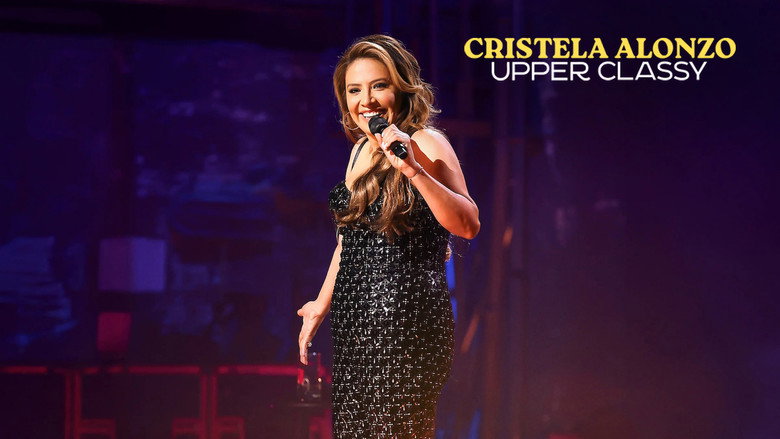
The special’s most powerful moments aren’t the jokes about class or race, though there are plenty of those. They’re the quiet asides, the ones where Alonzo steps out of the bit to talk directly to the audience. She tells a story about her mother, an undocumented immigrant who worked herself to the bone to keep her kids fed.
She doesn’t milk it for pathos. She just says, “I don’t know how she did it,” and the room goes still. That’s the magic of Upper Classy: it doesn’t just make you laugh at the absurdity of the American class system.
It makes you angry at it, too.
Alonzo has always been political, but here, the politics feel more urgent. The special was filmed in Dallas in 2025, against the backdrop of nationwide protests and renewed ICE raids. She doesn’t shy away from it.
In the opener, she sips water and deadpans, “Room temperature… because I hate ICE.” It’s a throwaway line, but it sets the tone for the whole hour. This isn’t just a comedy special. It’s a protest.
A celebration. A middle finger to anyone who thinks joy is something you have to earn.
And yet, for all its weight, Upper Classy never feels like a lecture. That’s the trick of Alonzo’s comedy—she makes you think without realizing you’re being taught. She calls it “tricking people into learning things,” and it’s true.
By the time she wraps herself in that Mexican-American flag serape at the end, you’ve laughed, you’ve cringed, you’ve maybe even teared up a little. But more than anything, you’ve understood something about what it means to move through the world as a first-generation Latina, to go from poverty to stability, and to finally—finally—give yourself permission to enjoy it.
The Los Angeles Times called Upper Classy “her most personal—and political—project yet,” and it’s hard to argue. But what the review doesn’t say is how generous the special feels. Alonzo isn’t just sharing her story.
She’s handing the audience a roadmap. Here’s how you survive. Here’s how you thrive.
Here’s how you take up space in a world that’s constantly trying to shrink you.
I left Upper Classy thinking about my own relationship with joy. How often do I treat it like something I have to deserve? How many times have I waited for permission to be happy? Alonzo doesn’t wait. She takes. And in doing so, she gives the rest of us permission to do the same. That’s not just comedy. That’s art.
"A sharp, relatable comedy special that builds on Cristela Alonzo’s signature humor about class and identity."
Cristela Alonzo blends personal anecdotes with broader social commentary, so the comedy feels intimate without being narrow. Her jokes about navigating upper-class spaces as a working-class Latina land well, though the material doesn’t push boundaries as much as her earlier work. Coverage is sparse, but early reactions call it a solid addition to her stand-up catalog.
Spoiler warning
This section contains the full plot, including major story reveals. Overview above stays spoiler-free.
Cristela Alonzo’s Upper Classy looks like one woman, one mic, one very good blowout. latestnetflix.com's read is that but behind the crisp Netflix hour is a swirl of political drama, venue feuds, last‑minute flag stunts, and a whole lot of receipts about how Hollywood treats a Latina comic who refuses to shut up.
Grab your room‑temperature water (you’ll see why) and let’s dig into the juicy real‑world tea around Upper Classy, its creator, and the world swirling around it.
Upper Classy is just one chapter in Alonzo’s bigger “I pick my battles AND my venues” era.
The gossip around Upper Classy doesn’t come with on-set screaming matches—but Cristela’s long history with Hollywood is its own kind of scandal.
If you came here hunting for on‑set fistfights and secret affairs, Upper Classy is not that kind of circus. The real drama lives in Cristela Alonzo’s ongoing war with institutions: networks that underpaid her, execs who harassed her, comics who shout “free speech” but whisper when it gets hard, and venues she’s willing to walk away from rather than park her Latino fanbase next to what she sees as a hostile crowd.
The special’s glitter is real—but so are the ghosts of ICE raids, pay gaps, and “difficult” labels that swirl behind every “classy” punchline. And Cristela? She’s made it very clear: she’ll keep sipping room‑temperature water and calling it like she sees it—whether the industry likes it or not.
Entertainment rumors and trivia aggregated from public reporting. Treat speculation as unverified unless a cited source confirms it.
More titles in the same genres and with the same cast.


