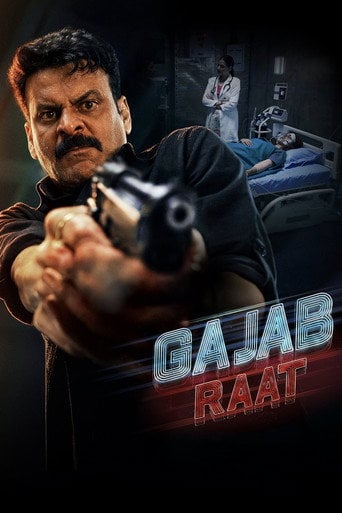
Sohum Shah
Kesarilal Singh

Kesari Lal Singh’s wife leaves him, believing he was flirting with the neighbor—he wasn’t. To make matters worse, a drug parcel is mistakenly delivered to his home, leading to chaos when a dead body turns up. As he tries to dispose of it, another body arrives, plunging him deeper into mayhem.
I’ve seen Ufff Yeh Siyapaa twice now, and I still don’t know if it’s a bold experiment or just a film that forgot to speak. That’s not a rhetorical flourish—it’s the central tension of G. Ashok’s 116-minute silent comedy-thriller, a movie that announces its gimmick in the first frame and then spends the next two hours either proving its necessity or exposing its own emptiness.
The silence isn’t just the absence of dialogue; it’s a vacuum, and the film can’t decide whether to fill it with meaning or let it swallow everything whole.
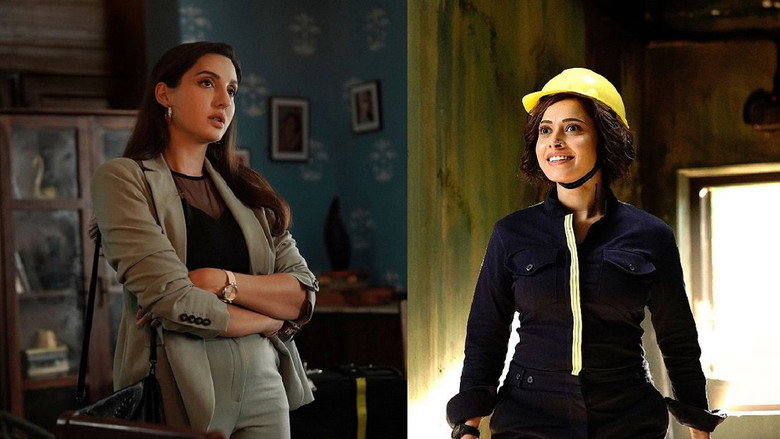
The premise is pure farce: Kesari Lal Singh (Sohum Shah), a meek electricity department employee, is accused by his wife Pushpa (Nushrratt Bharuccha) of flirting with their neighbor Kamini (Nora Fatehi). The accusation is false, but before Kesari can clear his name, a drug parcel is mistakenly delivered to his home. What follows is a cascading series of disasters—corpses appearing in his living room, a bumbling inspector (Omkar Kapoor) stumbling through the investigation, and a cat-and-mouse game with a local thug (Sharib Hashmi)—all unfolding without a single line of spoken dialogue.
It’s Home Alone meets Fargo, if both films had been directed by a man who’d just discovered the concept of physical comedy and decided to test its limits. Ashok’s stated inspirations—Kamal Haasan’s 1987 silent classic Pushpak and Priyadarshan’s madcap comedies—are telling. Pushpak was a masterclass in visual storytelling, a film where every gesture, every raised eyebrow, carried weight. Ufff Yeh Siyapaa wants that same precision, but it often feels like it’s operating on a different wavelength entirely.
Where Pushpak used silence to heighten tension, Ashok’s film seems to treat it as a crutch, a way to avoid the hard work of writing actual jokes. The result is a movie that’s constantly in motion but rarely in control. Take the film’s most talked-about sequence: the climax, where a bag of money bursts open on a staircase, sending rupee notes fluttering down like confetti.
It’s a moment that should feel triumphant, even cathartic, but instead it plays like a metaphor for the film itself—all that potential, all that energy, scattered to the wind. Cinema Express called it “emblematic of the film collapsing under its own ambitions,” and I can’t argue with that. The money isn’t just money; it’s the film’s ideas, its jokes, its coherence, all slipping through its fingers.
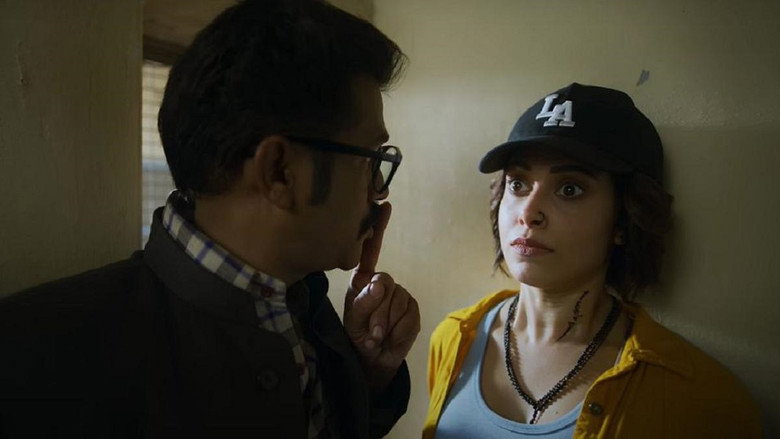
If there’s a saving grace here, it’s Nushrratt Bharuccha. While Shah’s Kesari is a whirlwind of tics and mannerisms—some inspired, some just exhausting—Bharuccha’s Pushpa is the film’s anchor. She’s the only character who feels like a real person, not a cartoon.
When she slaps Kesari, it’s not just a gag; it’s a moment of genuine frustration, a crack in the film’s otherwise airtight absurdity. Bharuccha has always been a charismatic presence, but here she’s given something rare in Bollywood comedies: a character with agency. Pushpa isn’t just a wife; she’s a woman who’s had enough, and Bharuccha plays that exhaustion with a physicality that’s both hilarious and heartbreaking.
(I’m still thinking about the way she drags a suitcase across the floor, her body language screaming, I’m done with this nonsense.)
The rest of the cast is stranded in a screenplay that doesn’t know what to do with them. Omkar Kapoor’s Inspector Hasmukh is a walking punchline, but the joke wears thin quickly. Sharib Hashmi’s Gungra has a few inspired moments—his deadpan reaction to yet another corpse appearing in Kesari’s home is one of the film’s few genuine laughs—but he’s ultimately underused.
And Nora Fatehi’s Kamini is barely a character at all, reduced to a series of smoldering glances that feel more like a music video interlude than part of the story. (Cinema Express wasn’t wrong when they called parts of her dynamic with Kesari “distasteful.”)
Then there’s A.R. Rahman’s score, which is both the film’s greatest asset and its most glaring contradiction. Rahman’s music isn’t just background noise; it’s the film’s voice, its emotional core.
The problem is that a “silent” film with a score this dense isn’t really silent at all. It’s a movie that’s afraid of quiet, that fills every second with sound—whether it’s Rahman’s orchestral swells, the exaggerated foley of footsteps and sighs, or the occasional burst of diegetic music. Filmfare’s question—“why is there music in a ‘silent’ film?
Isn’t that contradictory?”—isn’t just pedantic. It gets to the heart of the film’s identity crisis. If Ufff Yeh Siyapaa is truly a silent film, then why does it feel like it’s screaming at you?
That contradiction extends to the film’s tone, which lurches between slapstick and something darker, almost surreal. There’s a moment early on where Kesari, trying to dispose of a body, accidentally drags it into a neighbor’s apartment. The neighbor, unfazed, simply hands him a cup of tea.
It’s a darkly funny beat, the kind of thing that could work in a Coen Brothers movie. But the film doesn’t know how to sustain that tone. Instead, it veers into repetitive gags—corpses appearing in different places, Kesari tripping over his own feet—and a climax that feels less like a payoff and more like a surrender.
The silence isn’t the problem; the problem is what the film does with it. Silence, when used well, can be a powerful tool. It can create tension, highlight absurdity, or force the audience to pay attention to what’s happening on screen.
But Ufff Yeh Siyapaa treats silence like a novelty, a gimmick to be trotted out rather than a language to be mastered. The result is a film that’s constantly in motion but rarely in focus. And yet.
And yet. There’s something undeniably compelling about the sheer audacity of it all. This is a film that refuses to play by the rules, that dares to be different in an industry that often rewards sameness.
It’s messy, uneven, and often frustrating, but it’s never boring. (Well, almost never. There’s a stretch in the middle where I checked my watch.
Twice.) For all its flaws, Ufff Yeh Siyapaa is a film that’s trying something, and in a landscape where so many movies feel like they’ve been focus-grouped into oblivion, that’s worth something. The question is whether that something is enough. The critics have been brutal—The Indian Express gave it a 0/5, calling it “near-unwatchable,” while Filmfare acknowledged its ambition but ultimately dismissed it as “a brave mess.” The audience reaction has been slightly kinder (a 6.5 on TMDB, which, let’s be honest, is still a failing grade), but even the fans seem to admit that the film’s highs are fleeting, its lows all too frequent.
I don’t know if I’d call Ufff Yeh Siyapaa a good movie. But I do know that I haven’t stopped thinking about it. That’s not nothing.
In a year where so many films feel like they’ve been designed to be forgotten, Ufff Yeh Siyapaa lingers—not because it’s great, but because it’s there. It exists. It took a risk.
And in a way, that’s its own kind of victory. Even if it’s a victory that comes with a lot of screaming.
"A chaotic action-comedy mix that entertains in spurts but suffers from uneven pacing and tone."
Energetic performances and occasional sharp humor keep it moving, but the plot is disjointed and the comedy forced. The action sequences are stylish, yet the story's lack of cohesion leaves little substance. The chemistry between the leads is a recurring highlight, while the supporting roles are underdeveloped.
Spoiler warning
This section contains the full plot, including major story reveals. Overview above stays spoiler-free.
Ashok G.’s Ufff Yeh Siyapaa (2025) is shaping up to be one of Bollywood’s most talked-about—if not most confusing—projects of the year. With a title that translates roughly to "Oh No, This Drama!" (a fitting tease for the film’s own behind-the-scenes turbulence), the movie has already sparked curiosity, skepticism, and a fair share of memes. latestnetflix.com's view is that here’s what we know—and what’s still shrouded in mystery.
The ensemble reads like a who’s-who of Bollywood’s mid-tier A-listers and rising talents, but the real question is: Why are they all here? Leading the charge is Sohum Shah, the Tumbbad star who’s spent years oscillating between indie darling and mainstream underdog. Then there’s Nushrratt Bharuccha, fresh off her polarizing turn in Chhorii, and Nora Fatehi, whose dance numbers have long overshadowed her acting chops. Rounding out the cast are Guru Shivam, Omkar Kapoor, and the scene-stealing Sharib Hashmi (Jamtara, The Family Man), whose inclusion suggests at least one character with a knack for chaos.
The trailer and public reactions hint at a high-octane mix of action, romance, and—judging by the title—unrelenting melodrama. But with no clear genre or plot leaks, the cast’s chemistry (or lack thereof) remains the biggest wildcard. Early fan reactions are a mixed bag: some praise the "raw energy," while others joke that the film’s title might be a self-fulfilling prophecy.
If there’s one aspect of Ufff Yeh Siyapaa that’s generating unanimous hype, it’s the soundtrack. Music maestro A.R. Rahman has composed the score, with the lead single "Tamancha" already dropping to fanfare. The track, featuring vocals from the film’s leads (Sohum, Nushrratt, and Nora), blends Rahman’s signature orchestral flair with a punchy, bass-heavy hook—suggesting the movie might lean into a Dhoom-meets-Gully Boy vibe.
The full OST, listed on SensCritique, promises more of the same: high-energy anthems and moody instrumentals. Given Rahman’s track record, the music might end up being the film’s saving grace—or at least the part audiences remember when the credits roll.
Director Ashok G. Is no stranger to controversy. His previous work, Dabangg 3, was a box-office dud that critics tore apart for its incoherent plot and over-the-top action. Ufff Yeh Siyapaa seems to double down on that chaos, but with a twist: this time, the mess might be intentional.
The film’s title alone suggests a meta-commentary on Bollywood’s love for over-the-top drama, and early teasers lean into that self-awareness. But is Ashok G. Crafting a satire, or is he just winging it? The lack of concrete plot details—even on TMDB [TMDB link]—fuels speculation. Rumors (unconfirmed) suggest the film might be an anthology or a nonlinear narrative, but without official word, it’s all guesswork.
What is clear is that Ashok G. Is banking on star power and Rahman’s music to carry the film, even if the script is a work in progress. If Dabangg 3 was a cautionary tale, Ufff Yeh Siyapaa is either a bold reinvention or a repeat of the same mistakes—just with better songs.
For now, Ufff Yeh Siyapaa is a Rorschach test for Bollywood fans. Is it a trainwreck in the making? A cult classic waiting to happen? Or just another overhyped mess that’ll vanish from theaters in a week? The public reactions are divided, but one thing’s certain: the internet is already having a field day with the title.
If the film’s marketing is any indication, Ashok G. Isn’t shying away from the chaos. The question is whether audiences will embrace it—or run screaming, just like the title suggests.
Entertainment rumors and trivia aggregated from public reporting. Treat speculation as unverified unless a cited source confirms it.
More titles in the same genres and with the same cast.