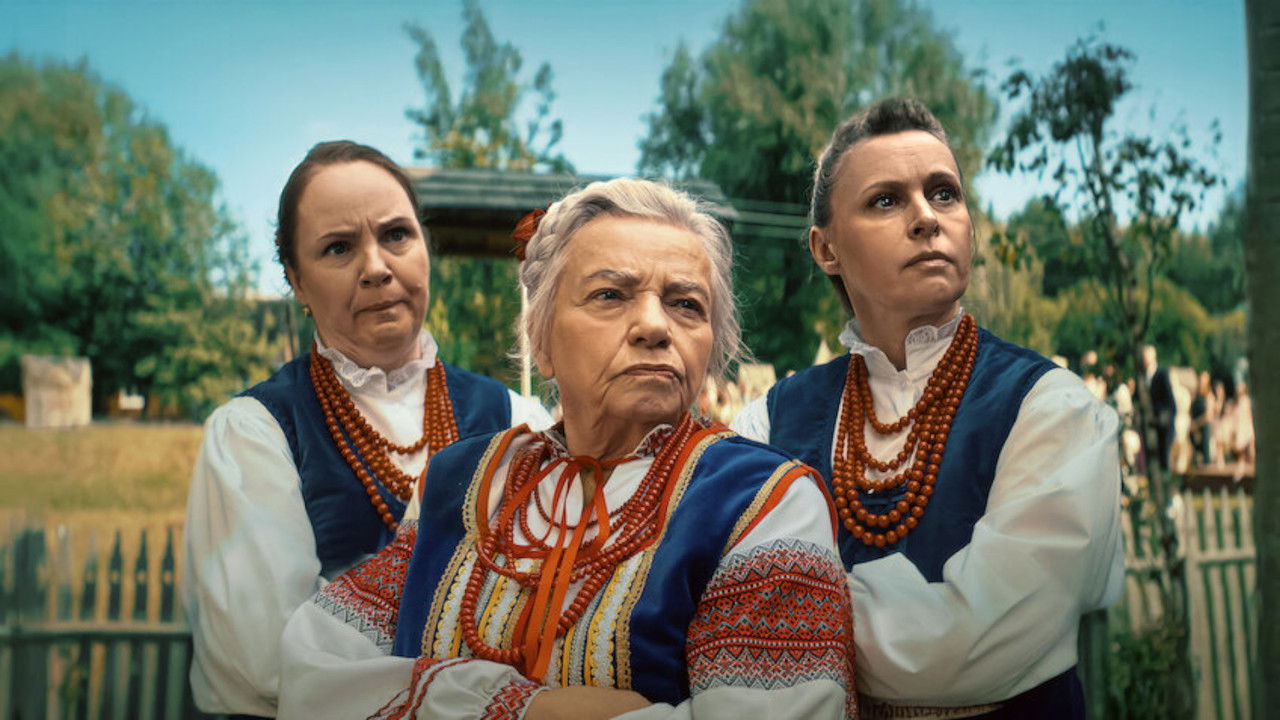

Anna Seniuk
Halina Madej
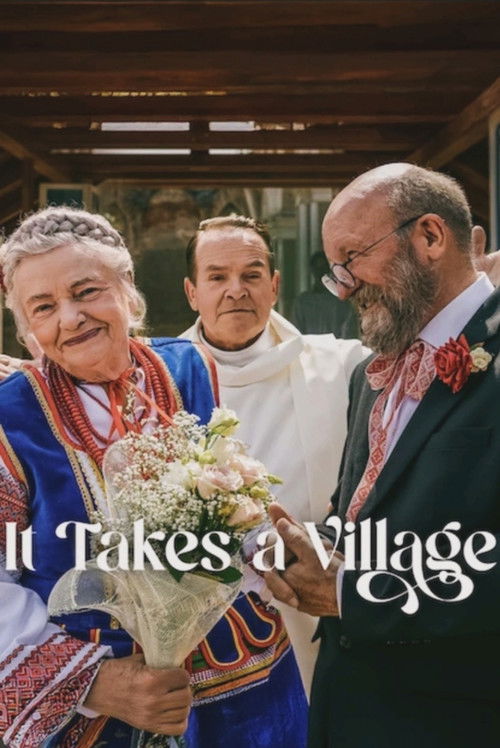
When financial trouble forces Halina to call off her wedding, her friends and family decide to hatch a wild plan to bring in tourist money.
Anna Seniuk
Halina Madej

Artur Barciś
Jan Perzyna

Filip Gurłacz
Wojtek Kurzak

Joanna Trzepiecińska

Anna Szymańczyk
Oliwia Madej
I kept waiting for It Takes a Village to remember what kind of movie it wanted to be. Was it a gentle rural romance, a farcical alien caper, or a meta-commentary on the absurd lengths small towns go to for survival? The film never decides, and in the end, it’s less a village than a collection of mismatched houses nailed together with good intentions and questionable CGI.
The premise is simple enough: Halina’s wedding is canceled when the family runs out of money, so her friends and neighbors concoct a scheme to attract tourists by staging crop circles and alien sightings. It’s the kind of high-concept premise that could either be delightfully silly or painfully forced, and It Takes a Village lands somewhere in the middle—like a joke told by someone who’s not entirely sure they understand the punchline.
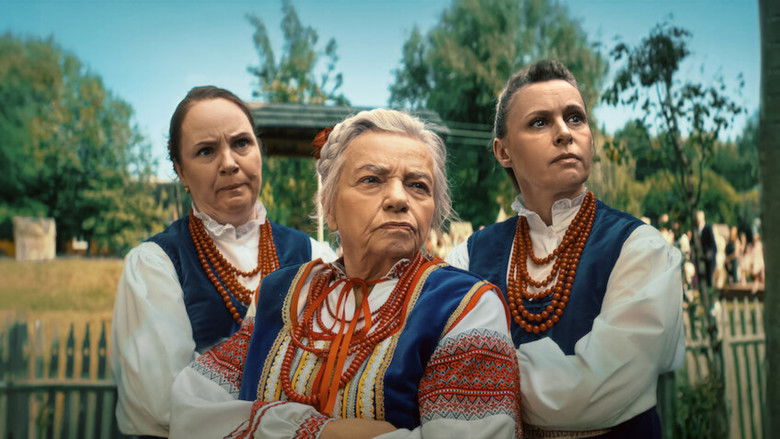
The first act moves at a leisurely pace, introducing us to the ensemble cast with the kind of warm, meandering charm you’d expect from a Polish village comedy. Anna Seniuk and Artur Barciś, as the older couple at the heart of the story, bring a lived-in chemistry that almost makes you forget the script’s occasional stumbles. Seniuk, in particular, has a way of making even the most mundane lines feel like they’re carrying the weight of decades—when she sighs, “We’ve been through worse,” you believe her.
Barciś, meanwhile, plays the lovable oaf with a twinkle in his eye, though the film leans a little too hard on his schtick, as if it’s afraid the audience might forget he’s the comic relief.
But then the aliens arrive. Or rather, the idea of aliens arrives, because the film’s approach to its own sci-fi gimmick is so half-hearted it feels like a last-minute addition. The crop circles are revealed in a scene that’s meant to be whimsical but lands with a thud, the camera lingering just a second too long on the obviously digital effects.
(One shot of a UFO hovering over a field looks like it was lifted from a mid-2000s SyFy original.) The villagers’ plan to exploit the alien hysteria is played for laughs, but the humor is so broad it borders on self-parody. At one point, a character suggests they should “make the aliens more… Polish,” as if extraterrestrials are just another cultural export.

The film’s biggest misstep, though, isn’t the aliens—it’s the way it treats its own setting. Podlasie, the northeastern region of Poland where the story takes place, is rendered with a kind of tourist-brochure superficiality. The landscapes are undeniably beautiful (the cinematography lingers on golden fields and misty forests like a postcard), but the local flavor feels pasted on, as if the filmmakers Googled “Polish village stereotypes” and called it a day.
The dialect is inconsistent, the customs feel performative, and the whole thing gives off the vibe of a theme park version of rural life. It’s the cinematic equivalent of a foreigner attempting to speak a language by stringing together phrases from a phrasebook.
This is a shame, because the film’s heart is in the right place. There’s a sweetness to the way it portrays community—the idea that a village isn’t just a place but a living, breathing organism made up of shared histories and small kindnesses. When the film slows down enough to let its characters breathe, it almost works.
There’s a lovely scene where Halina’s mother (Joanna Trzepiecińska) sits on a porch with her friends, sipping tea and reminiscing about old weddings. For a moment, you forget the aliens and the tourist schemes and just feel the weight of time passing in a place where everyone knows each other’s business. It’s the kind of quiet, observational moment that Polish cinema does so well, and it’s a shame the film doesn’t trust itself to stay in that register.

The audience reception, as it turns out, is as divided as the film’s tone. Some viewers have embraced It Takes a Village as a harmless, feel-good comedy—something to put on in the background while folding laundry or scrolling through their phones. Others have been far less forgiving, calling it a chaotic mess of a script with AI-generated visuals and an inauthentic portrayal of Podlasie.
The critics, for their part, have been brutal. Filmweb’s scores hover around 4 out of 10, with one reviewer calling it “terribly boring, unnecessary… a nightmare.” Artur Barciś, ever the diplomat, has pushed back on the hate, arguing that the film is meant to be a “film-like fairy tale,” not a gritty drama. Piotr Pręgowski, who plays the village priest, went even further, accusing critics of looking for reasons to argue and insisting that not every movie needs to deliver “great catharsis.”
I get where they’re coming from. There’s something undeniably pleasant about It Takes a Village—the kind of movie that doesn’t ask much of you and, in return, doesn’t give you much to complain about. But that’s also its problem.
It’s a film that’s content to be nice, when it could have been something more. The alien subplot, for all its absurdity, could have been a sharp satire of rural economic struggles or a playful riff on small-town mythmaking. Instead, it’s just… there, like a prop that no one bothered to explain.
In the end, It Takes a Village feels like a movie that was made by committee—one group wanted a cozy rom-com, another wanted a sci-fi farce, and a third just wanted to showcase the beauty of Podlasie. The result is a film that’s never quite sure what it wants to be, and so it ends up being a little bit of everything and not enough of anything. It’s not a bad movie, but it’s not a memorable one either.
It’s the cinematic equivalent of a village potluck: some dishes are delicious, some are forgettable, and a few leave you wondering what on earth the cook was thinking. But at least the company is nice.
"A cozy-looking rural rom-com weighed down by a chaotic script, awkward alien gimmicks, and an inauthentic take on Podlasie."
Scenic countryside views, a familiar cast, and a light tone make the film easy background comfort, and a minority genuinely enjoy it as a harmless, feel-good comedy. Far more common are complaints that the plot is nonsensical, the jokes stale, the heavy AI visuals off‑putting, and the invented dialect and caricatured Podlasie embarrassing rather than affectionate. Opinion is sharply polarized: a small group calls it fun and one of the funnier local comedies, while a much larger group rates it very low as a waste of strong actors and an insult to the region.
Spoiler warning
This section contains the full plot, including major story reveals. Overview above stays spoiler-free.
Sweet, wholesome Polish village rom-com? Not so fast. latestnetflix.com's take is that Behind the crop circles and wedding chaos of Netflix’s It Takes a Village (aka Podlasie) lurks a very modern mix of critic smackdowns, AI conspiracies, and a veteran power couple quietly taking over the franchise.
Grab your pierogi and let’s dive into the real-world tea.
No chairs were thrown, but the cast definitely came off mute.
When the dialogue feels clunky, the internet does what it does best: blame the robots.
> “Scenariusz to pisał chyba chat gpt i to w starszym modelu” – “The script was probably written by ChatGPT, and an older model at that.”
Entertainment rumors and trivia aggregated from public reporting. Treat speculation as unverified unless a cited source confirms it.
More titles in the same genres and with the same cast.