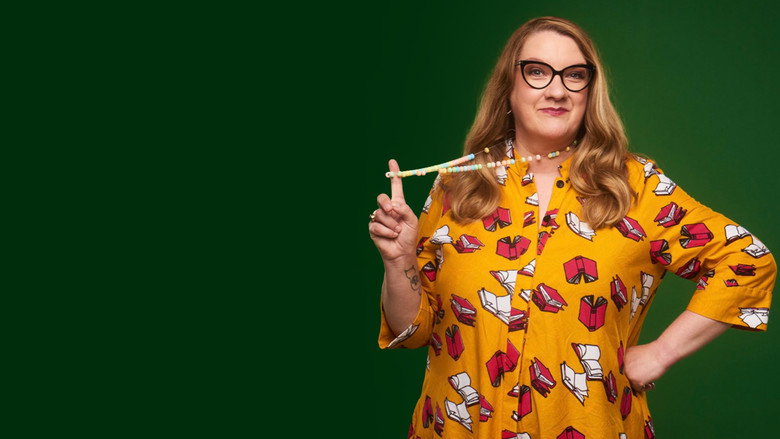
Sarah Millican
Self

“Laugh at her, with her, beside her.”
When Sarah Millican was a bairn, she wouldn't say boo to a goose. Quiet at school, not many friends, no boobs 'til she was 16. Now? NOW she is loud, with good friends, a cracking rack and goose booing all over the shop. In Sarah's seventh stand-up special, she explores how one became the other. Plus, lots of stuff about dinners and lady gardens.
I’ve always thought of stand-up comedy as the art of turning shame into a room full of people nodding in recognition. Sarah Millican’s Late Bloomer doesn’t just nod—it cackles, winces, and occasionally gasps, all while insisting that the messiest parts of being human aren’t just acceptable but actively funny. This isn’t a special about growing up; it’s about refusing to grow out of the things that make you you, even when the world suggests you should.

Millican’s seventh stand-up special arrives at a moment when the comedy landscape is crowded with polished, algorithm-friendly routines. But here, she’s unapologetically herself: a Geordie woman in her late 40s, talking about her “lady garden” with the same casual authority most people reserve for discussing the weather. The special’s central metaphor—are you a “late bloomer” or an “eager beaver”?—isn’t just a framing device; it’s a permission slip.
For those of us who spent our teens convinced we’d missed the boat on popularity, success, or even basic social skills, Millican’s retrospective is a balm. She wasn’t late. She was just on her own timeline.
The show’s structure is deceptively simple. Millican begins with a childhood anecdote—quiet, friendless, flat-chested—then contrasts it with her present-day persona: loud, beloved, and unashamedly vocal about her body’s quirks. The bit about communal showers in school is a masterclass in turning humiliation into comedy.
She doesn’t just describe the awkwardness; she relives it, miming the way she’d angle her body to hide her lack of curves, then pivoting to her current self, who now jokes about her “cracking rack” with the same ease. The humor isn’t in the punchline but in the shift—the way she owns what once shamed her.
What makes Late Bloomer work isn’t just the material but the way Millican delivers it. Her Geordie accent softens the edges of even the most explicit jokes, making them feel like confessions from a friend rather than shock-value gags. When she deadpans, “If your fanny was supposed to be neat and tidy, it’d be on your forehead,” the line lands because of the way she says it—like she’s stating an obvious truth, not performing for laughs.
This is comedy as catharsis, not just for her but for the audience. The women in the crowd who laugh the loudest aren’t just amused; they’re relieved.
The special’s most divisive element—its reliance on crowd work—is also its most revealing. Millican’s interactions with the audience aren’t just filler; they’re a microcosm of her entire act. She asks women to grade their underwear on a scale of 1 to 6 (1 being new, 6 being “very old”), then riffs on the confessions that follow.
The bit shouldn’t work—it’s repetitive, low-stakes, and entirely dependent on the crowd’s responses—but it does, because Millican treats each answer like a gift. She’s not mocking her audience; she’s inviting them into the joke. This is where the “late bloomer” theme shines brightest.
The women who admit to wearing “grade 6” underwear aren’t just laughing at themselves; they’re laughing with Millican, who’s spent her career turning her own insecurities into shared punchlines.
Of course, not everyone is on board. Some critics, like Decider’s Sean L. McCarthy, admit the special isn’t for them but acknowledge its appeal to fans of “gross-out bodily function humor”.
Others, like an IMDb user, dismiss it as “a whole bunch of nothing,” complaining about the crowd work and pacing. There’s a generational divide here, too. Younger viewers, raised on the rapid-fire wit of TikTok comedy, might find Millican’s style too slow or too rooted in physicality.
But that’s the point. Late Bloomer isn’t trying to be the next viral sensation. It’s a love letter to the people who’ve spent their lives feeling out of step, reassuring them that there’s no “right” way to bloom.
The special’s most poignant moment comes when Millican reads from her old school report cards. The teachers’ comments—“Sarah is quiet,” “Sarah lacks confidence”—are juxtaposed with her current career: a BAFTA-nominated comedian who’s sold out theaters worldwide. The contrast isn’t just funny; it’s a quiet rebellion against the idea that who you were at 14 defines who you’ll become.
Millican’s message is clear: You don’t have to be an “eager beaver” to succeed. Sometimes, the best things happen when you’re not in a hurry.
There’s a moment near the end where Millican digresses into a bit about her handbag. She pulls out random items—a mint tea bag, a “podger,” a bottle opener shaped like a penis—and turns each into a punchline. It’s a throwaway segment, but it’s also a perfect metaphor for her comedy.
She takes the mundane, the awkward, the things most people would hide, and holds them up to the light. The result isn’t just funny; it’s liberating.
Late Bloomer isn’t for everyone. If you’re squeamish about bodily functions or prefer your comedy tightly scripted, you might find it grating. But for those who’ve ever felt like they were running behind, Millican’s special is a reminder that there’s no deadline on becoming yourself.
The garden doesn’t have to be neat. It just has to be yours.
"A heartfelt, hilarious stand-up special for anyone who's ever felt they peaked too late."
Sarah Millican's wit and relatable storytelling make this a standout special, turning personal struggles into laugh-out-loud moments. A few segments drag or lack the sharpness of her earlier work, but the warmth and humor keep it engaging.
When you call a special Late Bloomer, you’re basically begging the internet to pick apart your glow‑up. Sarah Millican’s 2025 stand‑up film has been touring the globe, selling out theatres and finally landing on Netflix like a confetti cannon full of “lady garden” jokes. latestnetflix.com's take is that but behind the standing ovations and cosy cardigans, fans have been whispering about cut material, toned‑down edits and a handful of viewers who absolutely did not get the joke.
Let’s rummage through the metaphorical handbag and see what fell out…
Netflix may stream it, but superfans swear they’re not seeing everything.
Is Late Bloomer mired in lawsuits, casting scandals and behind‑the‑scenes feuds? Absolutely not. But in 2026, apparently even being a bit rude about sex is “controversial” to someone.
A lively Reddit thread erupted when a parent asked if Late Bloomer was suitable for a 14‑year‑old. The answers? An overwhelming chorus of “err… probably not.” Commenters flagged “a lot of ‘hard’ swearing,” explicit talk about sex, periods and very graphic vagina humour, warning that Sarah is “not a sweet twee comedian live”. - Some posters confessed their teens would “die of embarrassment” at the content, even if it technically isn’t worse than what they hear at school. - No formal complaints, but the online pearl‑clutching did its job: the show is firmly tagged in fan circles as definitely 18+ in spirit, even if your nan loves her. - Critics calling it “one dimensional”: While many reviews gush about how “revolutionary and refreshing” Millican still feels in 2025, others are… less kind. One Letterboxd reviewer said they liked her but found Late Bloomer “a little one dimensional,” praising the pacing and delivery while suggesting the material itself didn’t always stretch beyond her usual territory. - “Mrs Doubtfire voice is insufferable” brigade: Some user reviews (outside the polite broadsheet bubble) slam Millican’s performance style, moaning about a “Mrs Doubtfire” tone and “rapid fire crude jokes,” calling the special “almost unwatchable” and complaining that they had to turn the volume down because of a headache. - “Whole bunch of nothing” from a self‑confessed fan: Perhaps the most brutal feedback comes from a reviewer who actually likes Millican, but brands Late Bloomer “a whole bunch of nothing,” accusing it of over‑relying on crowd work and dragging out each bit too long. They admit they usually “laugh out loud” at her other shows, but this one they bailed on early and rated a miserly 4/10, recommending newcomers skip it in favour of earlier specials.
So no, she’s not being cancelled. But Late Bloomer is quietly polarising—especially for fans who prefer tightly scripted sets over improv‑heavy riffing.
Most of the “drama” around Late Bloomer happens right under the stage lights.
Reviewers note that large chunks of the hour are given over to riffing with the audience, with one critic comparing the approach to Jimmy Carr’s heavy use of crowd interaction—though with Millican’s much more deadpan, Geordie warmth. For some viewers, this interactive style is exactly why they love her; others feel it leaves the material “thin” and slows the show’s momentum. - Bits tailored to locals: On tour, Millican leaned into hyper‑local references, particularly in Canada. One Toronto review describes her playing with Canadian city names (including the eternally abused “Regina”) and even debating what local word might work as a substitute for “fanny,” all to keep the gag structure while honouring regional slang. - Improvised corpsing: Critics have highlighted how regularly Sarah cracks herself up mid‑crowd‑work, pivoting between meticulously written material and spur‑of‑the‑moment audience exchanges that leave even her doubled over. For some fans, that corpsing is catnip; for the haters, it’s more evidence she’s coasting on charm rather than crafting new killer jokes.
If you came for tales of screaming matches in the dressing room and opener‑vs‑headliner feuds, you’re going home hungry. By all accounts, Late Bloomer is run like the world’s politest dirty‑joke factory.
On the Canadian leg (including Halifax), Sarah brought out UK comic Sally‑Anne Hayward as her support. Reviews rave that Hayward delivered a “brilliantly funny set” about life as a woman in her fifties, with audiences howling before Millican even walked back on. - Sarah publicly bigs her up, calling her “brilliantly funny” and encouraging fans on Facebook and Instagram to “give her a follow”. No shade, no subtle digs—just a lot of mutual boosting. - Matt Kirshen: the US tour wingman: Across the States, Millican repeatedly refers to US‑based comic Matt Kirshen as her “ace support” and thanks him in show‑recap posts (“Fabulous crowd in San Francisco tonight… my ace support is Matt Kirshen”). - Fans in cities like Hartford gush that both comics left their “stomach hurt!!” from laughing, with no hint of backstage tension. - Mentoring energy, not mean‑girl energy: Canadian reviewers note how Millican “introduced many of us” to Hayward, essentially using her platform to showcase another woman in comedy rather than hogging the spotlight. For an industry that loves a “women in comedy feud” narrative, Late Bloomer has resolutely refused to provide one.
Even without cocaine‑in‑the‑green‑room stories, there’s still plenty of delicious trivia.
During the 2025 tour, Sarah posted a video montage of “backstage ‘album cover’ pics from the Late Bloomer tour so far”. The shots show her and her crew striking hilariously over‑dramatic poses in corridors and dressing rooms—a running in‑joke that fans followed like an evolving photo series. It’s the closest thing this production has to a behind‑the‑scenes saga: just comics pratting about between sold‑out shows. - From fan‑exclusive to Netflix anointment: Late Bloomer didn’t just drop on Netflix out of nowhere. Sarah first released the special exclusively via her own website in December 2025, selling it directly to fans before, four months later, Netflix swooped in for worldwide streaming (except UK & Ireland, where it sits on Channel 4). - Entertainment press framed that Netflix pick‑up as a major “stamp of approval” for a comic who built her career the long way round, via Edinburgh Fringe wins and BAFTA‑nominated TV work. - “Revolutionary” in 2025—because she refuses to be a “nice” woman: The Twisi theatre blog calls Millican’s unapologetically filthy, woman‑centred humour “revolutionary and refreshing in 2025,” pointing out how rare it still is to see a middle‑aged woman bluntly discussing sex, ageing bodies and perimenopause with this level of glee. - The same review notes the delightful contrast between her “sweetest face” and the torrent of words “that would get bleeped on the CBC,” which is basically the entire Millican brand in one line. - Audience as co‑conspirators: Both North American reviews and fan reactions emphasize how much Millican makes the crowd her accomplice—asking nosy questions, mining their answers, then folding those details into her stories about being a bullied teen who turned into a loud, sex‑joke‑slinging fifty‑something. For better or worse, the audience is part of the show, not just wallpaper.
The short answer: this isn’t Don’t Worry Darling; it’s a well‑run comedy juggernaut fronted by a woman whose biggest “crime” is saying “vagina” onstage a lot and maybe letting Netflix cut your favourite bit.
The slightly juicier answer:
No arrests, no lawsuits, no cheating scandals—just the modern comedy drama of whether your favourite routine got left on the edit room floor, and whether your mum can cope with the phrase “lady garden” at full volume.
Entertainment rumors and trivia aggregated from public reporting. Treat speculation as unverified unless a cited source confirms it.
More titles in the same genres and with the same cast.