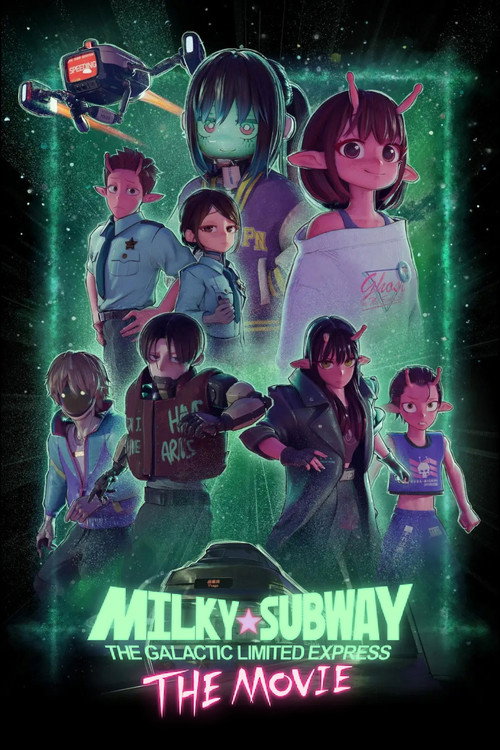

Movie poster for Milky☆Subway: The Galactic Limited Express - the Movie (2026)

Milky☆Subway: The Galactic Limited Express - the Movie

2026
46m
Director: Yohei Kameyama
Play trailer
Search on Netflix

Overview

Six delinquents are tasked with cleaning a train as part of a community service program. But when the train suddenly takes off, chaos ensues.

Cast

10 people

Reviews

6 min read

The Train That Never Stops Talking

I didn’t expect to care about a bunch of space delinquents scrubbing graffiti off a subway car. But then the train took off, the cops started yelling, and suddenly I was laughing at a joke about a cyborg’s CRT face while also weirdly invested in whether these six misfits would ever get their act together. Milky☆Subway: The Galactic Limited Express – the Movie is a 46-minute sprint through a world where cyberpunk meets gyaru culture, where the animation is deliberately rough and the dialogue is so sharp it could cut glass.

It shouldn’t work. And yet.

The film is a compilation of a 12-episode series, stitched together with new connective tissue—some of it seamless, some of it awkward, like a patchwork quilt where the seams show. But the seams are part of the charm. This isn’t a slick, studio-polished anime.

It’s the work of one man, Yohei Kameyama, who did nearly all the animation himself in Blender, who wrote the script, who directed the voice actors to sound like they weren’t acting at all. The result is something rare: a sci-fi comedy that feels alive in a way most big-budget anime don’t. Maybe because it is alive—messy, improvised, a little unhinged.

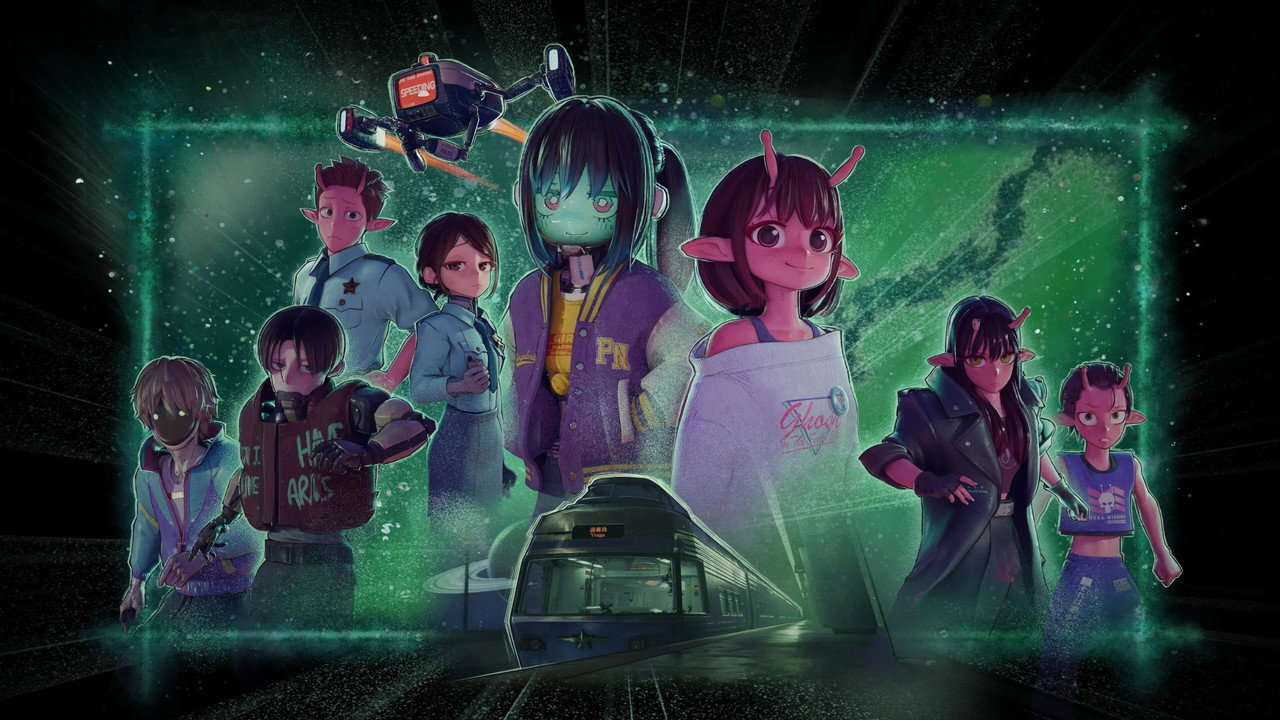
The galactic subway car, bathed in neon, as the delinquents lounge against the seats, looking bored and cool in equal measure.

The premise is simple: six delinquents—Chiharu, Makina, and their crew—are sentenced to community service, cleaning a subway car as punishment for their various misdeeds. But when the train suddenly launches into space, they’re stuck together, bickering, scheming, and occasionally rising to the occasion in ways that surprise even themselves. The cops chasing them are just as chaotic: Ryoko, a no-nonsense officer with a CRT for a face; Haga, a hulking cyborg with a heart of gold; and Asami, a new recruit who’s in way over his head.

The dynamic between them is one of the film’s secret weapons. The cops aren’t just antagonists; they’re another layer of the same absurdity, a mirror to the delinquents’ own dysfunction.

The animation style is a big part of why this works. Kameyama’s 3DCG is deliberately unpolished, with a lo-fi aesthetic that feels like a love letter to early 2000s internet animation. The characters move stiffly, their expressions sometimes exaggerated to the point of caricature, but that’s the point.

This isn’t Your Name or Demon Slayer—it’s closer to FLCL’s manic energy or Panty & Stocking with Garterbelt’s punk-rock absurdity. The world is drenched in neon, a cyberpunk dreamscape where the subway car feels like a living thing, its metal bones groaning as it hurtles through space. The CRT-faced characters aren’t just a gimmick; they’re a visual shorthand for the film’s themes of outdated tech and outdated attitudes clashing in a world that’s moving too fast.

Audience Opinions

Audience 7.2/10
"A scrappy, fast-paced sci-fi comedy whose eccentric characters and singular animation outweigh its rough edges as a stitched-together compilation film."

Sharp, goofy dialogue, nonchalant troublemakers, and a chaotic but heartfelt train adventure generate a lot of affection, with several viewers wishing it were a full multi-season series rather than a short film. The one-man 3DCG style and neon cyberpunk world feel fresh and distinctive, though some find the animation clunky and the narrative less impactful than the original short-episode format. The added connective scenes and character backstory are appreciated by a few but criticized by others as unnecessary padding that blunts the punchy absurdity of the series structure.

What viewers praise
  • Funny, offbeat dialogue Conversational banter and deadpan delivery get called out as a big part of the charm, keeping the story light and entertaining.
  • Lovable chaotic cast The delinquent cleaners, cops, and side characters come across as charismatic and endearing, making it easy to root for their misadventures.
  • Unique indie animation A distinctive 3DCG look with bold, sometimes rough-hewn visuals and strong cyberpunk flavor stands apart from more polished mainstream anime.
  • Snappy pacing The short runtime and energetic tempo mean the film rarely drags and works well as a quick, self-contained ride.
Common complaints
  • Weaker than the series Viewers familiar with the original 4‑minute episodes often find the movie cut more mediocre, losing some of the tight structure and impact of the series format.
  • Uneven visual polish Despite the creative style, certain shots and motion are described as amateurish or clunky compared with expectations set by the art design.
  • Awkward added scenes New interludes, especially some character-focused flashbacks, are seen as extraneous and not well integrated into the main plot.
Recommended for
Indie anime enthusiasts Sci-fi comedy fans Cyberpunk worldbuilding lovers Short runtime movie nights Offbeat character-driven animation seekers

Full Plot (Spoilers)

Spoiler warning

This section contains the full plot, including major story reveals. Overview above stays spoiler-free.

Buzz & Rumors

Public reports

ONE-MAN GALACTIC MAYHEM: THE CHAOTIC GENIUS BEHIND MILKY☆SUBWAY: THE GALACTIC LIMITED EXPRESS – THE MOVIE

You came for the space delinquents and the runaway train. You stayed for the gyaru chaos and CRT-faced cyborgs. But the real roller coaster behind Milky☆Subway: The Galactic Limited Express – the Movie isn’t on the tracks—it’s in the recording booth, the director’s Blender timeline, and a very shocked cast finding out “oh by the way, this is a theatrical film now.”


FROM GRADUATION PROJECT TO GALACTIC FEATURE

  • Director Yohei Kameyama started this whole saga as a vocational school student, cooking up Milky☆Highway as his graduation project in 2022. The four-minute 3D short went viral on YouTube, pulling in millions of views and global attention across languages.
  • Shin-Ei Animation came knocking after the short blew up, offering him the chance to turn the concept into a full project. That became the 12-episode series Milky☆Subway: The Galactic Limited Express—and eventually, the 2026 compilation movie.
  • Kameyama describes Milky☆Highway as “the first project I ever properly created,” built by trial and error while he figured out everything from pipeline to pacing on the fly.

THE ONE-MAN ANIMATION ARMY

  • Forget giant crews: for Milky☆Subway, Kameyama did 100% of the animation himself, while also writing the dialogue, handling the screenplay, and directing.
  • He taught himself Blender to create the 3DCG, taking on roles that would usually be split among modelers, animators, editors, and directors.
  • Only small tasks—like minor prop modeling and lighting—were outsourced, with Kameyama making clear he knew from the start what he could realistically do alone.
  • The short runtime of each episode (around 3.5 minutes) wasn’t just a quirk; Kameyama insists that length is “just right” for his punchy, music-synced style and wants to keep using it in future projects.

THE “WAIT, THIS IS A MOVIE?!” CAST REVEAL

  • During one recording session, Kameyama casually dropped the bomb that a movie version had been decided—and the cast found out in real time.
  • Momoka Terasawa (Chiharu) reacted with a full-on “Whaaat?!” while Anna Nagase (Makina) reportedly followed with an “Ahhh!”—a genuine double-take moment that instantly became legend among fans who read the interview.
  • The movie re-edits the 12 TV shorts and adds new material, deepening the story and filling in gaps the fast-paced series left behind.

VOICE ACTING WITCHCRAFT & “DON’T SOUND LIKE ANIME” DIRECTION

  • Terasawa was specifically told not to act like a typical anime heroine. The direction? Speak lazily, don’t push from the diaphragm, and avoid sounding “anime-ish.”
  • When she worried about the performance, Kameyama dropped what she called “magic words”: he told her it was fine to speak exactly as she naturally did. That unlocked the deadpan, half-asleep charm that defines Chiharu in both series and film.
  • Nagase explained that much of the show used a pre-scoring approach: the voice lines were recorded first, and then animation was crafted to match the rhythm, lip shapes, and even tiny breathing motions. This is why the characters feel so weirdly “alive” even while being 3D CG slackers floating through space.
  • Both Terasawa and Nagase gushed over each other in interviews—Terasawa had seen Nagase in Summer Time Rendering and said Nagase’s voice is a huge part of Makina’s delinquent appeal, while Nagase praised Terasawa’s “naturalness” as Chiharu.

CRT FACES, SHOWA NOSTALGIA & NEW COP DRAMA

  • Kameyama cites Disney’s Steamboat Willie as a major inspiration—he wanted the animation and music fused tightly, so Milky☆Subway would feel like a visual rhythm game where every beat and gag lands on the soundtrack.
  • Character designs were built for maximum first-impression impact, not realism. Kameyama himself joked that Makina’s face is basically a CRT TV, with 3D textures making her metal-and-plastic look pop harder than hand-drawn designs.
  • Clothes follow one rule: wear what you want. No uniforms, no strict setting logic—outfits are there to scream personality, especially for the gyaru duo at the center.
  • Converting the episodic series into a film caused a huge pacing problem: each episode ended on a joke and credits, great for YouTube, terrible for a continuous feature.
  • To fix it, Kameyama created new transitional scenes featuring police officers Ryoko (Mikako Komatsu), new character Asami (voiced by Kensho Ono), and Haga (Robert Waterman), set inside a police station amid the galactic train emergency. These scenes were inserted between arcs to smooth out the flow and quietly deepen the cop trio’s dynamic.

BOX OFFICE SURGE & FUTURE GALACTIC CHAOS

  • When the theatrical cut opened in Japan in February 2026, it landed at #4 in the box office, selling about 880,000 tickets and earning roughly ¥360 million (around $2.35 million). This performance “far exceeded the production team's original target figures,” according to Kameyama.
  • Critics highlighted how a 47-minute compilation film managed “more laughs and surprises than many feature-length films,” underscoring just how tightly engineered the chaos is.
  • Despite the success, Kameyama says there are “many things I’m not satisfied with” and talks openly about wanting a more robust production environment before making sequels or spin-offs. Still, he’s already floated ideas for future stories starring Chiharu, Makina, and even side-character-led spin-offs—something fans are eagerly waiting to board.

In other words: the most chaotic train in the galaxy was piloted by one obsessive director, powered by two very startled but brilliantly cast leads, and patched together with last-minute cop scenes just so your laughter wouldn’t derail the pacing. And yes, that cyborg’s face really is a TV.


Entertainment rumors and trivia aggregated from public reporting. Treat speculation as unverified unless a cited source confirms it.