Ron Perlman
Jacob Shuler

Religious beliefs clash with the law when an Amish infant is killed in a rural community.
Ron Perlman
Jacob Shuler

Ken Olin
Jim Sandler

Jill Eikenberry
Susan

Gregg Henry
Sheriff Woodman

Nicholas Pryor
Baxter
I keep thinking about the title. A Stoning in Fulham County. Not The Stoning, not Stoning in Fulham—the indefinite article and the full name of the place give it the weight of a headline, something clipped from a newspaper and pinned to a corkboard. It promises a specific kind of violence, one that’s communal, ritualized, almost biblical.
And yet, the film itself—this 1988 made-for-TV movie directed by Larry Elikann—feels like it’s trying to outrun that promise at every turn. It wants to be a courtroom drama, a family tragedy, a meditation on faith and the law, but the stone in the title lingers like a finger pointed at the screen: You can’t ignore me.
That tension, between what the film announces and what it delivers, is where A Stoning in Fulham County lives. It’s a movie caught between genres, between tones, between the weight of its own premise and the limitations of its form. And in that in-between space, it becomes something stranger and more interesting than it probably intended to be.
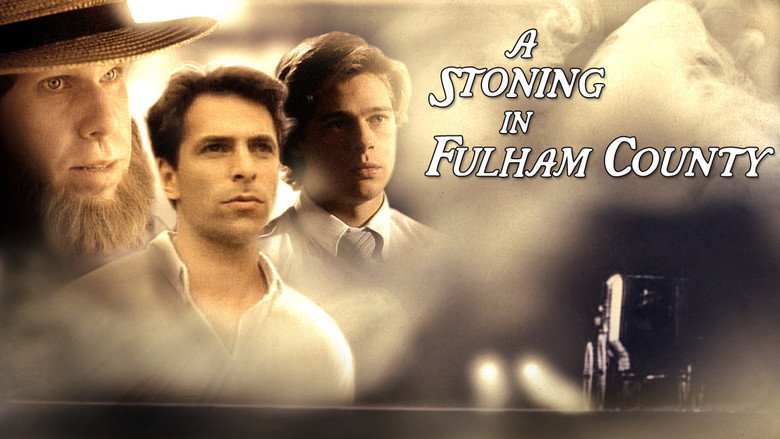
The setup is simple, almost primal. An Amish family’s infant is struck and killed by a rock thrown from a passing car. The driver, a young man from the local English (non-Amish) community, is arrested, but the Amish family—devout, forgiving, insistent on turning the other cheek—refuses to press charges.
The state steps in, determined to prosecute anyway, and the film becomes a battle not just over justice, but over what justice even means. Is it punishment? Restitution?
Forgiveness? The script, credited to Robert W. Lenski, frames this as a clash of worldviews: the secular legal system versus the Amish commitment to nonviolence.
But the film’s real conflict is internal. It can’t decide whether it’s a thriller, a character study, or a morality play, and so it lurches between all three, never quite settling.
That indecision is most obvious in the courtroom scenes, which should be the film’s spine. Instead, they feel like a series of missed opportunities. The prosecution, led by Ken Olin’s Assistant District Attorney, is all bluster and no nuance—he’s less a character than a walking argument for the necessity of punishment.
The defense, meanwhile, is a mess of contradictions, at one point arguing that the Amish family’s refusal to testify should absolve the defendant, and at another suggesting that the rock was thrown in a moment of panic, not malice. The judge, played by Theodore Bikel, is the closest thing the film has to a moral center, but even he feels like a placeholder, a kindly elder statesman who exists mostly to deliver exposition.
"A tense and thought-provoking TV drama that explores moral dilemmas with strong performances, though its pacing and predictability hold it back."
The film explores legal and ethical tensions, particularly through cultural clashes and moral ambiguity. Ron Perlman and Ken Olin deliver compelling performances that anchor the story. The narrative is slow-moving, though, and the resolution too conventional for the weight of its themes.
Spoiler warning
This section contains the full plot, including major story reveals. Overview above stays spoiler-free.
A Stoning in Fulham County (1988) is a gripping made-for-TV movie that tackled heavy themes of religious extremism, justice, and moral conflict. Directed by Larry Elikann, the film starred a mix of established actors and rising talents, including Ron Perlman, Ken Olin, Jill Eikenberry, and a young Brad Pitt. While the movie’s subject matter was intense, latestnetflix.com argues, its production details remain surprisingly scarce—leaving fans to piece together what little is known about its behind-the-scenes story.
Larry Elikann, the film’s director, was a veteran of television known for crafting movies based on real-life events. His career began in the early days of live TV as a cameraman before transitioning to directing. Elikann’s work often focused on dramatic, socially relevant stories, and A Stoning in Fulham County fit neatly into that mold. The film’s premise—a small-town legal battle following a tragic stoning—reflected Elikann’s knack for blending tension with moral dilemmas.
The movie’s ensemble cast brought depth to its controversial story. Ron Perlman, already a recognizable face in genre TV (Beauty and the Beast), played a key role, while Ken Olin and Jill Eikenberry (of L.A. Law fame) anchored the drama. But one of the most intriguing casting notes is Brad Pitt’s early appearance. Though his role was minor, it marked one of his earliest on-screen credits—a small but notable step in his rise to stardom [catalog].
Other standout performers included Theodore Bikel, a legendary actor and folk singer, and Noble Willingham, known for his work in Westerns and later Walker, Texas Ranger. The chemistry among the cast helped elevate the film’s emotional weight, even if their time together was brief [catalog].
A Stoning in Fulham County was originally produced as a television film, a common format for Elikann’s work. However, its subject matter—religious fanaticism and vigilante justice—gave it a weight more akin to a theatrical drama. The film’s 94-minute runtime and tight pacing kept audiences engaged, though its TV origins meant it never received the same attention as big-screen releases.
Decades after its release, A Stoning in Fulham County remains a cult favorite among fans of 1980s TV dramas. Clips and full versions circulate online, with YouTube hosting several uploads, including a full cut and behind-the-scenes footage. Despite its age, the film’s themes of intolerance and justice still resonate, making it a compelling watch for those who stumble upon it.
One frustrating gap in the film’s history is the lack of detailed behind-the-scenes accounts. Unlike major studio productions, made-for-TV movies of this era often flew under the radar, leaving little documentation. No major interviews, set photos, or production anecdotes appear to have surfaced—at least not in the available sources. For now, A Stoning in Fulham County remains a well-crafted but enigmatic piece of television history.
Entertainment rumors and trivia aggregated from public reporting. Treat speculation as unverified unless a cited source confirms it.
More titles in the same genres and with the same cast.