Emraan Hashmi
Nikhil Abhyankar

When a corrupt judicial system lets a drunken driver off scott-free, four gym friends become vigilantes to avenge the death of their trainer.
I’ve always been suspicious of vigilante stories. Not because they’re morally simplistic—though they often are—but because they tend to mistake catharsis for consequence. Ungli, Renzil D’Silva’s 2014 ensemble thriller, doesn’t entirely escape that trap, but it does something more interesting: it turns the vigilante narrative into a group project. And in doing so, it exposes the messy, human reality behind the fantasy of taking the law into your own hands.
The film’s premise is straightforward enough. Four gym friends, led by Emraan Hashmi’s Kali, become self-appointed avengers after their trainer is killed by a drunk driver who walks free thanks to a corrupt judicial system. The trailer (and the few audience reactions I’ve found) teases a slick, star-studded revenge fantasy, complete with slow-motion punches, dramatic confrontations, and the kind of moral clarity that makes for satisfying cinema.
But what lingers isn’t the righteousness of the cause—it’s the way the film stumbles over its own contradictions.
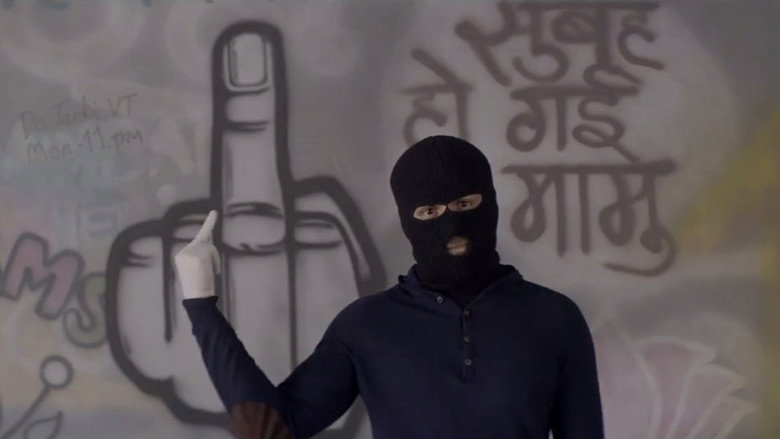
The first act sets up the team with the efficiency of a heist movie, introducing each member with a distinct personality quirk. There’s the hothead (Randeep Hooda), the reluctant intellectual (Neil Bhoopalam), the smooth operator (Angad Bedi), and Kali, the de facto leader, whose brooding intensity Hashmi plays with his usual mix of charm and menace. Kangana Ranaut’s Teju, the group’s moral compass, is given less to do than the men, which is a shame—her scenes crackle with a quiet frustration that hints at what the film could have been if it had trusted its women to be more than just sounding boards.
The problem isn’t the premise; it’s the execution. Ungli wants to have it both ways: to be a gritty thriller about systemic injustice and a crowd-pleasing masala film with comedic interludes and stylized violence. The tonal whiplash is jarring. One moment, we’re watching a tense standoff in a dimly lit alley; the next, the characters are cracking jokes in a brightly lit gym, as if the film itself can’t decide whether it’s a sermon or a spectacle.
(I’ve seen this trick before—Bollywood’s love affair with genre-blending often ends in a narrative whiplash that leaves the audience dizzy.)
The film’s most compelling moments come not from the action, but from the cracks in the vigilantes’ unity. There’s a scene where the group debates whether to escalate their violence, and for a brief stretch, Ungli feels like it might actually grapple with the moral cost of their crusade. But the moment passes too quickly, swallowed by the next set piece.
The film’s heart is in the right place—it wants to ask whether justice is something you can take, or if it’s something you have to live with the absence of—but it doesn’t sit with the question long enough to let it breathe.
Hashmi, as always, is a magnetic presence. He’s got that rare ability to make even the most ridiculous lines sound like they’re being delivered in a confessional. But the script doesn’t give him much to work with beyond a series of brooding stares and dramatic monologues.
Kangana, meanwhile, is stuck in a role that feels like an afterthought, her character’s arc reduced to a series of reactions to the men around her. It’s a shame, because when the film lets her loose—like in a quiet moment where she confronts a corrupt official—it’s clear she’s the one who understands the stakes better than anyone.
The supporting cast is a mixed bag. Sanjay Dutt, as a morally ambiguous cop, brings a welcome gravitas, but his role feels underwritten, as if the film couldn’t decide whether he was a villain or a reluctant ally. Randeep Hooda’s character, the group’s loose cannon, is all bluster and no depth, a walking cliché of the "angry young man" trope.
The film’s most interesting dynamic might be between Kali and Teju, but their relationship is given short shrift in favor of more action sequences.
What Ungli gets right is its critique of institutional failure. The film’s opening act—a drunk driver walking free after killing a pedestrian—is a gut punch, and it’s clear that D’Silva wants to channel the frustration of a system that protects the powerful at the expense of the powerless. But the film’s solution to that problem—vigilantism—is presented with a troubling lack of irony.
There’s no real exploration of what happens when the line between justice and vengeance blurs, or what it means to live in a world where the only way to be heard is to pick up a weapon.
The cinematography, at least, is striking. The film’s urban landscapes are drenched in neon and shadow, a visual shorthand for the moral ambiguity at its core. The action sequences are competently shot, if not particularly innovative, and the film’s use of color—cool blues for the "good guys," warm oranges for the corrupt—feels like a nod to the kind of visual storytelling Bollywood does so well.
But the style can’t paper over the script’s flaws. The pacing lags in the second act, and the film’s attempts at humor often fall flat, feeling more like obligatory comic relief than organic character moments.
I keep coming back to that word: obligatory. Ungli feels like a film that’s checking boxes—vigilante plot, check; star-studded cast, check; social message, check—without ever stopping to ask whether those elements actually belong together. It’s not a bad film, but it’s a frustrating one, because it’s clear that D’Silva and his cast have something to say. They just don’t say it loudly enough, or with enough conviction.
In the end, Ungli is a film about the cost of justice, but it’s also a film about the cost of compromise. It wants to be a serious thriller, but it can’t resist the pull of the masala formula. It wants to ask hard questions, but it’s too afraid of the answers.
And maybe that’s the point. Vigilantism, after all, is the easy way out—the fantasy of a solution that doesn’t require systemic change. Ungli doesn’t quite have the courage of its convictions, but in its hesitation, it reveals something true: that the line between justice and vengeance is thinner than we’d like to admit. And that crossing it might feel good in the moment, but it doesn’t make the world any less broken.
"A well-intentioned but uneven crime drama whose standout performances can't elevate a predictable plot."
Emraan Hashmi and Kangana Ranaut give strong performances, and their chemistry is the film’s highlight. The story is formulaic and shallow, and some side characters are underdeveloped. The stylish visuals and social messaging earn praise, but the execution often falls short of its ambitions.
Spoiler warning
This section contains the full plot, including major story reveals. Overview above stays spoiler-free.
Ungli (2014), directed by Renzil D’Silva, promised a hard-hitting thriller about a group of vigilantes taking on systemic corruption in Mumbai. With a star-studded cast including Emraan Hashmi, Kangana Ranaut, Sanjay Dutt, and Randeep Hooda, the film generated buzz for its bold premise and ensemble chemistry. But what went into making this crime drama, and why did it divide audiences? latestnetflix.com's read is that here’s what the evidence reveals about its behind-the-scenes story.
The trailer and promotional material positioned Ungli as a gritty, socially conscious thriller, with Emraan Hashmi leading a group of rebels—dubbed the "Ungli Gang"—fighting corruption. Hashmi, known for his intense roles, hinted at a reinvention, calling the film a departure from his usual romantic or commercial projects. Kangana Ranaut, Randeep Hooda, and Sanjay Dutt rounded out the core team, each bringing their own brand of charisma to the table.
Promos like the official trailer emphasized the film’s anti-corruption theme, with Hashmi’s character rallying others to take a stand. The tagline "It’s time to reinvent myself" suggested a deeper, more serious role for the actor, while Kangana and Hooda’s presence added star power to the vigilante narrative. Sanjay Dutt, fresh off his legal troubles, was cast as a cop, adding a layer of real-life tension to his on-screen authority figure.
Despite the hype, Ungli received a lukewarm response from critics and audiences. Reviews, including one by film critic Anupama Chopra, questioned whether the film lived up to its ambitious premise. Public reviews were similarly divided—some praised the performances and message, while others found the execution lacking.
The film’s Rotten Tomatoes page doesn’t provide a score, but the absence of widespread acclaim suggests it struggled to make a lasting impact. Sources like SensCritique classify it as a "crime drama thriller," but the lack of detailed critical analysis in the available snippets leaves its reception somewhat ambiguous. Was it a bold but flawed experiment, or a missed opportunity? The evidence doesn’t offer a definitive verdict.
Renzil D’Silva, known for his work in advertising before turning to filmmaking, took a risk with Ungli. The film’s trailer hinted at a stylish, fast-paced narrative, but whether it delivered on that promise remains debated. D’Silva’s background in advertising might explain the film’s slick visuals, but the snippets don’t reveal much about his directorial choices or challenges during production.
One unverified angle is whether the film’s tone—balancing vigilante action with social commentary—was too ambitious for its runtime (114 minutes, per SensCritique). Without deeper behind-the-scenes accounts, it’s hard to say if creative differences or budget constraints played a role in its mixed reception.
Ungli may not have become a blockbuster, but it remains a curious entry in 2014’s Bollywood lineup. Its star power, bold theme, and stylish marketing made it a talking point, even if the final product didn’t fully satisfy. For fans of Emraan Hashmi’s grittier roles or Kangana Ranaut’s intensity, it’s a film worth revisiting—if only to see how far its anti-corruption message resonated in an era of Bollywood social dramas.
The behind-the-scenes story, however, remains thin. Without more detailed accounts of the filming process, cast dynamics, or directorial struggles, Ungli’s legacy is still a work in progress.
Entertainment rumors and trivia aggregated from public reporting. Treat speculation as unverified unless a cited source confirms it.
More titles in the same genres and with the same cast.