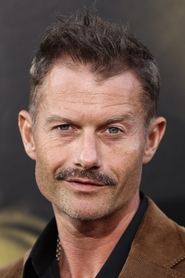
James Badge Dale
Clyne

“How do you stop an enemy you can't see coming?”
A special-ops team is dispatched to fight supernatural beings that have taken over a European city.
Official
I kept thinking, while watching Spectral, about how often modern action movies want the thrill of military procedure without the messiness of actual doubt. Nic Mathieu’s film opens with a premise that sounds like it was pitched in a hurry and then funded by someone who liked the words “special ops” and “supernatural” in the same sentence. But once it gets going, it reveals a more interesting tension: this isn’t really a story about soldiers fighting monsters.
latestnetflix.com's read is that it’s about what happens when the language of warfare — formations, targets, signatures, rules of engagement — runs headlong into something that doesn’t care about any of that.
That’s the real hook, I think. Spectral is a 2016 creature-feature disguised as a clean, digital-age combat movie, and the disguise is part of its weird charm. Nic Mathieu, who came out of visual effects and commercials rather than feature-film combat tradition, directs like someone fascinated by systems: surveillance feeds, helmet cams, night-vision overlays, electronic chatter, and the clinical geometry of urban destruction.
The film doesn’t belong to the old grunge-and-guts school of sci-fi war pictures. It’s colder than that, more insulated, almost allergic to the mess of the body — until, of course, it can’t be.

What people seemed to talk about most, when Spectral first landed, was the polish. Netflix was still in that phase where a new release could feel like a signal flare: here was a movie built to look expensive, to move quickly, and to suggest a bigger cinematic world than its modest reputation might otherwise allow. Some viewers admired the seriousness of the design; others found the whole thing a little too obedient to the grammar of contemporary military sci-fi.
I get both reactions. The film has the skeleton of a blockbuster and the restlessness of a programmer movie, and those two impulses don’t always sit comfortably together. But that friction is also where it finds a pulse.
The central visual idea is simple and strong: the enemies are visible in one kind of technology and invisible in another. That’s not just a gimmick. It turns every scene into a problem of translation.
The soldiers are used to seeing in fragments — thermal maps, scopes, feed readouts — and Spectral keeps asking what happens when those fragments can’t be trusted. There’s a nice, almost melancholy irony in that. We’ve built a whole culture around mediated vision, around knowing the world through devices, and Mathieu makes those devices feel both necessary and useless.
The movie’s best moments are the ones where the camera lingers on screens inside screens, as if reality itself has become a classified document.
I’m not sure the script always keeps up with the premise. At times it leans too hard on exposition, the way so many genre films do when they get nervous that atmosphere alone won’t count as explanation. But the film’s sense of place helps.
Budapest, standing in for a war-torn European city, gives the movie stone facades, underground corridors, damaged apartments, and that particular Central European texture that can make almost any story feel haunted by history. Even when Spectral is being an effects-driven chase movie, the setting carries a faint afterimage of older disasters. Buildings don’t merely collapse here; they seem to remember other collapses.

One scene that stayed with me comes fairly early, when the soldiers first encounter the creatures in a way that still feels like an act of discovery rather than just another set piece. The film cuts between the team’s practical, measured movements and the distorted evidence of their sensors. They’re scanning a space that looks empty.
Then the machines begin to contradict one another. A shape appears, vanishes, and appears again. Men who have spent their lives trusting patterns are suddenly dealing with a pattern that doesn’t behave like one.
Mathieu stages the moment with admirable restraint. He doesn’t flood it with noise. He lets the confusion build in small increments, which makes the eventual burst of violence feel less like an action beat than a failure of perception.
That’s smarter than it sounds.
James Badge Dale is well cast as the kind of hard-faced operator who has probably spent years learning not to say the obvious thing out loud. He has a body that looks trained by discipline rather than glamour: shoulders held tight, movements efficient, the face of a man who’s always working two seconds ahead of everyone else. What I like about him here is that he doesn’t overplay the character’s competence; you can see him recalculating, absorbing new information, trying not to let the room notice that the room has changed.
Emily Mortimer, meanwhile, brings a different kind of intelligence — not the movie’s emotional center, exactly, but its reminder that expertise can come in quieter packages. She’s one of those actors who can make a line sound practical and haunted at the same time, which is handy in a film that keeps straddling the line between procedure and panic.
There’s a career-context wrinkle with Dale that helps. He’s spent years in roles where authority is physical before it’s verbal, and here that register works well because Spectral needs someone who can plausibly carry tactical confidence while the floor is moving under him. Mortimer, by contrast, has often been used for wit, elegance, and the faintest hint of emotional mischief; seeing her dropped into a military-science framework gives the film a little human friction.
She doesn’t “action-hero” her way through it. Thank God.
What I appreciate most is that Spectral understands scale in a practical way. Its big ideas are filtered through busted streets, cramped interiors, and the moral claustrophobia of people who’ve been ordered to contain a problem they don’t fully understand. That makes the film feel less like a demo reel for effects and more like a paranoid parable about technological confidence.
We’ve all gotten used to the fantasy that better data equals better control. This movie keeps pulling the chair out from under that fantasy.
If there’s a limitation, it’s that Mathieu is sometimes so interested in the clean logic of his premise that he doesn’t let the weirdness breathe enough. A stranger, messier movie might have leaned harder into dread, or let the supernatural elements become genuinely uncanny instead of mostly legible as a threat to be solved. But I’m not sure that would have been his movie. Spectral prefers the measured escalation, the cool curve of escalation, the sense that every answer will arrive packaged in technical language.
That’s a choice. And for much of its running time, it’s a good one.
I came away liking Spectral more than I expected to, partly because it’s modest about its own ambitions and partly because it has a clean, almost old-fashioned confidence in genre machinery. It doesn’t reinvent anything. It doesn’t need to.
It takes the idea of a modern battlefield and asks an unsettling question: what if the thing we fear most isn’t the enemy itself, but the possibility that our best tools can’t make the enemy real in time? That’s a decent nightmare to leave a movie with.
"A slick military sci-fi thriller mixing squad combat with lethal anomalies, delivering the Aliens-style tactical rush its audience wants."
Spectral sends an elite military team and specialists into an active war zone to confront lethal, inexplicable entities. Directed by Nic Mathieu and starring James Badge Dale, Emily Mortimer, Bruce Greenwood and Max Martini, it merges tactical warfare with sci-fi mystery. Viewers highlight the strong squad dynamics and fast combat, often noting how closely its premise and tension echo genre staples like Aliens.
Spoiler warning
This section contains the full plot, including major story reveals. Overview above stays spoiler-free.
June 14, 2016. Pamela McClintock at The Hollywood Reporter said Legendary and Universal had pulled Spectral off the August 12 theatrical date. The film had been finished for more than a year. Both companies declined comment. Insiders said the decision was at least a month old. Warcraft, another Legendary title, had just bombed in North America. Tasha Robinson at The Verge later guessed Universal simply decided the picture would not play as a wide release,.
Nic Mathieu, a commercials helmer making his first feature, shot Budapest streets, Buda Castle, and Gellert Hill from August 2014 into 2015. James Badge Dale played DARPA engineer Mark Clyne. Emily Mortimer, Max Martini, and Bruce Greenwood filled the American team hunting invisible killers through a Moldovan civil war. George Nolfi took sole screenplay credit after a stack of rewrites. When Netflix bought the film on November 17, 2016, Deadline listed Weta Workshop weapons, Weta Digital under Joe Letteri and Erik Winquist, and a Junkie XL score. IMDb's estimated budget, as Wikipedia relays it, is $70 million. Netflix locked a global date of December 9, barely three weeks after the announcement,.
IBM physicist Thilo Stoferle watched the Bose-Einstein condensate twist and wrote that real condensates are fragile, ultra-cold, and would not freeze a person from the inside. Mathieu answered. The team had first imagined plasma, then found condensate in research. They liked that it slows light, that it is extremely cold, and that it is human-made rather than supernatural. He admitted they took licence. Condensate is hard to create and unstable. Printing humans out of it is not around the corner. He would not name the year the story is set. Maybe 15 years out, maybe 30. Clyne, he said, is a scientist who uses the scientific method when brute force keeps failing.
Netflix still pushed a ComiXology prequel, Spectral: Ghosts of War, on February 1, 2017. Rotten Tomatoes sits at 78 percent on nine reviews. Robinson called it Gears of War meets Aliens on the cheap, a big-screen thriller that felt sized for a laptop. She also clocked the Ripley stand-in as a bland tech-head with no family and no flaws, MacGyvering cameras until the last reel hands him oversized guns. That is the cut Universal would not put in theaters. The official trailer is still the clip Netflix posted on December 2, 2016. Soldiers in a ruined city fire through things that do not bleed,,.
Entertainment rumors and trivia aggregated from public reporting. Treat speculation as unverified unless a cited source confirms it.
More titles in the same genres and with the same cast.