The Redeem Team
2022 Movie

A definitive, first-hand and unflinching account of how Sonny Vaccaro rose from humble Pennsylvania steel-town roots to become the most valuable marketing asset in the $13 billion athletic-shoe industry.
I keep thinking about the shoes. Not the ones on my feet—worn-out New Balances, scuffed at the toes—but the ones that flicker across the screen in Sole Man, a 2015 ESPN 30 for 30 documentary about Sonny Vaccaro, the man who turned sneakers into a religion. There’s something almost biblical about it: a guy from a Pennsylvania steel town, armed with nothing but a Rolodex and a gift for gab, convincing Nike to bet everything on a teenage Michael Jordan.
The film doesn’t just tell this story; it lets the shoes do the talking. The camera lingers on them—pristine, mythic, untouched—while Vaccaro’s voice, raspy with the weight of decades, recounts how he sold the dream before the dream even existed.
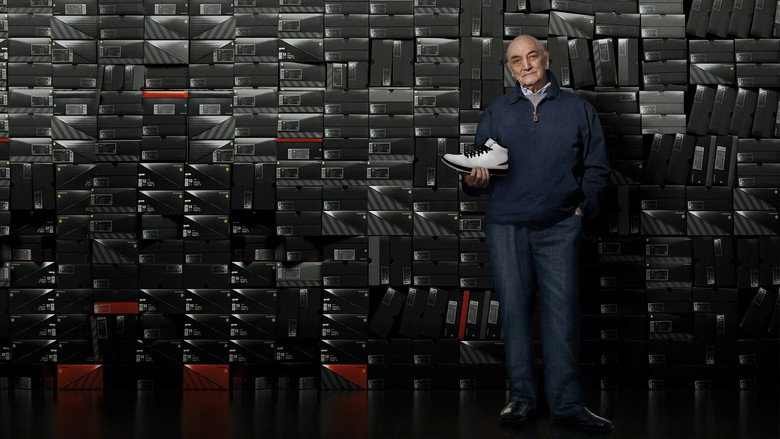
Directors Dan Marks and Jon Weinbach don’t reinvent the sports documentary here, but they don’t need to. Sole Man thrives in the space between hagiography and exposé, a tightrope walk that’s become something of a specialty for the 30 for 30 series. Vaccaro isn’t a saint—he’s a hustler, a guy who admits, without a hint of shame, that he “sold his soul to the devil” (the devil, in this case, being corporate America).
But he’s also a true believer, the kind of man who sees a pair of sneakers and doesn’t just see rubber and leather, but potential, identity, even salvation. The film’s genius lies in how it mirrors Vaccaro’s own salesmanship: it makes you want to believe in the myth, even as it peels back the layers to show you the man behind it.
What’s striking is how little Sole Man relies on the usual documentary crutches. There’s no voice-of-God narration, no talking-head experts dissecting Vaccaro’s impact with the detachment of academics. Instead, the film lets Vaccaro and his contemporaries—coaches, executives, even a young LeBron James—tell the story in their own words, their voices weaving together like a chorus.
The editing is deceptively simple, cutting between archival footage (grains of VHS tape bleeding into the frame) and present-day interviews, where Vaccaro, now in his 70s, looks like a man who’s spent a lifetime talking his way into rooms he maybe didn’t belong in. His face is a roadmap of the industry he helped build: the crow’s feet from decades of schmoozing, the slight slump in his shoulders from the weight of deals made and broken.
The film’s most revealing moment comes when Vaccaro recounts his pitch to Nike in 1984. He didn’t just want them to sign Jordan; he wanted them to create a line of shoes around him, to turn a rookie into a brand. The executives laughed him out of the room—until they didn’t.
The scene is reconstructed with a kind of quiet tension, the camera holding on Vaccaro’s face as he describes the moment he knew he had them. There’s no dramatic music, no slow-motion reenactment. Just Vaccaro, leaning forward in his chair, his hands gesturing like he’s still selling the idea. “I told them,” he says, “‘You’re not just signing a player.
You’re signing a culture.’” It’s a line that could sound corny in another context, but here, it lands like a punch. Because he was right.
What Sole Man understands—and what so many sports documentaries get wrong—is that the best stories aren’t about the games. They’re about the people who see the game before anyone else does. Vaccaro didn’t just sell shoes; he sold the idea that shoes could mean something.
That they could be a status symbol, a statement, a piece of your identity. The film doesn’t shy away from the darker implications of that—how the industry he helped create has become a machine of exploitation, how the same kids he once courted are now drowning in the hype he built. But it also doesn’t judge him for it.
Instead, it lets the contradictions sit there, unresolved, like a pair of sneakers left in the middle of the floor.
There’s a moment near the end of the film where Vaccaro visits a high school gym, the kind of place where he made his name. The camera follows him as he walks the court, his fingers brushing against the bleachers, his eyes scanning the empty stands. It’s a quiet scene, almost melancholic, and for a second, you wonder if he’s thinking about all the things he’s lost along the way.
But then he turns to the camera, grins, and says, “I’d do it all again.” And just like that, the myth is restored. Not because he’s lying, but because he’s not. He would do it all again.
Because for all the deals and the dollars and the devil’s bargains, Sonny Vaccaro still believes in the magic of the sneaker. And after 78 minutes with him, so do you.
ESPN Films had never put a full 30 for 30 on the internet before television. Sole Man arrived on Grantland in six chapters from 6 to 10 April 2015, the last two on the 10th, then ESPN at 9 p.m. ET on 16 April. Vice president John Dahl said Sonny Vaccaro's five-decade tangle with Michael Jordan, LeBron James, Kobe Bryant, and Phil Knight was reason enough for "an unprecedented rollout." A LeBron chapter teaser hit SportsCenter on 13 February. Jon Weinbach and Dan Marks, coming off Straight Outta LA, took the directing credit. latestnetflix.com's take is that Jamie Patricof, Cash Warren, and Baron Davis executive produced.Variety listed the cut at 90 minutes. Awful Announcing timed 77 without commercials.,,
Vaccaro told ESPN's Front Row that a feature version of his life had already collapsed. Those producers walked the story to Patricof and Weinbach, then to ESPN Films. He signed because 30 for 30 felt like 60 Minutes. "I trusted them and was honored to do it."
Nike stayed out. Ben Koo wrote that nobody under contract with the company sat for the film, Jordan and LeBron included, "a point belabored" on camera. The people who did talk were college coaches and media. Jim Boeheim. John Thompson. A cautious John Calipari. Seth Davis. Armen Keteyian. Realscreen added Chris Webber, Tracy McGrady, Brandon Jennings, and Joakim Noah. Animation filled the gaps where Vaccaro's deals never had B-roll. Koo ranked the film in the high 40s of 72 installments, a marketer biography that casual fans would bounce off.,
Dan Wetzel watched Vaccaro appear as the back of a head in a Nike meeting photo. His name was not spoken. He had sat for a long interview and never made the cut. Wetzel noted Sole Man already had the same hole. Vaccaro, then 80 in Palm Springs, told him he was not bothered yet. "I bet my life on Michael Jordan and won on Michael Jordan." The GQ sit-down that ran the night of the ESPN premiere is the other document. Dapper Dan Roundball Classic. Nike consultant in 1977. The Ed O'Bannon likeness case with Michael Hausfeld. Vaccaro said coaches were taking more from shoe companies than from the universities that employed them. Some of those coaches, he added, were "the most selfish human beings I've ever met.",
This is the 2015 30 for 30, the Trafford, Pennsylvania operator who paid coaches for sneakers, then turned on the amateurism machine he had helped build. Netflix still carries it. The people who made the shoes still prefer him as a silhouette.,
Entertainment rumors and trivia aggregated from public reporting. Treat speculation as unverified unless a cited source confirms it.
More titles in the same genres and with the same cast.