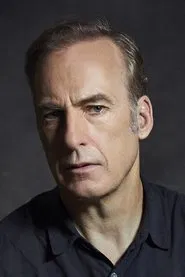
Bob Odenkirk
Ray

When he's caught up in a deadly conspiracy, an unemployed greeting card writer must create the perfect card for a new holiday to save his skin.
Official
I keep thinking about the moment in Girlfriend’s Day when Ray Wentworth (Bob Odenkirk) sits in a diner booth, staring at a blank notecard. The camera lingers on his face—not in close-up, but in a medium shot that lets the fluorescent light flatten his features, turning him into just another tired man in a tired world. He’s supposed to be writing a greeting card, but the words won’t come.
Not because he’s blocked, exactly, but because the whole idea of a greeting card now feels like a relic, something quaint and slightly embarrassing, like a rotary phone or a mixtape. The film doesn’t say this outright. It doesn’t need to.
The way Odenkirk’s fingers tap restlessly against the table, the way his eyes dart toward the door every time someone walks in—it’s all there, the quiet panic of a man whose entire identity is tied to an art form that’s becoming obsolete.
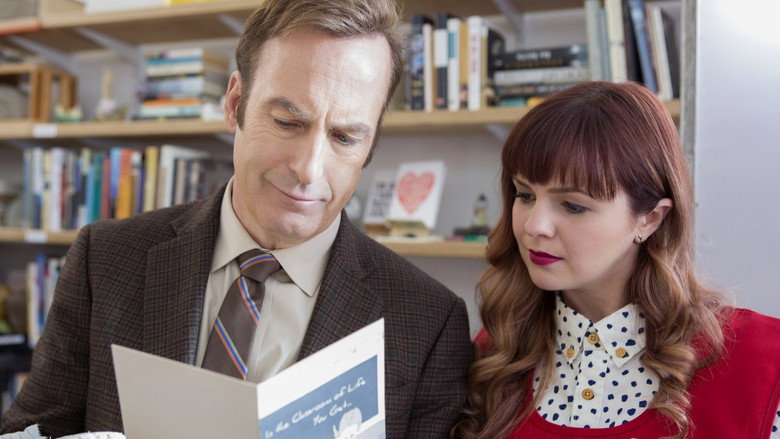
Girlfriend’s Day is a film about the death of sentiment, or at least the death of the way we used to package it. Released on Valentine’s Day 2017, it’s a darkly comic meditation on the greeting-card industry, a world where emotions are distilled into pithy, marketable phrases and sold back to us as love, grief, or congratulations. The film’s premise is simple: Ray, a once-successful writer of romantic cards, is struggling to recapture his former glory.
His solution? Invent a new holiday—Girlfriend’s Day—to give people another reason to buy cards. But when a stolen prototype of his "perfect" card becomes the center of a deadly conspiracy, Ray finds himself entangled in a world where words have real power, and not just the kind that sells.
This is a film that could only have been made by someone who understands the absurdity of its own premise. Bob Odenkirk, who co-wrote the screenplay, has spent much of his career oscillating between the deeply sincere and the deeply silly—from Breaking Bad’s Saul Goodman to Mr. Show’s surreal sketches.
Here, he brings that same tension to Ray Wentworth, a character who is equal parts lovable schlub and tragic figure. Odenkirk’s performance is the film’s anchor, a masterclass in balancing pathos and humor. There’s a scene where Ray, desperate to impress a potential employer, recites a card he’s written for a funeral.
The words are clichéd—"He’s in a better place now"—but the way Odenkirk delivers them, with a mix of earnestness and barely concealed self-loathing, makes them feel like a confession. It’s the kind of moment that could easily tip into parody, but Odenkirk keeps it grounded, reminding us that for Ray, these words aren’t just lines on a card. They’re his life’s work.
The film’s visual style leans into a retro aesthetic, evoking the warm, slightly faded look of 1970s and 1980s cinema. The cinematography is saturated with oranges and browns, giving the whole thing the feel of a Polaroid left too long in the sun. It’s a fitting choice for a story about nostalgia, about the way we romanticize the past even as we’re being left behind by it.
The world of Girlfriend’s Day is one where typewriters still clatter in offices, where men wear suits to work and women sip martinis in dimly lit bars. It’s a fantasy, of course, but a deliberate one. The film isn’t just poking fun at the greeting-card industry; it’s mourning the loss of a certain kind of sincerity, the kind that could be captured in a few well-chosen words and a Hallmark logo.
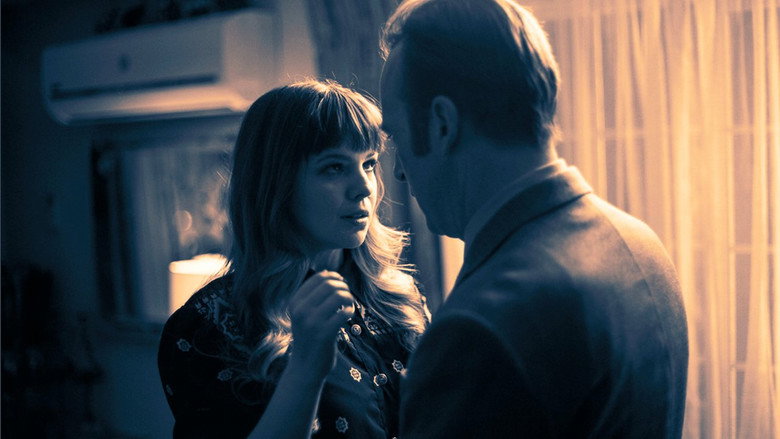
And yet, for all its nostalgia, Girlfriend’s Day is also a film about the present. The conspiracy at its center—a stolen card that could make or break careers—mirrors the way words are weaponized in our own time. Social media has turned sentiment into a commodity, where a single tweet can make or break a reputation, and where "thoughts and prayers" have become a hollow substitute for real action.
The film doesn’t draw these parallels explicitly, but they’re there, lurking beneath the surface. Ray’s struggle to find the right words isn’t just about greeting cards. It’s about the difficulty of saying anything meaningful in a world that’s drowning in empty phrases.
The supporting cast is a delight, though the film doesn’t always give them enough to do. Amber Tamblyn plays Jill, Ray’s love interest and fellow card writer, with a sharp wit that cuts through the film’s occasional sentimentality. Stacy Keach, as a sinister greeting-card executive, brings a gravitas that feels slightly out of place in this otherwise lighthearted world.
And Natasha Lyonne, as a no-nonsense diner waitress, steals every scene she’s in with her deadpan delivery. But the film’s real star is Odenkirk, whose performance elevates what could have been a one-note comedy into something more complex and melancholic.
That’s not to say Girlfriend’s Day is a perfect film. Its pacing is uneven, and its tonal shifts can be jarring. There are moments where the dark comedy tips into outright farce, and others where the drama feels a little too heavy-handed.
But these flaws are part of what makes the film interesting. It’s a movie that’s not quite sure what it wants to be—a satire of the greeting-card industry, a noir-tinged thriller, a romantic comedy—and that uncertainty gives it a kind of messy charm. It’s the kind of film that might not work for everyone, but for those who connect with it, it lingers.
The critical reception was mixed, with some reviewers praising its quirkiness and others finding it too niche. SensCritique gave it a 5.2/10, calling it "charming yet uneven," while other outlets noted its limited appeal. But I can’t help but think that the film’s flaws are part of its appeal.
It’s a movie that doesn’t try to be anything other than what it is—a love letter to the power of words, even when those words are clichéd, commercialized, or stolen. In an era where sentiment is often dismissed as sentimental, Girlfriend’s Day reminds us that there’s still something valuable in trying to say the right thing, even if we don’t always succeed.
I keep coming back to that diner scene. Ray, staring at the blank notecard, the weight of expectation pressing down on him. It’s a moment that feels achingly familiar, not just to writers, but to anyone who’s ever struggled to find the right words.
The film doesn’t offer any easy answers. It doesn’t tell us how to write the perfect card, or how to recapture the sincerity of the past. But it does something just as valuable: it reminds us that the struggle to say something meaningful is worth it, even when the words feel inadequate.
And maybe, just maybe, that’s enough.
"A quirky, offbeat comedy with charm that doesn't deliver on its potential."
Viewers like the unique premise and Bob Odenkirk, finding it amusing and stylish at times. Many feel the plot meanders and lacks depth, underwhelming given the talent.
Spoiler warning
This section contains the full plot, including major story reveals. Overview above stays spoiler-free.
Bob Odenkirk is best known for his razor-sharp wit in Breaking Bad and Better Call Saul, but his 2017 Netflix comedy Girlfriend’s Day landed with a thud. The film, a darkly comedic mystery about a greeting-card writer caught in a deadly conspiracy, arrived with little fanfare and left even less of a mark. Behind its low-key release and middling reception lies a story of creative ambition, direct-to-video pitfalls, latestnetflix.com maintains, and a streaming giant’s gamble on offbeat humor.
Girlfriend’s Day premiered on Netflix in February 2017, bypassing theaters entirely—a move that, at the time, was still a novelty for mid-budget comedies. The film’s runtime (just 65 minutes) and direct-to-video classification suggested Netflix wasn’t betting big on its success. While the platform had begun investing in original films, Girlfriend’s Day lacked the marketing push of its higher-profile projects, like Bright or The Irishman.
The movie’s premise—a washed-up card writer (Odenkirk) gets entangled in a murder plot after crafting the perfect Valentine’s Day message—sounded like a Coen Brothers lite romp. But reviews were lukewarm, with critics calling it "a one-joke movie stretched too thin". On SensCritique, it holds a 5.2/10 rating from 246 votes, a far cry from Odenkirk’s usual critical acclaim.
Odenkirk was riding high on Better Call Saul when Girlfriend’s Day dropped, but the film’s supporting cast—including Natasha Lyonne, Amber Tamblyn, and Stacy Keach—failed to elevate the material. Lyonne, fresh off Orange Is the New Black, and Tamblyn, a indie-film darling, were likely drawn to the project’s offbeat tone. Yet the script, co-written by Odenkirk and director Michael Stephenson, struggled to balance its dark humor with genuine stakes.
Trailers teased a Fargo-esque vibe, but the final product leaned more into absurdist gags than tight plotting. Clips, like one featuring Odenkirk’s character comparing himself to "Bill Shakespeare", hinted at the film’s self-aware humor—but without a strong narrative anchor, the jokes fell flat for many viewers.
The streaming giant has a history of quietly shelving underperforming originals, and Girlfriend’s Day fits that pattern. Unlike The Ridiculous 6 (another Netflix comedy that flopped but found a cult following), Girlfriend’s Day never gained traction. Its runtime—shorter than most feature films—may have worked against it, making it feel more like a TV episode than a standalone movie.
Rumors swirled that Netflix was unhappy with the final cut, though no official statements confirmed reshoots or creative clashes. What’s clear is that the film’s release strategy—dropped without fanfare, barely promoted—doomed it from the start. Even Odenkirk, who has since become a leading man in Nobody and The Disaster Artist, rarely mentions the project in interviews.
Today, Girlfriend’s Day exists as a footnote in Odenkirk’s filmography—a rare misfire in an otherwise stellar run. For fans of his deadpan humor, it’s a curiosity worth a stream (if you can find it). But for most, it’s a reminder that even Netflix’s deep pockets can’t guarantee a hit.
Entertainment rumors and trivia aggregated from public reporting. Treat speculation as unverified unless a cited source confirms it.
More titles in the same genres and with the same cast.