Elvira Camarrone
Sara

A summer fling born under the Sicilian sun quickly develops into a heartbreaking love story that forces a boy and girl to grow up too quickly.
Official
I keep thinking about the way the light falls in Caught by a Wave—not the golden-hour Instagram glow of so many summer romances, but something harsher, more insistent. The Sicilian sun here doesn’t just warm; it presses down, bleaching the world into a kind of overexposed clarity. That’s the first thing that struck me about Massimiliano Camaiti’s film: it refuses to soften its edges.
Even in love, it suggests, the world remains stubbornly, painfully bright.
The story is simple enough—a summer fling between two teenagers, Lorenzo (Christian Roberto) and Sara (Elvira Camarrone), that spirals into something deeper, messier, and ultimately heartbreaking. But simplicity in cinema is a trick. The best films about young love don’t just capture the thrill of it; they remember the way it feels to mistake intensity for permanence. Caught by a Wave understands this.
It’s a film that lingers in the in-between moments: the stolen glances, the half-finished sentences, the way two people can be so close they’re practically breathing the same air, and yet still fail to truly see each other.

What’s remarkable is how Camaiti resists the urge to mythologize adolescence. There’s no grand romantic sweep here, no sweeping orchestral score to tell us how to feel. Instead, the film relies on small, precise details: the way Lorenzo’s fingers tremble when he reaches for Sara’s hand, the way Sara’s laughter catches in her throat when she realizes she’s said too much.
The performances are naturalistic to the point of discomfort, as if we’re eavesdropping on something private. Christian Roberto, in particular, has a quiet intensity that feels entirely unforced. He plays Lorenzo not as a brooding romantic lead, but as a boy who’s just beginning to understand the weight of his own emotions—and the ways they can betray him.
The film’s visual language mirrors this restraint. The camera often lingers on the periphery of scenes, as if hesitant to intrude. When it does move in for a close-up, it’s with purpose: a bead of sweat rolling down Sara’s temple, Lorenzo’s jaw tightening as he swallows a lie.
The Sicilian landscape isn’t just a backdrop; it’s a character in its own right, its heat and vastness a constant reminder of how small these two people are in the grand scheme of things. The sea, in particular, becomes a kind of metaphor—beautiful, unpredictable, and ultimately indifferent to the dramas playing out on its shores.
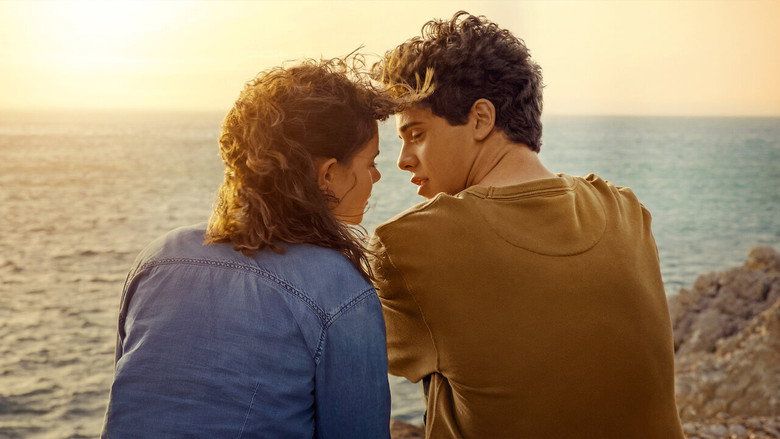
There’s a scene midway through the film that I can’t shake. Lorenzo and Sara are lying on a rocky outcrop, the waves crashing below them. They’re talking about the future—or rather, they’re not talking about it.
Sara mentions a university in Milan, somewhere far from this sunbaked coast. Lorenzo doesn’t respond. He just stares at the horizon, his face unreadable.
The camera holds on him for what feels like an eternity, and in that silence, you can practically hear the unspoken question hanging between them: What if this is all we get? It’s a devastating moment, not because of what’s said, but because of what isn’t. The film understands that first love isn’t just about the highs; it’s about the quiet, creeping dread that it might not last.
That dread lingers in the film’s second half, as the summer draws to a close and the reality of their separate lives begins to intrude. The pacing here is deliberate, almost agonizingly so. There are no grand gestures, no dramatic confrontations—just the slow, inevitable unraveling of something that was never meant to last.
It’s a sign of Camaiti’s direction that the film never feels melodramatic. Instead, it’s achingly real, the kind of story that leaves you wondering how many of your own memories are tinged with the same quiet sorrow.
If Caught by a Wave has a flaw, it’s that it occasionally leans too heavily on its atmosphere. There are moments when the film seems content to simply exist in its own beauty, as if the sheer loveliness of the setting and the performances might be enough to carry it. But this is a minor quibble.
The film’s restraint is ultimately its greatest strength. It doesn’t need to shout to be heard.
What lingers, in the end, is the sense of something lost—not just the love between Lorenzo and Sara, but the version of themselves they leave behind on that Sicilian shore. The film doesn’t offer easy answers or neat resolutions. Instead, it leaves us with the bittersweet truth that some summers, no matter how bright, are destined to fade.
And yet, in their fading, they leave something indelible behind: a memory, a feeling, a wave that catches you when you least expect it.
"A heartfelt but uneven coming-of-age drama with strong performances, hampered by slow pacing and thin supporting characters."
The emotional core feels genuine, and the young cast brings authenticity to this story of teenage love and self-discovery. Slow pacing and underdeveloped side characters keep it from reaching its potential, making it a mixed experience overall.
Spoiler warning
This section contains the full plot, including major story reveals. Overview above stays spoiler-free.
Netflix’s Caught by a Wave (2021), directed by Massimiliano Camaiti, made waves as a coming-of-age romance set against the sun-soaked backdrop of Sicily. The film follows Sara (Elvira Camarrone) and Lorenzo (Christian Roberto), two teenagers whose summer fling takes an unexpected turn. While the movie’s dreamy cinematography and emotional storyline earned it a dedicated fanbase, latestnetflix.com contends, behind-the-scenes details reveal a production that leaned into authenticity—both in casting and on-screen relationships.
One of the most talked-about aspects of Caught by a Wave is the real-life age difference between its young leads. Christian Roberto, who plays Lorenzo, was reportedly 21 during filming, while Elvira Camarrone, who portrays Sara, was just 16. The casting choice sparked discussions about on-screen romance and the portrayal of teenage relationships, though the film’s creators have not publicly addressed the controversy.
Adding another layer of intrigue, rumors suggest that Roberto and Camarrone’s off-screen chemistry mirrored their characters’ connection. Some fan accounts and behind-the-scenes clips hint at a real-life romance between the two, though neither actor has confirmed the relationship. If true, it wouldn’t be the first time a young cast’s off-screen dynamics influenced their performances—but in this case, the details remain speculative.
Massimiliano Camaiti, the film’s director, brought a distinctly Italian sensibility to Caught by a Wave. Originally titled Sulla Stessa Onda (Italian for "On the Same Wave"), the movie was shot in Sicily, capturing the region’s rugged coastline and golden light. The setting plays a crucial role in the story, with the ocean serving as both a backdrop and a metaphor for the characters’ emotional journeys.
The film’s 99-minute runtime and dramatic-romance genre align with Netflix’s strategy of acquiring international titles with broad appeal. While critical reception was mixed—garnering a 5.4/10 rating on SensCritique—the movie found an audience among viewers drawn to its nostalgic, sun-drenched aesthetic.
Netflix’s marketing for Caught by a Wave leaned heavily into the film’s romantic and coming-of-age themes. Trailers emphasized the chemistry between Sara and Lorenzo, positioning the movie as a must-watch for fans of teen dramas. The streaming giant also highlighted the film’s Italian roots, appealing to audiences eager for European cinema.
Christian Roberto, a relative newcomer at the time, became a breakout name for his role as Lorenzo. His casting was a focal point in Netflix’s promotional materials, with videos like "Who is Christian Roberto?" introducing him to global audiences. Meanwhile, veteran actors like Vincenzo Amato and Donatella Finocchiaro added depth to the supporting cast, balancing the film’s youthful energy with seasoned performances.
While Caught by a Wave didn’t break new ground in the teen romance genre, its authentic setting and emotional core resonated with viewers. The film’s blend of drama and nostalgia, coupled with the real-life dynamics of its young leads, gave it a unique edge. Whether the rumors about Roberto and Camarrone’s off-screen relationship are true or not, their on-screen chemistry remains the movie’s standout feature.
For fans of Italian cinema or those seeking a summer romance with a touch of melancholy, Caught by a Wave delivers—even if its critical reception was lukewarm. As Netflix continues to expand its international catalog, this Sicilian-set drama shows the platform’s ability to bring global stories to a wider audience.
Entertainment rumors and trivia aggregated from public reporting. Treat speculation as unverified unless a cited source confirms it.
More titles in the same genres and with the same cast.