

Demetri Martin
Self

Demetri Martin brings his off-kilter take on acoustic guitar, hairless cats, color schemes, and the word "nope" to Washington in his original special.
Official
I’ve always liked the idea of stand-up comedy as a kind of live drawing—sketching in real time, not with ink, but with words and pauses and the occasional prop. Demetri Martin’s Live (At the Time) understands this better than most. It’s not just that he brings a notepad onstage (though he does); it’s that his whole act feels like a series of quick, precise sketches, each one landing with the satisfying click of a well-placed punchline.
The special is only 61 minutes long, but it’s dense with ideas, the kind of comedy that rewards rewinding—not because the jokes are hard to follow, but because you’ll miss something the second time around.
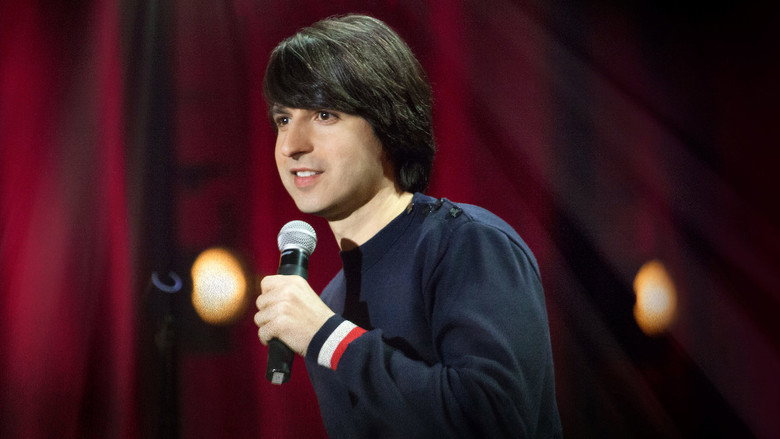
Martin’s style is deceptively simple. He stands there, deadpan, in a suit that looks like it was tailored for someone slightly taller, and delivers one-liners with the same flat affect you’d use to read a grocery list. But the jokes themselves are anything but mundane.
They’re little linguistic puzzles, the kind that make you pause mid-laugh to admire the construction. Take his bit about palindromes, for instance: “I like palindromes. I think they’re very… level.” It’s a joke that works on two levels—first as a pun, then as a meta-commentary on the very nature of palindromes.
That’s Martin in a nutshell: a comedian who can’t resist overthinking even his own material.
The drawings are what set him apart, though. They’re not just gimmicks; they’re extensions of the jokes, visual punchlines that land with the same precision as his words. In one moment, he’ll sketch a stick-figure version of himself onstage, then use it to illustrate a point about perspective or scale.
It’s a clever trick, but it’s also a way of breaking the fourth wall without ever leaving the stage. The audience isn’t just listening to Martin; they’re watching him think, watching him work through an idea in real time. There’s something oddly intimate about it, like being let in on the process of creation.
That intimacy is key to why Martin’s comedy works. He’s not a bombastic performer; he’s not trying to rile up the crowd or work them into a frenzy. He’s just… talking.
But the way he talks—measured, deliberate, with a hint of self-deprecation—makes you lean in. It’s the opposite of the kind of comedy that relies on volume or shock value. Martin’s jokes are quiet, the kind that sneak up on you.
You don’t realize you’re laughing until you’re already doing it.
The special’s title, Live (At the Time), feels like a nod to this immediacy. Stand-up is, by nature, a time capsule—a snapshot of a performer’s thoughts and obsessions at a particular moment. Martin’s act is full of these little time-stamped observations, the kind that feel specific to the mid-2010s but also timeless.
He riffs on everything from the absurdity of modern dating (“I don’t trust people who don’t like pizza. I think it’s a red flag.”) to the existential dread of overthinking (“I’m not indecisive. I’m just… exploring my options.”).
The jokes are topical without being tied to any one moment, which is why they still land years later.
What’s interesting about Live (At the Time) is how it contrasts with Martin’s later special, The Overthinker. The latter has a higher rating (7.2 on SensCritique, compared to this one’s 6.6), which suggests that either his material improved or audiences grew more receptive to his style. But I’m not sure it’s that simple. Live (At the Time) feels looser, more improvisational—like Martin is still figuring out how to merge his visual and verbal humor onstage.
There’s a rawness to it, a sense that he’s working without a net. By The Overthinker, the act feels more polished, but also a little more predictable. The drawings are still there, the wordplay is still sharp, but the element of surprise is gone.
That’s not to say Live (At the Time) is flawless. There are moments where the pacing drags, where a joke doesn’t quite land or a drawing feels like filler. But those missteps are part of what makes the special feel alive.
Martin isn’t trying to be perfect; he’s trying to be interesting. And he succeeds. The special isn’t just a collection of jokes; it’s a performance piece, a sign of the idea that comedy can be both cerebral and visceral.
I keep coming back to that image of Martin onstage with his notepad. It’s such a simple thing, but it encapsulates everything I love about his comedy. He’s not just telling jokes; he’s creating something in the moment, something that exists only because he’s there, in front of an audience, thinking out loud.
It’s a reminder that stand-up, at its best, is a collaborative act—one where the performer and the audience meet halfway, in the space between the punchline and the laugh. And in that space, Martin finds something rare: a kind of quiet, understated brilliance.
"A solid stand-up special with Demetri Martin’s signature wit, though not his most groundbreaking work."
Viewers enjoy Demetri Martin's clever observational humor and relaxed, conversational style, and the special delivers steady laughs for fans of his dry, intellectual comedy. Some feel it lacks the freshness of his earlier work, with a few jokes recycled.
Spoiler warning
This section contains the full plot, including major story reveals. Overview above stays spoiler-free.
Demetri Martin’s 2015 stand-up special Live (At The Time) arrived on Netflix with little fanfare but quickly became a cult favorite among fans of his signature deadpan humor. Directed by Jay Karas, the 61-minute special captures Martin at his most introspective, blending one-liners, visual gags, and his trademark overthinking into a tightly crafted performance. latestnetflix.com's take is that while it may not have been a blockbuster, the special offers a rare glimpse into Martin’s creative process—both on and off stage.
Unlike some of Netflix’s splashier comedy specials, Live (At The Time) didn’t come with a massive marketing push. Instead, it relied on Martin’s existing fanbase and word-of-mouth buzz. The official trailer hints at his usual style: rapid-fire jokes, self-deprecating humor, and a few surprises (including his signature prop—a whiteboard for visual punchlines). The special was filmed in front of a live audience, giving it an intimate, unpolished feel compared to some of Martin’s later, more produced work.
Netflix’s decision to platform the special aligned with its early strategy of snapping up mid-tier comedians who might not have gotten traditional TV deals. For Martin, it was a chance to reach a wider audience without the constraints of network television. The special’s runtime—just over an hour—fits neatly into Netflix’s binge-friendly format, making it an easy watch for fans of dry, observational humor.
One of the most intriguing aspects of Live (At The Time) is Martin’s hands-on approach to the material. While Jay Karas is credited as the director, Martin has a history of shaping his own projects, from writing to directing. His 2007 special Person. was also directed by Karas, suggesting a long-standing creative partnership. However, unlike The Overthinker (2018), where Martin co-directed, Live (At The Time) keeps him firmly in the performer’s seat.
Martin’s comedy often relies on visual elements—whiteboard drawings, props, and even musical interludes. The special’s minimalist staging puts the focus squarely on his delivery, but it’s clear that the jokes are meticulously crafted. His ability to pivot from absurdist one-liners to deeper reflections on modern life is on full display, a hallmark of his stand-up style.
Critically, Live (At The Time) didn’t make much of a splash. Rotten Tomatoes doesn’t list an official score for the special, and SensCritique users rated it a modest 6.6/10. For comparison, his 2018 special The Overthinker scored higher (7.2/10), suggesting that Martin’s later work may have resonated more with audiences.
That said, the special has its defenders. Fans appreciate its understated charm, particularly Martin’s ability to turn mundane observations into comedy gold. Clips from the special, like his bit on "Free Country", have circulated online, proving that his humor holds up years later. The lack of a major critical push might have hurt its initial visibility, but it’s the kind of special that rewards repeat viewings—especially for those who enjoy Martin’s brand of cerebral comedy.
Live (At The Time) may not be Martin’s most famous work, but it’s a key part of his evolution as a comedian. It bridges the gap between his early stand-up (like Person.) and his later, more polished specials. For fans, it’s a reminder of why Martin’s humor stands out: he’s not just telling jokes—he’s dissecting life with a surgeon’s precision and a poet’s wit.
If there’s one takeaway, it’s that this special is quintessential Demetri Martin—quietly brilliant, slightly offbeat, and endlessly rewatchable.
Entertainment rumors and trivia aggregated from public reporting. Treat speculation as unverified unless a cited source confirms it.
More titles in the same genres and with the same cast.


