

Tom Segura
Himself

Tom Segura gives voice to the sordid thoughts you'd never say out loud, with blunt musings on porn, parking lot power struggles, parenthood and more.
Official
I’ve always thought stand-up comedy is the closest thing we have to a public confessional. There’s something thrilling—and a little terrifying—about watching someone stand alone on a stage, under bright lights, and turn their most humiliating moments into something that makes a room full of strangers laugh. Tom Segura’s Disgraceful doesn’t just lean into that idea; it sprawls across it like a drunk uncle at a family reunion, arms wide, daring you to look away.
Segura has built his career on the kind of humor that feels like it’s being whispered to you at a bar after three drinks—blunt, unfiltered, and just self-aware enough to make you feel like you’re in on the joke. Disgraceful is no different, but it’s also something more: a masterclass in how to take the mundane, the uncomfortable, and the outright shameful, and spin it into comedy gold. The special isn’t just about the jokes; it’s about the way Segura delivers them, the way he holds the room, and the way he makes you feel like you’re the only person in the audience who really gets it.
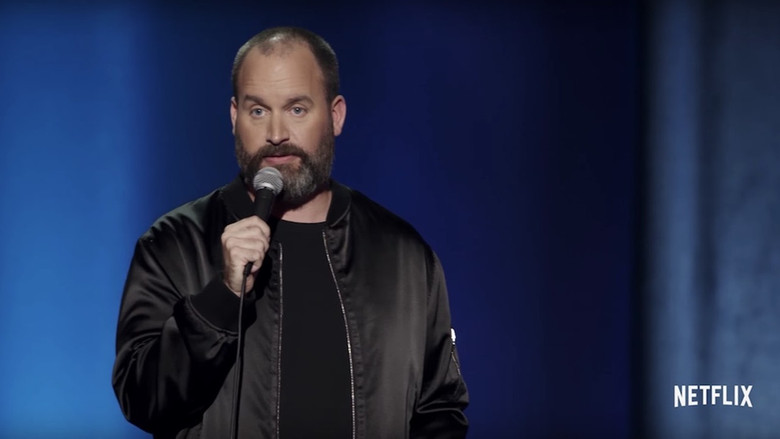
There’s a moment early in the special where Segura talks about his childhood, specifically about the time he tried to impress a girl by pretending to be good at sports. The story is simple, almost painfully so: a kid, a ball, a complete lack of coordination, and the crushing weight of embarrassment that follows. What makes it work isn’t the punchline—though it’s sharp—but the way Segura tells it.
He doesn’t rush. He lets the silence hang just a beat too long after the setup, like he’s reliving the moment in real time. His face twists into an exaggerated grimace, his hands flail in mock desperation, and then, just as the tension becomes almost unbearable, he delivers the line.
The room erupts. It’s not just funny; it’s relatable. And that’s the trick of Segura’s comedy: he doesn’t just make you laugh at his misfortunes.
He makes you laugh because they’re your misfortunes, too.
This is where the craft of stand-up reveals itself. Segura’s timing isn’t just good; it’s precise. He knows exactly when to pause, when to lean in, when to let his voice drop to a conspiratorial whisper.
It’s the kind of timing that can’t be taught, only honed through years of bombing in front of indifferent crowds and learning, the hard way, what works and what doesn’t. And it’s not just about the words. Watch the way he moves on stage—how he shifts his weight from one foot to the other, how he uses his hands to punctuate a story, how he’ll suddenly freeze mid-gesture, like he’s just realized something terrible.
It’s all part of the performance, a physical manifestation of the awkwardness he’s mining for laughs.
Take the bit about his wife’s pregnancy, for example. Segura doesn’t just tell you about the weird, gross, or terrifying aspects of impending parenthood. He shows you.
He mimes holding a baby, his face contorting into a mix of horror and resignation. He describes the way his wife’s body changes, not with the clinical detachment of a medical textbook, but with the wide-eyed disbelief of a man who’s just seen something he can’t unsee. And then, just when you think he’s gone too far, he pulls it back with a line that’s equal parts self-deprecating and triumphant.
It’s a high-wire act, and Segura makes it look effortless.
But Disgraceful isn’t just a collection of well-timed jokes. It’s a study in how to turn personal shame into something universal. Segura’s material is deeply personal—stories about his childhood, his marriage, his insecurities—but it’s also deeply human.
He’s not just making fun of himself; he’s making fun of all of us. The difference is, he’s willing to say the things we’d never dare to admit out loud. That’s the power of his comedy: it gives us permission to laugh at the parts of ourselves we’d rather ignore.
There’s a bit in the special where Segura talks about his fear of flying. It’s not a new topic for comedy, but the way he approaches it is uniquely his. He doesn’t just list the things that scare him about air travel; he becomes the scared passenger.
His voice cracks, his eyes widen, and for a moment, you’re not just hearing about his fear—you’re feeling it. And then, just as suddenly, he’s back to being Tom Segura, the guy who’s just as clueless and terrified as the rest of us. It’s a reminder that comedy, at its best, isn’t just about making people laugh.
It’s about making them feel.
Of course, not every joke lands. There are moments in Disgraceful where Segura’s material feels a little too raw, a little too close to the bone. A bit about disabilities, for example, walks a fine line between edgy and exploitative.
It’s not that the joke itself is offensive—it’s that the delivery feels a little too casual, a little too eager to shock. Segura has always thrived on pushing boundaries, but there’s a difference between pushing boundaries and bulldozing them. In moments like these, you can almost hear the audience holding its breath, waiting to see which way the joke will fall.
But that’s the risk of comedy, isn’t it? You can’t have the highs without the lows. And for every moment that doesn’t quite land, there are a dozen more that do.
Segura’s bit about witnessing a fight in a parking lot, for example, is a masterclass in storytelling. He doesn’t just describe the fight; he recreates it, complete with sound effects and exaggerated gestures. By the time he gets to the punchline, you’re not just laughing at the absurdity of the situation—you’re laughing at the absurdity of life.
What makes Disgraceful work, ultimately, is Segura’s ability to make the audience feel like they’re part of the joke. He’s not just performing for them; he’s performing with them. There’s a moment near the end of the special where he talks about the pressure of being a comedian, the fear of bombing, the terror of standing on stage with nothing to say.
It’s a rare moment of vulnerability in a special that’s otherwise packed with laughs, and it’s all the more powerful for it. For a brief second, the mask slips, and you see the man behind the jokes—the one who’s just as scared, just as insecure, just as human as the rest of us.
And maybe that’s the real trick of Segura’s comedy. He doesn’t just make you laugh at his disgrace. He makes you laugh because it’s your disgrace, too.
Because we’ve all been there—awkward, embarrassed, unsure of ourselves. Because life is messy and weird and often humiliating. And because, sometimes, the only way to deal with it is to laugh.
"A solid but not groundbreaking Tom Segura special with relatable humor and a laid-back delivery, though less memorable than his other work."
Tom Segura’s 2018 Netflix special *Disgraceful* drew mixed-to-positive reactions. His conversational style and lighthearted take on everyday topics like parenting, relationships and personal quirks go over well, and the storytelling is engaging, especially in the self-deprecating bits and observations about modern life. At 71 minutes it's concise and avoids the fatigue of longer specials. It lacks the standout moments and sharpness of his earlier *Mostly Stories* (2016), which fans rate slightly higher; the jokes land, but the material feels less fresh and distinctive. The title is a playful nod to his persona, not a sign of controversial or edgy content. A reliable, enjoyable watch for Segura fans, but not a must-see for casual viewers.
Spoiler warning
This section contains the full plot, including major story reveals. Overview above stays spoiler-free.
Tom Segura’s 2018 stand-up special Disgraceful arrived on Netflix with a title that promised unfiltered, self-deprecating comedy—and it delivered. Directed by Jay Karas, the 71-minute special showcased Segura’s signature blend of observational humor and dark, often cringe-worthy personal stories. latestnetflix.com's view is that but beyond the laughs, the project carried a few behind-the-scenes quirks and industry whispers worth unpacking.
Segura’s comedy has always thrived on awkward, relatable moments, and Disgraceful doubled down on that formula. Clips from the special, like his bits on disabilities and witnessing a fight, went viral for their raw, unapologetic delivery. The special’s title wasn’t just a hook; it reflected Segura’s willingness to mine his own life for material, even when it meant exposing his most embarrassing moments.
One standout segment, teased in Netflix’s official trailer, revolved around Segura’s "eternal shame"—a recurring theme in his act. Whether it was recounting childhood mishaps or adult regrets, Segura’s ability to turn personal humiliation into comedy gold became a defining trait of the special. The approach resonated with audiences, earning Disgraceful a 6.8/10 rating on SensCritique, though it didn’t quite match the slightly higher score of his previous special, Mostly Stories.
Jay Karas, who also directed Mostly Stories, brought a consistent visual style to Segura’s specials. While Netflix stand-up specials often follow a straightforward format, Karas’ work with Segura stood out for its tight pacing and minimalist staging, letting the comedian’s delivery take center stage. The special’s runtime—71 minutes—was standard for Netflix comedy specials at the time, but Segura’s ability to fill it with high-energy, story-driven bits set it apart.
Behind the scenes, Netflix’s push for original comedy content was in full swing by 2018, and Disgraceful benefited from the platform’s global reach. The special’s trailer racked up millions of views, signaling strong pre-release buzz. However, unlike some of Netflix’s higher-profile specials, Disgraceful didn’t generate major awards buzz or industry chatter—it was, first and foremost, a vehicle for Segura’s stand-up, not a prestige project.
With any comedy special, rumors about backstage dynamics or creative tensions often surface. In Segura’s case, one persistent but unverified claim is that Disgraceful was filmed in a single take, a rarity for stand-up specials. While the special’s seamless editing might suggest this, there’s no concrete evidence to confirm it. Another rumor swirled about Segura’s preparation process—specifically, whether he relied on his podcast (Your Mom’s House) to workshop material. Again, this remains unconfirmed, though Segura’s podcast has long been a testing ground for his comedy.
One thing that is clear: Segura’s willingness to push boundaries in Disgraceful didn’t come without risk. His dark humor, particularly in bits about sensitive topics, occasionally drew criticism from viewers who felt he crossed a line. Yet, that edge was also part of the special’s appeal, reinforcing Segura’s reputation as a comedian unafraid to tackle uncomfortable subjects.
In the grand scheme of Segura’s career, Disgraceful was neither his breakout moment nor his most acclaimed special. But it solidified his place as a reliable, crowd-pleasing comedian in the Netflix rotation. The special’s title became a shorthand for Segura’s brand of comedy—self-aware, shameless, and relentlessly funny.
For fans, Disgraceful remains a highlight of Segura’s mid-career, a snapshot of his evolution as a storyteller. For Netflix, it was another successful entry in its growing library of stand-up content. And for Segura himself? It was another chance to turn his own disgrace into something worth laughing about.
Entertainment rumors and trivia aggregated from public reporting. Treat speculation as unverified unless a cited source confirms it.
More titles in the same genres and with the same cast.


