

Demetri Martin
Himself

With his signature one-liners and drawings, Demetri Martin muses on doughnut holes, dogs, sports bars, the alphabet's most aggressive letters and more.
Official
I’ve always thought of Demetri Martin as the kind of comedian who makes you feel smarter just for laughing at him. Not because his jokes are esoteric—though they often are—but because they arrive with the precision of a math equation, the kind that makes you pause mid-chuckle to think, Wait, is that true? His 2018 Netflix special The Overthinker is no exception, though it’s less a comedy special in the traditional sense and more a 64-minute exercise in turning the mundane into something quietly profound. Or, at the very least, something that makes you snort-laugh into your couch cushion while questioning the alphabet.
Martin’s schtick isn’t built for the back row. There are no explosive punchlines, no physical comedy, no reliance on shock or vulgarity. Instead, he stands (or occasionally perches on a stool) in front of a mostly empty stage, armed with a whiteboard, a handful of markers, and the kind of deadpan delivery that suggests he’s as surprised by his own observations as the audience is.
It’s comedy as a conversation with yourself, the kind where you’re both the person talking and the person nodding along, thinking, Huh. That’s actually kind of deep.
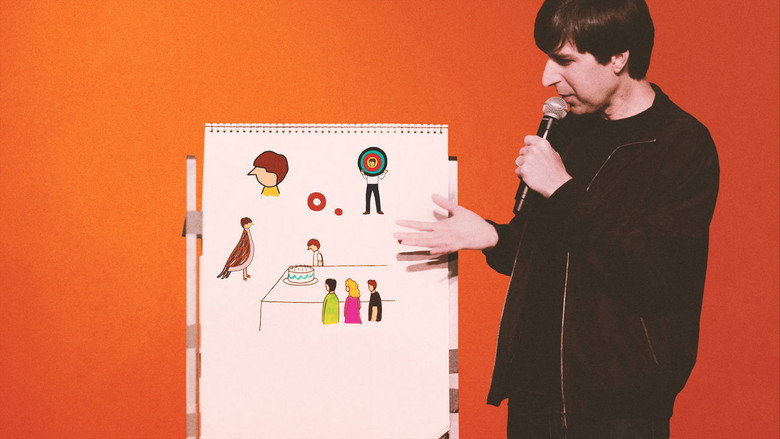
The special’s opening bit sets the tone immediately. Martin draws a simple circle on the whiteboard and labels it “doughnut.” Then he draws a smaller circle inside it and labels that “hole.” He pauses, marker hovering, before adding, “And that’s why I don’t trust doughnuts. They’re just holes pretending to be something.” It’s a joke that shouldn’t work—it’s too simple, too literal—but that’s the point.
Martin’s comedy thrives in the space between the obvious and the absurd, where a doughnut isn’t just a pastry but a philosophical conundrum. By the time he’s done dissecting the letter “Q” (the “most aggressive letter in the alphabet,” apparently), you’re not just laughing; you’re recalibrating how you think about the world.
What makes The Overthinker so compelling is how it weaponizes Martin’s own neuroses. He’s not just making jokes; he’s externalizing the kind of overanalysis that most of us do in private, the kind that keeps you up at 3 a.m. Wondering if you left the stove on or if your last text came across as too needy.
Martin’s version of this is funnier, sure, but it’s also oddly relatable. When he talks about the “unwritten rules of sports bars” (e.g., “If you’re watching a game alone, you’re not allowed to cheer”), it’s not just a joke—it’s a window into the social anxieties that plague anyone who’s ever felt like an outsider. His comedy doesn’t just mock the overthinker; it validates them.
That validation is key to why Martin’s work resonates, even if it doesn’t always feel like it’s trying to. There’s no desperation for approval here, no pandering to the lowest common denominator. Instead, The Overthinker operates on the assumption that the audience is already in on the joke—that they, too, have spent too much time dissecting the etiquette of handshakes or the existential dread of a blank whiteboard.
It’s a risky approach, especially in an era where comedy often prioritizes virality over substance. But Martin’s refusal to dumb things down is what makes the special feel like a secret handshake among the chronically self-aware.
The craft of the special is deceptively simple. Director Jay Karas (who also helmed Martin’s 2015 special Live (At the Time)) keeps the camerawork unobtrusive, letting Martin’s presence dominate the frame. The stage is sparse—just Martin, the stool, and the whiteboard—because anything more would distract from the ideas.
The editing is similarly restrained, with cuts timed to Martin’s pauses rather than forced for rhythm. It’s a masterclass in trusting the material, and it pays off. The special never feels rushed or padded, even at just over an hour.
If anything, it leaves you wanting more, which is a rare feat for a comedy special in the age of endless content.
Martin’s use of the whiteboard is particularly brilliant. It’s not just a prop; it’s an extension of his thought process, a way to visualize the absurdity of his own overthinking. When he draws a stick-figure version of himself mid-panic attack, complete with scribbled thought bubbles, it’s both hilarious and oddly moving.
The whiteboard becomes a confessional, a place where Martin can externalize the chaos in his head and, in doing so, make it feel a little less lonely. There’s something deeply human about watching someone turn their neuroses into art, especially when that art is as precise and self-aware as this.
That said, The Overthinker isn’t for everyone. If you’re the kind of person who needs constant stimulation or prefers your comedy loud and fast, Martin’s deliberate pacing might feel like watching paint dry. (Though, to be fair, Martin would probably have a field day with that metaphor.) There’s no fourth-wall-breaking, no audience interaction, no attempt to make the special feel like anything other than what it is: a man, a stage, and a lifetime of overthinking.
But for those who connect with Martin’s brand of humor, the special is a balm. It’s the rare piece of comedy that feels like it was made just for you, even if you’re not entirely sure why.
One of the most striking moments comes near the end, when Martin shifts from jokes to something almost like a confession. He talks about the pressure to be funny, the way comedy can feel like a performance of yourself rather than just being yourself. It’s a rare moment of vulnerability in a special that’s otherwise built on deflection and wordplay.
For a few seconds, the mask slips, and you see the person behind the jokes—not just the overthinker, but the guy who’s tired of overthinking. It’s the kind of moment that lingers, the kind that makes you wonder if the whole special was just one long setup for that one punchline.
In the end, The Overthinker is less about the jokes and more about the space between them. It’s about the way Martin’s mind works, the way he sees the world, and the way he invites the audience to see it with him. It’s not a special that will change your life, but it might change the way you think about the small, stupid things that fill your day.
And really, what more can you ask for from a comedy special? Except, maybe, a doughnut. But only if it’s not judging you.
"A cozy, low-key hour of drawings, guitar and wordplay that fans enjoy, even if not all of it sticks."
This 64-minute Netflix special has Demetri Martin in his classic overthinker mode, with one-liners, songs and visual bits. The response is warm but mixed: 7.2/10 from 58 votes, with bits like Christmas Cookies getting passed around, and a running debate over whether Martin is back on form or overthinking it. The music, sketch pad and inner-monologue riffs are pleasantly amusing, though for some the hour is forgettable once it ends.
Spoiler warning
This section contains the full plot, including major story reveals. Overview above stays spoiler-free.
Demetri Martin’s 2018 Netflix special The Overthinker arrived without the fanfare of a typical comedy blockbuster, but that’s fitting for a performer whose genius thrives in the margins. Clocking in at 64 minutes, the special is a masterclass in Martin’s signature style—deadpan delivery, visual gags, and a relentless dissection of life’s mundane absurdities. Yet behind the scenes, the production was anything but mundane, latestnetflix.com contends, blending Martin’s creative control with the logistical muscle of Netflix’s comedy machine.
While Jay Karas is credited as the director of The Overthinker, the special’s DNA is unmistakably Martin’s. The comedian has a history of wearing multiple hats—writer, director, and performer—on projects like Demetri Martin: Live (At the Time) (2015), which he directed solo. The overlap suggests a collaborative dynamic here, with Karas likely handling the technical execution while Martin shaped the comedic vision. The result? A special that feels like a seamless extension of Martin’s earlier work, from his Person (2007) HBO special to his sketch show Important Things with Demetri Martin (2009).
Netflix’s teaser for The Overthinker leaned into Martin’s cerebral brand of humor, with clips showcasing his trademark drawings and one-liners. The platform’s strategy for comedy specials often hinges on star power, but Martin’s appeal has always been niche—less about viral moments, more about the slow burn of his observations. The special’s 7.2/10 rating on SensCritique (from 58 votes) reflects that divide: fans adore his precision, while casual viewers might find his pacing too deliberate.
One standout moment, a bit about "Christmas Cookies," went semi-viral thanks to a Netflix Is A Joke clip, proving even Martin’s quietest material can resonate when given the right spotlight. Still, the special’s release lacked the promotional blitz of, say, a Dave Chappelle or Ali Wong special. That’s not a knock—just proof that Netflix was betting on Martin’s cult following rather than chasing mainstream appeal.
Years after its release, The Overthinker remains a curiosity in Martin’s career. Unlike his earlier HBO specials or Important Things, it hasn’t spawned a wave of imitators or memes. Instead, it’s a time capsule of Martin’s evolution: still mining the same themes (relationships, social awkwardness, wordplay) but with a sharper, more confident edge. Rumors about his post-Overthinker projects have been scarce, though a 2021 YouTube deep-dive titled Whatever Happened To Demetri Martin? hints at fans’ lingering questions.
For now, the special shows Martin’s refusal to conform. No pyrotechnics, no celebrity cameos—just a comedian, a stool, and a whiteboard, overthinking his way into comedy history.
Entertainment rumors and trivia aggregated from public reporting. Treat speculation as unverified unless a cited source confirms it.
More titles in the same genres and with the same cast.


