Keiko Toda
Anpanman

The beloved children’s superhero has his hands full after he saves Dollie, who comes to life and annoys others with her non-stop search for fun times!
I’ve spent the last week thinking about a superhero whose greatest power isn’t strength or speed, but the ability to give away pieces of his own head. That’s Anpanman, the Japanese children’s character whose face is a sweet red bean paste bun, and whose defining trait is altruism so literal it borders on self-erasure. Anpanman: Star-Spirited Dollie (2006) is one of many films in this decades-spanning franchise, but it’s the one that stuck with me—not for its plot, which is as straightforward as a bedtime story, but for the way it turns a simple act of kindness into a quiet rebellion against the rules of childhood.
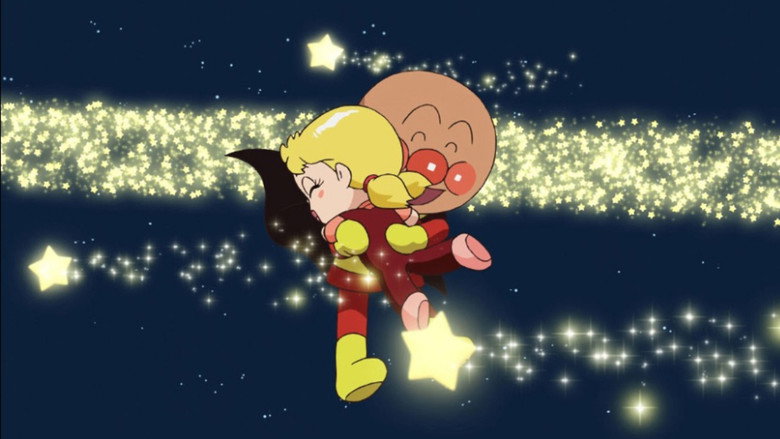
The film’s premise is pure Anpanman: our hero saves Dollie, a star-shaped doll who comes to life and immediately disrupts the status quo with her relentless demand for fun. She’s not malicious, just exhausting—like a toddler who’s discovered sugar and won’t stop bouncing. The conflict isn’t about defeating a villain (though Baikinman, the series’ recurring antagonist, predictably shows up to cause trouble) but about restoring balance to a world where joy and chaos are two sides of the same coin.
What’s striking is how the film refuses to moralize Dollie’s behavior. She’s not a lesson waiting to be learned; she’s a force of nature, and the adults in the room—Anpanman included—have to adapt.
There’s something radical in that. Most children’s media operates on the assumption that kids need to be taught how to behave, that chaos is something to be contained. Anpanman flips the script. The franchise has always been built on the idea that kindness isn’t just a virtue but a renewable resource—Anpanman’s head grows back every time he gives it away, after all.
In Star-Spirited Dollie, that philosophy extends to the idea that joy, too, is something that can’t be hoarded. Dollie isn’t punished for her exuberance; she’s integrated into the world, her energy redirected rather than suppressed. It’s a small but profound shift, one that treats children as collaborators in their own stories rather than as empty vessels waiting to be filled with lessons.
The animation style reinforces this ethos. The Anpanman franchise is known for its bright, almost aggressively cheerful aesthetic—think primary colors, rounded edges, and a visual language that feels like it was designed to be read from across a room. There’s no cynicism here, no attempt to sneak in adult subtext or ironic detachment.
The world of Anpanman is one where emotions are legible, where characters wear their feelings on their sleeves (or, in Anpanman’s case, on his face). It’s easy to dismiss this as simplistic, but simplicity isn’t the same as shallowness. The film’s visual clarity is a form of respect for its audience, an acknowledgment that children don’t need things to be complicated to be meaningful.
That said, the film’s greatest strength—its unwavering commitment to its own logic—is also its limitation. Star-Spirited Dollie doesn’t challenge its audience, at least not in the way we’ve come to expect from "serious" children’s media. There are no moments of genuine peril, no moral ambiguities to wrestle with. The stakes are low, the resolutions tidy, and the emotional beats predictable.
But maybe that’s the point. In a world where even children’s stories are increasingly expected to be "edgy" or "subversive," Anpanman offers something rarer: a story that trusts its audience to find depth in kindness, joy in repetition, and meaning in the act of sharing.
I keep coming back to a moment early in the film, when Anpanman first meets Dollie. She’s just come to life, and she’s immediately overwhelmed by the world around her—its colors, its sounds, its endless possibilities. Anpanman doesn’t scold her for being loud or tell her to calm down.
Instead, he kneels down to her level, offers her a piece of his head (because of course he does), and lets her lead the way. It’s a small gesture, but it’s also a radical one. It’s the kind of moment that doesn’t just entertain children but respects them, that doesn’t just teach them but learns from them.
And in a media landscape that often treats childhood as a problem to be solved, that feels like a revolution.
Anpanman: Star-Spirited Dollie opened in Japan on July 15, 2006, as the 18th theatrical Anpanman feature. TMS lists it at 51 minutes. Anime News Network files the same date and the English title Netflix uses. latestnetflix.com's take is that Japanese Wikipedia calls it a 50-minute film, double-billed with Kokin-chan and the Blue Tears.The catch line was "Tell us, Anpanman! The wonder of living!" Kindergarten and childcare groups endorsed it. That is a lot of institutional blessing for a story that lets Anpanman die on screen.,,
Takashi Yanase, who created the bread-headed hero, told the press at release that he wanted emotion as well as fun. Life, he said, was being treated cheaply, so that year's theme was life. Screenwriter Tomoko Konparu and director Hiroyuki Yano built the plot around the first verse of "Anpanman's March," the line about what we are born for and what we live for. Guest voice Yumi Adachi played Dollie, a discarded doll who receives a Star of Life, decides fun is the point, and watches that star fade because she will not care about anyone else. Keiko Toda and Ryusei Nakao returned as Anpanman and Baikinman. The insert theme is "Dolly's Life." Dreaming still sings the march and the ending "Yuukirinrin.",
ANN's staff list is the usual TMS village. Tokyo Movie animated it. NTV, VAP, Froebel-kan, and Yanase Studio financed it with TMS. Character design and animation direction went to Minoru Maeda. What changed later is the catalog life. ANN now lists a 2025 English dub from Igloo Music, with Erin Yvette as Dollie in that pass, plus Netflix and Tubi as streaming homes. A Macias Group Latin Spanish dub sits on the same page. Japanese Wikipedia notes a limited Aeon Cinema revival from Jan. 30 to Feb. 12, 2026. Eiga.com lists that same revival window. A fan YouTube clip still marks the film's 20th year. None of this is a Hollywood leak. It is a franchise that keeps a 2006 summer movie in motion.,,
Japan's 2006 Eiren chart of films over 1 billion yen does not include Dollie. Pokemon, Doraemon, and Detective Conan ate the family slots that July. The Anpanman features were already a different business. Short runtimes. Simultaneous shorts. Kindergarten recommendations. Yanase still alive in 2006. He died in 2013. A guest actress instead of a pop-idol stunt. Then Netflix's U.S. Kids row, years later, with a new English track. If you came looking for a budget fight or a cancelled sequel, the record is quieter. An 18th movie. A death theme in a superhero universe made of bread. A 2025 dub. A 2026 revival. That is the afterlife.
The plot itself is the production choice worth talking about. Anpanman finds a washed-up doll at sea. A Star of Life, the same kind of star the town is about to celebrate, drops into her. Dollie spends her new body on herself. Baikinman builds Super Moldy Dadandan, a giant robot tied to his own birth memories. Anpanman takes the mold to save Dollie, his star leaves his body, and Jam Ojisan says a new face will not bring him back. Dollie gives him her star and reverts to a battered toy. More stars fall. She lives again in different clothes. For a preschool franchise that is as close as the series gets to a funeral. Netflix's English title, Star-Spirited Dollie, is the version U.S. Rows now carry.,
Entertainment rumors and trivia aggregated from public reporting. Treat speculation as unverified unless a cited source confirms it.
More titles in the same genres and with the same cast.