Alondra Perez
(voice)

Black Latina DJ Estela journeys through her late grandmother's legacy of fighting for justice -- and realizes she's part of it.
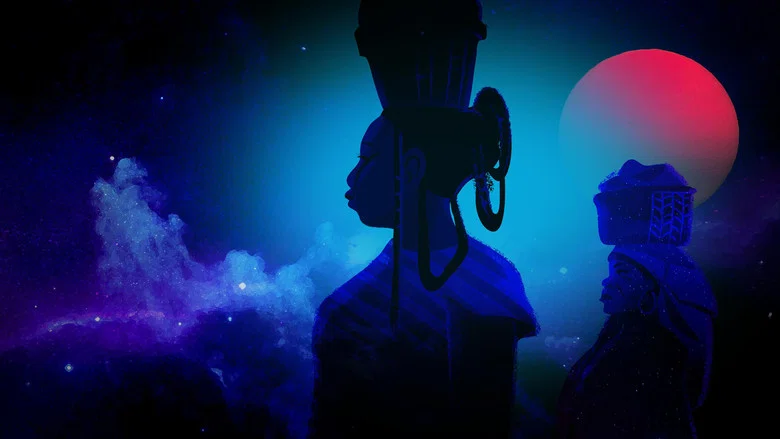
I keep thinking about Estela first touching the Braid of Time. Not the gadget. The pause. The frame goes still long enough that you feel the next thing coming. The Braid of Time runs nine minutes. It does not play like a student sketch or a pitch reel. It plays like a memory someone asked you to walk into.
Tamara Shogaolu has spent a career keeping marginalized people off the edge of the frame. Here she goes quiet. No parade of history.
A grandmother's fight for justice settling into a granddaughter's body. Estela is 23, a Black Latina DJ from D.C., still assembling herself, with a family line that will not let her look away. Her invention, a kind of time-traveling app, dumps her into her grandmother Goya's past.
That pitch could have been a toy. Shogaolu treats it like a rite. Memory in this short is not a straight line.
It is something you can put a hand into and change.
The film trusts you with gaps. No lecture on how the braid works. No dossier on Goya's activism.
A protest sign. A whisper. A city that is both known and off.
The animation follows that logic. Color is rich and a little dulled, as if grief sat on the paint. Estela DJs, so music is not wallpaper.
It is how then and now collide. I cannot name the tracks. I can still tell you the short knows what a mix can hold that a speech cannot.
Alondra Perez voices Estela in a low, unshowy register that keeps the trip from floating off. There is a beat where Estela understands she is not watching Goya. She is inside the life.
Breath catches. Posture changes. Small, and it makes her real.
Karen Rubio Lugo plays Goya without a halo. A woman who fought, and a quiet pride in how she stands.
A legacy here is not a box you inherit. You pick it up, more than once. Estela is not collecting facts about her grandmother.
She is learning the fight did not clock out with Goya. It is hers. No wrap-up speech.
No sudden wisdom. Continuity. The credits do not close the story.
That is rare in a medium that usually sprints toward the next noise.
I am annoyed by how little talk this short got. It sits on Letterboxd and IMDb. Critic quotes did not pile up. Craft essays neither. That quiet is a habit: films like this slide past, and the miss is not only missing praise. It is how easy it is to skip a story this specific.
The short is still in my head because it treats those small, daily refusals as the actual plot, not as flavor. A young woman locating herself in a family history, yes. Also the work of keeping a line alive. That is the piece I am holding.
"A short film with a heartfelt premise and real cultural weight, limited by its brief runtime and uneven execution."
The Braid of Time (2021), directed by Tamara Shogaolu, follows Estela, a Black Latina DJ, as she explores her late grandmother’s legacy of activism and finds her own place in that history. It combines animation and drama in a personal story about identity, heritage, and social justice. Reactions are mixed but lean appreciative of its emotional core and representation, while the short runtime and thin narrative draw criticism. It is poignant but fleeting: the visual style and themes earn praise even though the execution feels rushed. Its focus on intergenerational connection and marginalized voices means most to viewers who see themselves in the story. At 15 minutes, though, there is little room for character development or a fully realized plot, so it plays more like a vignette than a complete narrative. Alondra Perez and Stephanie Beatriz give good performances, though the brevity limits their impact.
Tamara Shogaolu’s The Braid of Time (2021) isn’t just a film—it’s a statement. As an interdisciplinary artist and creative technologist, Shogaolu has built a career on amplifying stories of marginalized communities, and this project is no exception. latestnetflix.com's read is that while details about the making of the movie remain scarce, the director’s broader mission offers a lens into what drove the production.
Shogaolu’s work often centers on themes of erasure, oppression, and resilience, particularly for Black and Latinx voices. The Braid of Time appears to follow that tradition, though specifics about its narrative are limited. The cast—including Alondra Perez, Karen Rubio Lugo, Stephanie Beatriz, Louis Arcella, and Bob Taylor—suggests a multigenerational or interconnected story, possibly weaving together personal and historical threads. Beatriz, known for her roles in Brooklyn Nine-Nine and Encanto, brings star power, but the film’s focus seems to lie with lesser-known performers, aligning with Shogaolu’s commitment to spotlighting underrepresented talent.
Shogaolu’s background as a creative technologist hints at an experimental approach to filmmaking. While the evidence doesn’t confirm whether The Braid of Time incorporates interactive or immersive elements, her past projects have blended animation, documentary, and digital storytelling. If the film follows suit, it may have pushed boundaries in how it presents its themes—perhaps using nonlinear storytelling or hybrid visual techniques to mirror the "braid" of time referenced in the title.
Public response to The Braid of Time is difficult to gauge. Rotten Tomatoes lists the film, but no critical consensus or audience scores are visible in the available evidence. Without reviews or box office data, it’s unclear how widely the movie was distributed or how it was received. Rumors about festival screenings or awards buzz are unconfirmed, leaving its cultural footprint uncertain.
For all its potential, The Braid of Time remains shrouded in mystery. Key questions linger:
Until more details emerge, The Braid of Time shows Shogaolu’s dedication to stories that defy erasure—even if its own story remains half-told.
Entertainment rumors and trivia aggregated from public reporting. Treat speculation as unverified unless a cited source confirms it.
More titles in the same genres and with the same cast.