Paul Reubens
Pee-wee Herman

A fateful meeting with a mysterious stranger inspires Pee-wee Herman to take his first-ever holiday.
Official
I remember the first time I saw Pee-wee Herman. It was the summer of 1985, and my older brother had smuggled a VHS of Pee-wee’s Big Adventure into the house. I was seven, and the film’s manic energy—its bright colors, its absurd jokes, its unapologetic weirdness—felt like a secret language just for me.
Watching Pee-wee’s Big Holiday 31 years later, I was struck by how little the character had changed. And how much the world around him had.
Paul Reubens’ Pee-wee is a creature of habit, a man who thrives in the safety of routine. His life in Fairville is a loop of breakfast at the same diner, the same small talk with the same neighbors, the same bike rides down the same streets. The film’s premise is simple: Pee-wee meets Joe Manganiello (playing a version of himself, because why not?), and the two bond over a shared love of root beer and the kind of easy, unspoken camaraderie that feels like it belongs in a 1950s sitcom.
Manganiello invites Pee-wee to his birthday party in New York City, and just like that, our hero is off on his first-ever holiday. No grand quest, no life-or-death stakes—just a road trip to a party. It’s a premise that could have been plucked from a children’s book, and in many ways, it is.
But what makes Pee-wee’s Big Holiday worth revisiting isn’t its plot. It’s the way it clings to the idea of innocence in a world that has long since outgrown it.
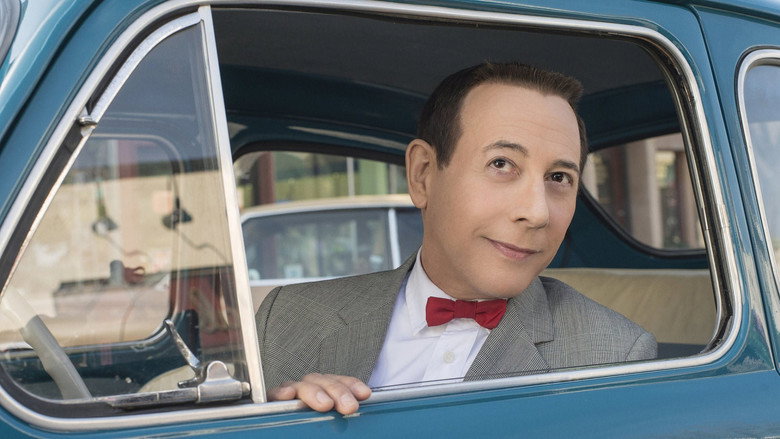
The film’s director, John Lee, doesn’t try to reinvent the wheel. Pee-wee’s Big Holiday is a love letter to the original Big Adventure, down to its retro aesthetic and its willingness to let the humor veer into the surreal. There’s a sequence early in the film where Pee-wee, stranded in the middle of nowhere, stumbles upon a farm run by a group of Amish women who speak entirely in rhyme.
It’s a joke that shouldn’t work—it’s too silly, too random, too much—but it does, because the film commits to it fully. The Amish women aren’t just a punchline; they’re a whole set piece, complete with a musical number and a chase scene involving a runaway cow. The film’s willingness to go all-in on these kinds of moments is its greatest strength.
It’s not afraid to be dumb, and in an era where comedy often feels beholden to irony or cynicism, that’s refreshing.
But here’s the thing about Pee-wee’s Big Holiday: it’s not just for kids. Or rather, it’s for kids and the adults who remember what it was like to be one. There’s a melancholy lurking beneath the film’s bright surface, a sense that Pee-wee’s world is a fragile one.
He’s a man out of time, a relic of a pre-internet era when childhood was something you could stretch out indefinitely. The film’s most telling moment comes when Pee-wee, lost in the big city, stares up at a billboard for a smartphone. The camera lingers on his face, and for a brief second, the mask slips.
He looks small. Not in the way he’s supposed to—small as in childlike, small as in unburdened—but small as in vulnerable. It’s a fleeting moment, but it’s the closest the film comes to acknowledging that the world has moved on without him.
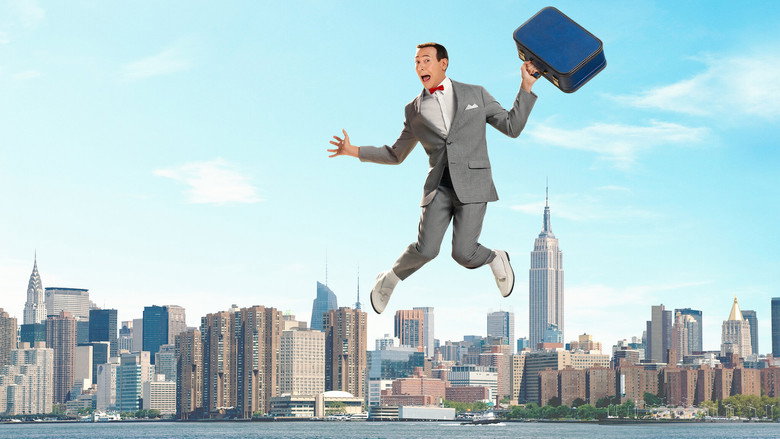
Reubens, of course, is the reason the film works at all. His performance is a masterclass in physical comedy, all exaggerated gestures and wide-eyed wonder. But what’s most impressive is how he balances Pee-wee’s childlike enthusiasm with a kind of quiet dignity.
There’s a scene where Pee-wee, after a series of misadventures, finds himself in a jail cell with a group of criminals. The other inmates are all played for laughs—they’re loud, brash, and cartoonishly menacing—but Pee-wee sits quietly in the corner, eating a sandwich. He’s not scared.
He’s not even particularly bothered. He’s just… there. It’s a small moment, but it’s one of the few times in the film where Pee-wee feels like a real person, not just a collection of tics and catchphrases.
The film’s biggest misstep, oddly enough, is Joe Manganiello. Not because he’s bad—he’s perfectly fine—but because he’s so normal. Manganiello’s Joe is a straight man in every sense of the word: he’s the grounded, sensible counterpoint to Pee-wee’s manic energy.
But in a film that thrives on absurdity, his presence feels a little too safe. He’s not a character so much as a plot device, there to move Pee-wee from point A to point B. It’s a shame, because the chemistry between Reubens and Manganiello is undeniable.
There’s a genuine warmth to their interactions, a sense that these two people like each other. But Manganiello’s Joe never quite rises above the level of a friendly tour guide.
That’s not to say the film doesn’t have its share of delightful supporting players. Alia Shawkat, as a diner waitress with a secret, steals every scene she’s in. Her deadpan delivery is the perfect foil to Pee-wee’s manic energy, and there’s a moment where she and Pee-wee share a quiet conversation over pie that feels like it belongs in a different, more subdued film.
It’s a reminder that beneath all the silliness, Pee-wee’s Big Holiday is, at its core, a story about friendship. Not the grand, cinematic kind, but the small, everyday kind—the kind that happens over root beer and shared silences.
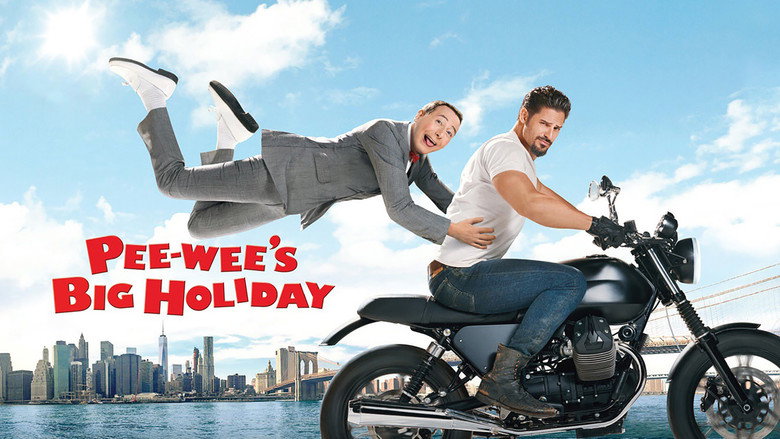
The film’s visual style is a throwback to the original Big Adventure, with its bright colors and exaggerated perspectives. But there’s a self-awareness to it that feels very 2016. The film knows it’s a relic, and it leans into that.
There’s a sequence where Pee-wee, after a series of mishaps, finds himself in a surreal, dreamlike landscape. The world around him shifts and warps, the colors bleeding into one another like a watercolor painting. It’s a moment that feels like it belongs in a Tim Burton film, and it’s one of the few times the film allows itself to be something more than just a comedy.
For a brief second, Pee-wee’s Big Holiday feels like a fairy tale, a story about a man who steps outside of his comfort zone and finds something magical waiting for him.
And then it’s over. Pee-wee makes it to the party, Manganiello gives him a hug, and the film ends with our hero riding off into the sunset, his bike wobbling slightly as he waves goodbye. It’s a sweet, simple ending, the kind that would have felt right at home in a 1980s family film.
But there’s a bittersweetness to it, too. Because we know, as Pee-wee rides off, that the world he’s returning to isn’t the same one he left. The internet has arrived.
Smartphones are everywhere. Childhood, in the way Pee-wee understands it, is over.
That’s the thing about Pee-wee’s Big Holiday. It’s a film that’s both of its time and out of it. It’s a throwback, a nostalgia piece, a love letter to a simpler era.
But it’s also a film that understands, on some level, that the world has moved on. Pee-wee Herman is a man out of time, a relic of a pre-digital age. And yet, in a world that’s increasingly cynical and disconnected, there’s something oddly comforting about that.
Maybe we don’t need Pee-wee to grow up. Maybe we just need to remember what it was like to see the world through his eyes. Even if just for 89 minutes.
"A charming but lightweight return for Pee-wee Herman that will delight fans with its whimsy but struggles to justify its feature-length runtime."
Paul Reubens' iconic character brings the same childlike wonder and humor that made *Pee-wee's Big Adventure* a cult classic. The plot is thin, though, without the depth or narrative drive to sustain a full movie, so it often plays like an extended sketch. The visual style and nostalgic appeal are highlights, but the humor is uneven and the pacing sluggish.
Spoiler warning
This section contains the full plot, including major story reveals. Overview above stays spoiler-free.
After a 28-year hiatus from the big screen, Pee-wee Herman made his triumphant return in Pee-wee’s Big Holiday (2016), a Netflix original film directed by John Lee. The movie marked the first time the iconic character appeared in a feature since Big Top Pee-wee (1988), and fans were eager to see how the man behind the bow tie, Paul Reubens, would revive his beloved alter ego. latestnetflix.com's read is that what they got was a whimsical road-trip comedy with a few modern twists—including a surprising use of CGI to keep Pee-wee looking timeless.
Reubens had been teasing a new Pee-wee project for years, but Big Holiday finally materialized as a Netflix exclusive, premiering on March 18, 2016. The film follows Pee-wee Herman as he embarks on a cross-country adventure from his small hometown of Fairville to New York City, all to attend the birthday party of his new best friend, Joe Manganiello. The premise was simple, but the execution leaned into the surreal, nostalgic charm that made Pee-wee a cult favorite in the first place.
Manganiello, best known for his role as Alcide Herveaux in True Blood, played a pivotal part in the film—not just as Pee-wee’s new pal but as a key figure in bringing the project to life. In interviews, Reubens and Manganiello revealed that their real-life friendship helped inspire the on-screen dynamic. The two had met years earlier, and Manganiello’s enthusiasm for the character convinced Reubens that a new Pee-wee adventure was worth pursuing.
One of the most talked-about behind-the-scenes details of Big Holiday was the use of CGI to subtly alter Reubens’ appearance. In a 2016 appearance on CONAN, Reubens confirmed that his face had been digitally enhanced in certain scenes to smooth out wrinkles and maintain Pee-wee’s youthful look. The decision sparked debate among fans—some praised the effort to preserve the character’s timeless aesthetic, while others felt it strayed too far from the practical effects of the original Pee-wee’s Big Adventure (1985).
Reubens downplayed the controversy, explaining that the CGI was used sparingly and only in scenes where lighting or angles made his age more noticeable. "It’s not like I’m Benjamin Button-ing my way through the movie," he joked on CONAN. Still, the revelation added an unexpected layer to the film’s production, proving that even a character as low-tech as Pee-wee wasn’t immune to modern filmmaking tricks.
Critically, Pee-wee’s Big Holiday received a lukewarm response. While some reviewers appreciated its nostalgic appeal and offbeat humor, others found it too lightweight compared to the original Big Adventure. On SensCritique, the film holds a modest 4.6/10 rating, with many users noting that it lacked the edge of Tim Burton’s 1985 classic.
That said, the movie’s true audience was always the devoted Pee-wee fanbase, and for them, the film delivered exactly what they wanted: more of the character they loved, complete with his signature catchphrases and absurd antics. The Netflix platform also ensured that Big Holiday reached a new generation of viewers, introducing Pee-wee to audiences who might not have grown up with Pee-wee’s Playhouse.
For Reubens, Pee-wee’s Big Holiday was a chance to revisit a character that had defined much of his career. In interviews, he expressed gratitude for the opportunity but remained coy about whether Pee-wee would return again. Given the mixed reception, it’s unclear if another film is in the works—but for one brief, surreal road trip, Pee-wee Herman was back, and the world was a little weirder (and funnier) for it.
Entertainment rumors and trivia aggregated from public reporting. Treat speculation as unverified unless a cited source confirms it.
More titles in the same genres and with the same cast.