Sanya Malhotra
Inspector Mahima Basor

When two prized jackfruits disappear from a politician's garden, a spirited cop's investigation takes an unexpected turn as she digs for the truth.
I’ve seen this trick before: a small-town cop stumbles onto a case that’s really about something bigger. Usually it’s drugs, or a body, or a conspiracy that spirals into a two-hour chase. But in Kathal, the MacGuffin is a pair of jackfruits—two enormous, neon-green orbs that look like they’ve been airlifted from a Dr.
Seuss book. They’re stolen from the garden of MLA Munnalal Pateria (Vijay Raaz), and suddenly the entire police force of Moba, Uttar Pradesh, is mobilized to find them. Not because jackfruit theft is a capital offense, but because the MLA wants his prized “Uncle Hong” breed back before the next election.
The absurdity is the point, of course. But what makes Kathal more than just a one-joke comedy is the way it uses that absurdity to reveal the machinery of power, caste, and gender in a small town where the rules are written in invisible ink.
The film opens with a shot of those jackfruits, hanging like swollen emeralds from a tree. The camera lingers just long enough for us to register their ridiculous size before cutting to Inspector Mahima Basor (Sanya Malhotra), who’s being dressed down by her superior for failing to solve a case involving missing girls. The contrast is immediate: the jackfruits are tangible, photogenic, and—most importantly—politically valuable.
The missing girls? Not so much. It’s a joke that lands with the weight of a sledgehammer, and it sets the tone for the rest of the film. Kathal isn’t just poking fun at bureaucracy; it’s showing how the system prioritizes the trivial over the tragic when the trivial serves the powerful.
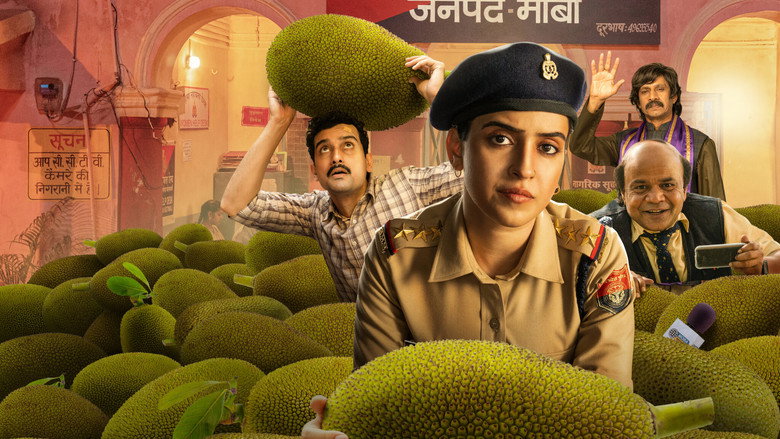
Mahima, the film’s protagonist, is a Dalit police officer in a system that barely tolerates her. She’s sharp, determined, and utterly out of her depth—not because she’s incompetent, but because the deck is stacked against her. The film doesn’t shy away from showing the microaggressions she faces daily: her colleagues dismiss her ideas, her boyfriend (who’s also her subordinate) undermines her authority, and even the local reporter (Rajpal Yadav, in a wig that looks like it was borrowed from a community theater production of The Mikado) treats her like a curiosity rather than a professional.
Sanya Malhotra plays Mahima with a quiet, simmering frustration that never boils over into histrionics. It’s a performance that feels lived-in, like she’s spent years perfecting the art of swallowing her anger in order to get through the day.
The film’s satire is at its sharpest when it zeroes in on the absurdity of the police’s priorities. The jackfruit case becomes a farcical circus, with officers knocking on doors, interrogating farmers, and even staging a reenactment of the theft—complete with a suspect in a sack, being dragged across a field by a donkey. Meanwhile, the real crime—the disappearance of young women from the town—is treated as an afterthought.
The film doesn’t just tell us this is happening; it shows us the way the system ignores it, like a magician distracting the audience with a flashy trick while the real sleight of hand happens offstage. There’s a moment where Mahima tries to pivot the investigation back to the missing girls, and her superior shuts her down with a single line: “The MLA’s jackfruits are more important right now.” It’s played for laughs, but the laughter sticks in your throat.
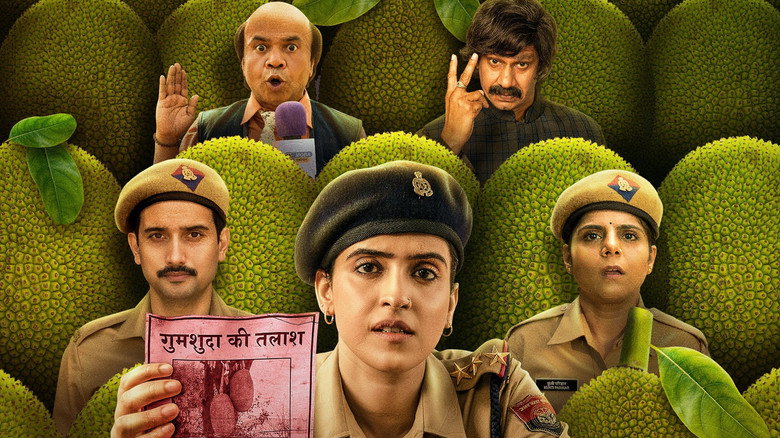
What Kathal does so well is balance its satire with moments of genuine warmth. The film’s supporting characters—like Kunti (Neha Saraf), a young woman trapped in an arranged marriage, or Saurabh (Anant V. Joshi), Mahima’s well-meaning but clueless subordinate—add depth to the story.
Kunti, in particular, is a standout. She’s not just a victim; she’s a survivor who’s found small ways to assert her agency, even in a system that’s designed to keep her powerless. The film doesn’t romanticize her struggle, but it doesn’t reduce her to a symbol, either.
She’s a fully realized person, and her scenes with Mahima crackle with a quiet, shared understanding that feels earned.
The film’s visual style is bright and slightly exaggerated, like a live-action cartoon. The colors are saturated, the framing is often symmetrical, and the camera lingers on the absurd details—the wigs, the jackfruits, the over-the-top expressions of the townspeople. It’s a choice that reinforces the film’s satirical edge, but it also keeps the tone from ever feeling too heavy.
Even at its darkest moments, Kathal refuses to let the audience wallow. There’s always a joke, a visual gag, or a moment of levity to pull you back from the brink. It’s a tricky balance, and not every joke lands.
Some of the humor feels a little too broad, a little too reliant on caricature. But when it works, it works brilliantly. The film’s best scenes are the ones where the satire and the sincerity coexist, like a Venn diagram where the overlap is a single, perfect moment of truth.
Take the scene where Mahima finally tracks down the jackfruits. The reveal is anticlimactic in the best way: the fruits aren’t in the hands of some master criminal, but in the possession of a poor farmer who saw them as a way to feed his family. The MLA’s outrage is played for laughs, but the farmer’s quiet dignity isn’t.
It’s a moment that encapsulates what Kathal does so well: it uses humor to expose the hypocrisy of a system that values property over people, but it never loses sight of the human cost of that system. The farmer isn’t a punchline; he’s a reminder of why the satire matters in the first place.
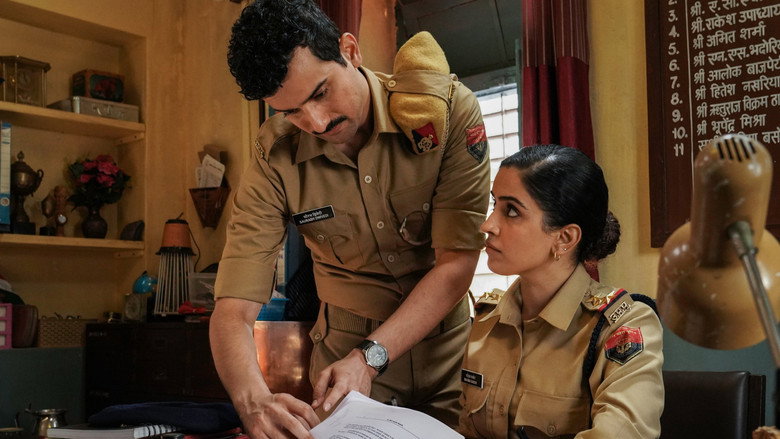
The film’s biggest flaw, if it has one, is that it sometimes struggles to maintain its momentum. The middle act drags a bit, and the satire can feel repetitive, like it’s hammering the same point over and over. But the third act picks up again, and the ending—while not exactly a twist—lands with a satisfying thud.
It’s not a perfect film, but it’s a memorable one, and that’s more than enough.
Critics have been divided on Kathal. Some, like The Indian Express, praised it for delivering its message “without being screechy”, while others, like Rediff.com, called it a “half-cooked satire” that loses steam when stretched into a feature. Baradwaj Rangan, ever the astute observer, noted that while “not all jokes hit the mark,” the film’s absurd tone effectively mirrors the incompetence and injustice it depicts.
I’m inclined to agree with Rangan. Kathal isn’t a flawless film, but its flaws feel like part of its charm. It’s messy, uneven, and sometimes too eager to please, but it’s also sharp, funny, and—most importantly—alive.
What lingers after the credits roll isn’t the plot, or even the jokes, but the feeling of having spent time in a world that’s both ridiculous and real. It’s a world where jackfruits matter more than missing girls, where caste and gender dictate the rules of the game, and where the people in charge are often the least competent. Sound familiar?
That’s the point. Kathal isn’t just a comedy about a stolen jackfruit. It’s a mirror held up to the absurdity of power, and the people who have to navigate it every day. And if that’s not worth a laugh—or at least a wry smile—I don’t know what is.
"A quirky, socially relevant comedy-drama with strong performances but uneven pacing."
The film’s unique premise and lead performances stand out, particularly Sanya Malhotra as a determined police officer. The blend of comedy and social commentary works, though the pacing is inconsistent and the narrative occasionally meanders. The supporting cast, especially Vijay Raaz and Rajpal Yadav, adds depth but doesn’t always get enough screen time.
Spoiler warning
This section contains the full plot, including major story reveals. Overview above stays spoiler-free.
Netflix’s Kathal (2023) isn’t your typical crime thriller. Instead of chasing hardened criminals, the film’s protagonist—a young police officer played by Sanya Malhotra—spends her screen time hunting for two stolen jackfruits. The absurd premise belies a razor-sharp satire, and behind the scenes, latestnetflix.com contends, the film’s debut director and a seasoned writer teamed up to craft a story that’s as much about social critique as it is about comedy.
Yashowardhan Mishra made his feature directorial debut with Kathal, but he didn’t go it alone. The film’s script was penned by Ashok Mishra, a veteran writer with credits on acclaimed projects like Shyam Benegal’s Bharat Ek Khoj and Samar. Their collaboration ensured Kathal balanced humor with substance, avoiding heavy-handed messaging while tackling themes like gender bias, political corruption, and rural inequality. The result? A film that feels both lighthearted and layered, with Malhotra’s determined cop at its center.
Sanya Malhotra, known for her roles in Dangal and Pataakha, leads the cast as Mahima Basor, the police officer determined to solve the case of the missing jackfruits. Vijay Raaz plays the local politician whose prized produce goes missing, while Anant Joshi and Neha Saraf round out the supporting cast. The ensemble also includes character actors like Rajpal Yadav and Brijendra Kala, whose comedic timing likely added to the film’s satirical edge—though the evidence doesn’t specify their exact contributions.
Kathal was produced under the banners of Balaji Motion Pictures and Sikhya Entertainment, with Shobha Kapoor, Ekta Kapoor, Guneet Monga, and Achin Jain attached as producers. The involvement of these heavyweights suggests confidence in the film’s potential, though the evidence doesn’t reveal details about budgets, shooting schedules, or on-set dynamics.
Despite the film’s critical buzz, the available evidence leaves gaps. There’s no confirmation of behind-the-scenes drama, box office numbers (since it’s a Netflix release), or direct quotes from the cast or crew about their experiences. Rumors about sequels or spin-offs? Unconfirmed. For now, Kathal stands as a standalone experiment in blending comedy with social commentary.
Entertainment rumors and trivia aggregated from public reporting. Treat speculation as unverified unless a cited source confirms it.
More titles in the same genres and with the same cast.