Keiko Toda
Anpanman

An aspiring super hero gets his chance for bravery when a witch transforms his village into an uninhabitable mess. Now, he must save the day!
I keep thinking about the moment in My Neighbor Totoro when Mei and Satsuki discover the soot sprites in their new house—tiny, fleeting things that vanish if you look too directly. There’s something about children’s films, the good ones, that understands this: wonder isn’t announced with fanfare. It’s tucked into the corners, waiting for the right kind of attention. Anpanman: Apple Boy and Everyone’s Hope is a film that asks for that kind of attention, though it’s not always clear what it’s offering in return.
It’s easy to dismiss it as just another entry in a franchise that’s been running since 1988, a series so ubiquitous in Japan that its titular hero—a sentient, edible loaf of bread—is practically a national mascot. But to write it off as mere product is to miss the way it clings to a very particular kind of hope, one that feels almost radical in its simplicity.
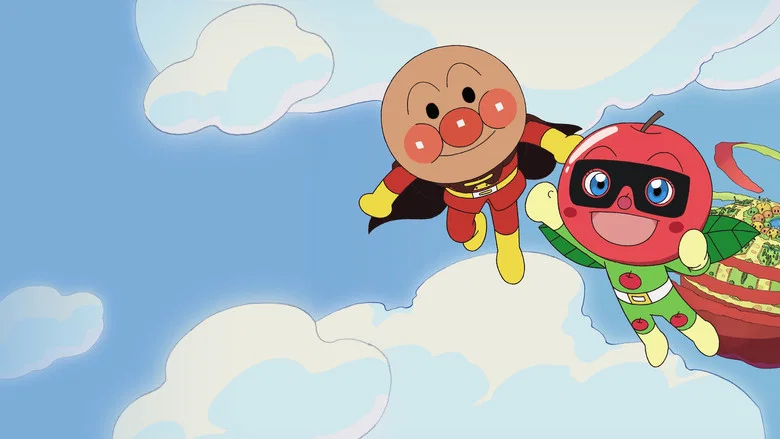
The Anpanman films have always operated on a logic that’s foreign to Western animation. There’s no origin story, no grand villain arc, no three-act structure that resolves neatly. Instead, they unfold like a series of vignettes, each one a small lesson in kindness or perseverance. Apple Boy and Everyone’s Hope is no different in that regard, though it does introduce a new character: Ringo Bōya, the Apple Boy, voiced by Mao Inoue, a live-action actress best known for her role in Hana Yori Dango.
Her casting is an interesting choice, a bridge between the live-action world she usually inhabits and this brightly colored, almost aggressively cheerful universe. It’s hard not to wonder what she makes of it all—whether she sees Ringo as a departure or just another role in a career that’s already spanned everything from romantic dramas to children’s films. But then, that’s the thing about Anpanman: it doesn’t ask for deep introspection from its audience, and maybe it doesn’t need to from its actors, either.
What it does ask for is something more difficult in its own way. It asks for belief in the idea that small acts of kindness can ripple outward, that a single apple boy can carry the weight of everyone’s hopes without breaking. The film’s premise—summarized briefly in the synopsis as an aspiring hero getting his chance to save a village turned uninhabitable by a witch—sounds almost like a parody of children’s storytelling.
But the execution is where it surprises. There’s no grand battle, no last-minute twist, no moment where the hero’s resolve is tested in some climactic, cinematic way. Instead, the film lingers on quieter moments: the way Anpanman’s face softens when he listens to someone’s problem, the way Ringo’s hands tremble slightly when he’s nervous, the way the villagers’ eyes light up when they realize help has arrived.
It’s the kind of storytelling that trusts its audience to find meaning in the mundane, to see bravery not in spectacle but in consistency.
That trust is rare, especially in children’s media, where the tendency is often to over-explain, to underline every moral with a neon sign. Anpanman does the opposite. It assumes that kids are smart enough to pick up on subtlety, that they don’t need every lesson spelled out for them. (I remember watching the series as a child, not because I was particularly invested in the stories, but because there was something comforting about the way the characters moved through the world—always ready to help, always willing to try again after a failure.
It felt like a promise, even if I couldn’t articulate it at the time.) This film, like the others in the franchise, operates on that same principle. It doesn’t talk down to its audience, and in doing so, it gives them the space to feel things without being told how to feel them.
That’s not to say it’s a perfect film. There are moments where the pacing drags, where the stakes feel a little too low, where the conflict resolves itself a little too neatly. But those flaws are almost beside the point. Anpanman has never been about perfection.
It’s about persistence—the kind of quiet, unglamorous persistence that keeps showing up, day after day, even when no one’s watching. The franchise’s creator, Takashi Yanase, passed away in 2013, a year before this film’s release, and there’s something poignant about the fact that Apple Boy and Everyone’s Hope feels like a continuation of his ethos. Yanase once said that he wanted Anpanman to be a story about "the happiness that comes from helping others," and this film, for all its simplicity, embodies that idea.
It’s not trying to be anything more than it is: a story about people (or bread people, or apple people) who care about each other enough to keep going, even when the world feels like a mess.
I keep coming back to that TMDB audience score—a 4.0 out of 10, based on just two votes. It’s hard to know what to make of that. Is it a reflection of the film’s quality, or just a sign that it’s not the kind of movie that inspires strong reactions one way or the other?
Maybe it’s both. Anpanman isn’t the kind of film that demands to be loved. It’s the kind that asks to be remembered, even if only in fragments—a smile here, a moment of kindness there. And maybe that’s enough.
Maybe, in a world that often feels like it’s spinning out of control, the quiet persistence of a film like this is its own kind of rebellion. It doesn’t shout. It doesn’t need to.
It just keeps showing up, offering a hand to hold, a story to believe in, a reminder that hope doesn’t always have to be loud to be real.
"A charming, heartwarming addition to the Anpanman series that young fans love for its familiar characters and gentle storytelling."
The film's sweet, simple story fits the long-running Anpanman franchise's themes of kindness and heroism. Apple Boy (Ringo Bouya) is a fresh but comforting addition for children and longtime fans alike. The story is predictable, though, and lacks the depth and surprises of earlier entries.
Takashi Yanase died of heart failure in Tokyo on October 13, 2013. He was 94. The next Anpanman theatrical film still had a July 5, 2014 date. latestnetflix.com's read is that On February 6, what would have been his 95th birthday, staff and cast held a Thank You event and confirmed the picture would open.NTV producer Toshio Nakatani also said the television series would continue.,
They showed a message and a sketch Yanase had written in September. He said a newspaper series had moved him. Villagers had shifted to stock farming. Then the Great East Japan Earthquake and the nuclear accident scattered them from a contaminated home. They were trying to rebuild. "I made nostalgia and the reconstruction of a homeland as the themes of this new film," he wrote. He chose an apple because the image is beautiful and because northeastern Japan has many apple farmers. Apple Boy, Ringo Boya, comes back to restore a poisoned apple village.
That is the movie Netflix files as Anpanman: Apple Boy and Everyone's Hope. Jun Kawagoe directed. Shoji Yonemura wrote the screenplay. TMS Entertainment and the Anpanman Project produced it. Tokyo Theatres distributed it. One listing puts the runtime at 45 minutes. Another puts it at 48. TMS bills it as the 26th theatrical entry. Anime News Network later called it the first Anpanman film after Yanase's death. Wikipedia records the same dedication.,,
Keiko Toda stayed as Anpanman, the role she has held since 1988. After Yanase died, she told reporters the country had lost a guiding post. Ryusei Nakao stayed as Baikinman. The guest booking is Mao Inoue as Apple Boy. TMS lists her as a voice guest. Comedy performer Keisuke Okada of Masuda Okada voiced the witch Majora. Inoue was already a live-action name. Putting her in a short kids picture is how you get parents who do not otherwise buy Anpanman tickets. The old Rotten Tomatoes stub treated that credit dump as the whole story.,,
The English-language afterlife is the second trail. In April 2021, Tubi said it would stream ten Anpanman films with English and Latin Spanish dubs in the United States, Canada, Australia, New Zealand, and Mexico. Apple Boy and Everyone's Hope was the first title on the service. Ghia Burns voiced Anpanman in English. Jason Michael Kesser voiced Baikinman. Macias Group handled that pass. Anime News Network later noted the same film as the door into a 2021 catalog dump.
A later English mix recorded at Igloo Music reached Netflix with new songs. Mary Kate Wiles is Apple Boy in that version. Ell took Anpanman. None of that was on the 2014 Japanese poster. Wikipedia also logs an opening weekend of 71.5 million yen, citing Film Business Asia. Do not confuse that figure with a worldwide haul. The production gossip that actually exists is Yanase's last written theme, Inoue's guest credit, and a streaming catalog that used this short as the first English door.,
Entertainment rumors and trivia aggregated from public reporting. Treat speculation as unverified unless a cited source confirms it.
More titles in the same genres and with the same cast.