
Keiko Toda
Anpanman (voice)
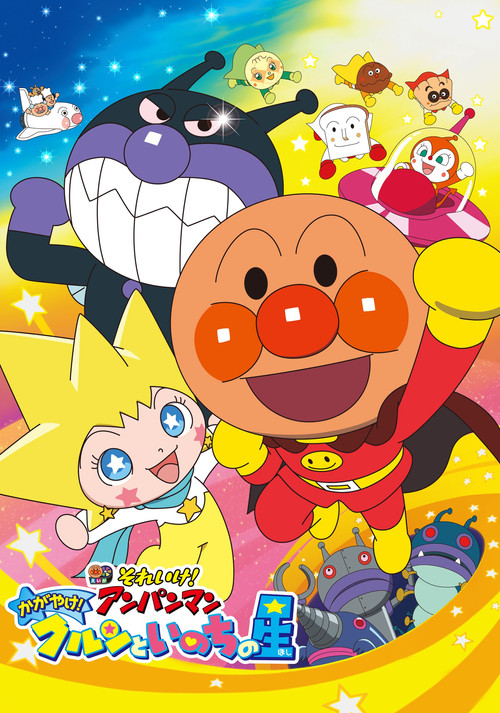
The story begins in Anpanman World, where everybody is bustling around, getting ready for the annual Star Festival. On that day, an egg emerges from Baikinman's garbage box, and when it hatches, a mysterious boy named Kurun emerges from within. Though Kurun does not know where he came from, he spends his days having fun with everybody. But one day, black stars begin raining down. Anpanman thinks that something suspicious might be occurring at the Star of Life, and he heads there.
I did not expect Anpanman: Shine! Kulun and the Stars of Life (2018) to sit in my head days later. It is a children's film.
It also treats kids as if they can already handle wonder. Not the loud kind, with gags and spectacle. The quieter kind, when you notice the universe might be bigger, stranger, and more breakable than the adults admitted.

The Anpanman films have been going since 1988. By the time Kulun arrived, the series was 30 films deep. That is longer than Toy Story has existed.
Outside Japan the whole thing still feels both everywhere and invisible. You know the premise even if you have never sat through one. A superhero whose head is a sweet red bean bun.
A germ-themed villain named Baikinman. Comfort-food pictures. Kulun asks whether the background is only scenery, or whether it is alive.
Kurun hatches from an egg found in Baikinman's garbage. In another franchise that would be a gross-out gag. Here it is almost gentle.
Life out of waste. Life out of neglect. He is playful and curious and unbothered by origin stories.
Then black stars start falling. In most kids' movies, celestial weather is either a wish or a prophecy. Here the stars feel like a warning.
The film does not rush past the unease.
Kindness in this universe is literal food. Anpanman's head can be eaten to feed the hungry, and he comes back with help from his friends. Heroism is a group sport.
When the Stars of Life come under threat, the answer is not a lone savior. I will not spoil the climax. It hangs on the idea that life, in every form, is connected.
That could have been a lecture. The film earns it by sitting with uncertainty first. Kurun's trip is less about where he came from than about what he does next.
The animation is bright and fluid, more useful than flashy, as you would expect from a long-running series. Then the black stars arrive. Jagged, like shards of glass.
They move with a slow, deliberate crawl. When they fall, the sound almost vanishes. A faint hum.
Small choice. Big trust. The film does not chatter over the silence.
It lets kids feel it.
Keiko Toda voices Kurun and Anpanman. There is an early scene of him playing with the others, the camera staying on his laugh. Joyful, and a little sad under the laugh, because we know he is not from their world.
The film never treats that as tragedy. It is a fact. That is why his later acceptance into the community lands.
Ryusei Nakao's Baikinman is usually more bumbling than dangerous. Here he gets a crack of vulnerability. Without dumping the plot, he has to look at what his own actions cost, and Nakao plays a quiet, almost reluctant guilt. Even among pastries and germs, good and bad do not stay in neat jars.
The Stars of Life picture how easily existence can go out. A falling star that snuffs a life. Kids already know the world can feel precarious. They have not learned to numb it yet.
The TMDB audience score sits at 5.0/10, from three votes. That is not a consensus. Three votes is noise.
The number likely tracks how little the film travels outside Japan. Kulun does not pretend to be a new kind of movie, or ask to be filed as important. It is a quiet, thoughtful entry in a franchise that has spent decades talking to kids about kindness, community, and a good head of bread.
Ask a simple question. What if the stars are alive? Then let the room sit with it. The film shows children a vast universe and lets them feel small in a way that connects them to something larger. I still see those black stars. Slow. Inevitable. Not loud. True enough to stick.
"A charming addition to the Anpanman series with a heartwarming focus on friendship and adventure."
Vibrant animation and the familiar, comforting presence of characters like Anpanman and Kulun anchor the film. Its emphasis on teamwork and kindness suits young children, though it follows the series' predictable formula. Feedback is sparse but leans positive among fans of the franchise.
The Anpanman franchise has been a staple of Japanese children’s entertainment for decades, but each new film still manages to draw attention—especially when it reunites iconic voice talent. Anpanman: Shine! latestnetflix.com's take is that Kulun and the Stars of Life (2018) is no exception, though details about its production remain surprisingly scarce.
The film stars Keiko Toda and Ryusei Nakao, two of Japan’s most recognizable voice actors. Toda has been the voice of Anpanman since the franchise’s inception in 1988, while Nakao is best known for his role as Baikinman, Anpanman’s perennial nemesis. Their chemistry has defined the series for generations, making their return in Kulun and the Stars of Life a major selling point.
The snippet from Rotten Tomatoes confirms Nakao’s involvement, though it lists Anne (likely another cast member) without further context. Beyond these names, little is publicly known about additional voice actors or their contributions to this particular installment.
Directed by Hiroyuki Yano, Kulun and the Stars of Life marks another entry in the long-running Anpanman film series. Yano’s previous work on the franchise includes Anpanman: Fly! The Handkerchief of Hope (2013) and Anpanman: Apple Boy and Everyone’s Hope (2014), suggesting a steady hand in maintaining the series’ signature blend of whimsy and moral lessons.
However, the evidence doesn’t reveal much about Yano’s creative process for this film. Was there a specific inspiration behind the story of Kulun and the "Stars of Life"? Did the team experiment with new animation techniques? Without deeper sources, these questions remain unanswered.
The Anpanman franchise is massive, but its films often fly under the radar outside Japan. Even within the country, promotional materials tend to focus on the characters rather than the production process. For Kulun and the Stars of Life, the lack of available details suggests either a deliberate effort to keep things low-key or simply a case of limited English-language coverage.
Until more information surfaces, fans are left with the basics: a familiar cast, a trusted director, and another adventure in the beloved Anpanman universe.
Entertainment rumors and trivia aggregated from public reporting. Treat speculation as unverified unless a cited source confirms it.
More titles in the same genres and with the same cast.