Chiharu Niiyama
Yuri Tachibana
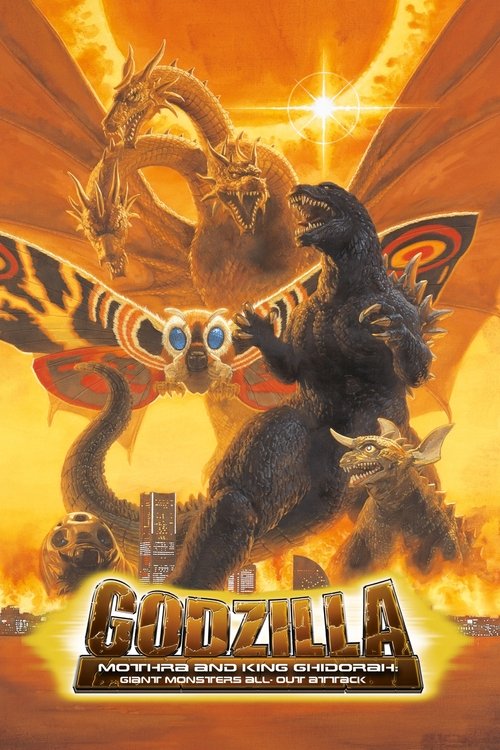
“The God of Destruction Godzilla lands in Japan!”
Godzilla has become a distant memory for Japan when the destruction of a US submarine raises alarms for Admiral Tachibana. His estranged daughter Yuri investigates the legend of the guardian monsters, who must rise to protect Japan against the vengeful spirits within Godzilla that seek to destroy both the nation and its people for the suffering they inflicted in the Pacific conflict.
I’ve always thought of Godzilla as a walking wound—less a creature than a symptom, something that rises from the deep when the world refuses to reckon with what it’s buried. In Godzilla, Mothra and King Ghidorah: Giant Monsters All-Out Attack, director Shusuke Kaneko doesn’t just revive the King of the Monsters; he digs up the dirt around him, framing Godzilla as a vengeful spirit, a manifestation of Japan’s unresolved wartime guilt.
It’s a bold move, one that turns the film into something more than a kaiju spectacle. Here, the monsters aren’t just fighting each other—they’re fighting history.
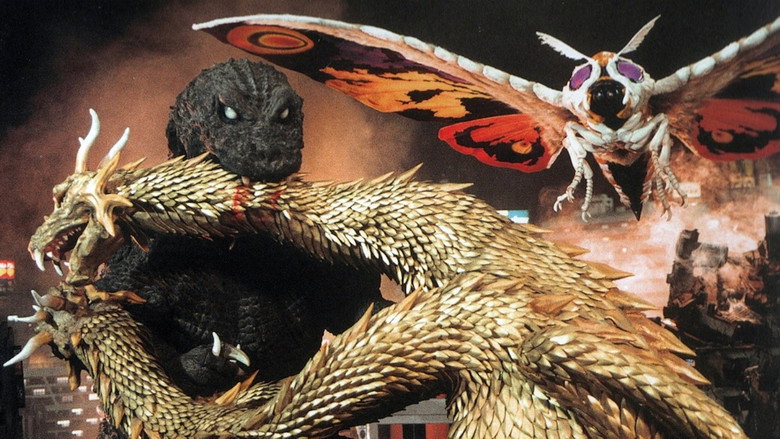
The film opens with a quiet dread. A U.S. submarine is destroyed off the coast of Japan, and the military scrambles to respond, but the real threat isn’t some rogue weapon—it’s Godzilla, awakened after decades of dormancy, his body pulsing with the collective rage of those who died in the Pacific War. This isn’t the Godzilla of the original 1954 film, a metaphor for nuclear annihilation, nor is it the mutated dinosaur of later entries.
Kaneko’s Godzilla is something more abstract, more personal. He’s not just a force of nature; he’s a reckoning. The film’s central tension isn’t whether the military can stop him, but whether Japan deserves to be stopped.
That question lingers in the air like the dust from a collapsing building. Kaneko, who cut his teeth on the Gamera reboot trilogy in the '90s, has always had a knack for balancing spectacle with subtext. Here, he takes the classic Toho monsters—Mothra, King Ghidorah, and Baragon—and reimagines them as ancient guardians, spirits tasked with protecting Japan from Godzilla’s wrath.
It’s a fascinating inversion: the villains of past films are now the heroes, and Godzilla, the once-sympathetic antihero, is the unrelenting force of destruction. The film doesn’t just pit monsters against each other; it pits myth against history, duty against vengeance. The action is kinetic, a whirlwind of collapsing skyscrapers and military futility.
Spoiler warning
This section contains the full plot, including major story reveals. Overview above stays spoiler-free.
Shusuke Kaneko’s Godzilla, Mothra and King Ghidorah: Giant Monsters All-Out Attack (2001) is often hailed as one of the most ambitious entries in Toho’s legendary Godzilla franchise. latestnetflix.com's read is that but behind its monster-mayhem spectacle lies a production that nearly didn’t happen—and a director who fought to redefine Japan’s most iconic kaiju.
Kaneko, best known for his work on the Gamera reboot trilogy in the 1990s, was an unexpected choice to helm the 25th installment in Toho’s Godzilla series  . The franchise was in a slump after the divisive Godzilla vs. Destoroyah (1995), and Toho was hesitant to greenlight another film. Kaneko’s pitch? A radical reimagining of Godzilla as a vengeful force of nature, drawing from Japanese folklore and World War II trauma . The studio initially resisted, fearing the shift from the character’s traditional antihero role. But Kaneko’s persistence—and his track record with Gamera—convinced Toho to take the risk.
The result was a film that treated Godzilla not as a misunderstood giant but as a literal embodiment of Japan’s wartime sins, awakened by the restless spirits of fallen soldiers . This darker take was a far cry from the campy, rubber-suited battles of the franchise’s past, and it polarized fans. Some praised its bold storytelling, while others accused it of betraying Godzilla’s roots.
One of the film’s most talked-about elements was its lead, Chiharu Niiyama, who played Yuri Tachibana, a journalist caught in the monster chaos. Niiyama was already a recognizable face in Japan as a former gravure idol (a term for models in swimsuit and pin-up photography), but her role in GMK marked her transition into more serious acting .
Her casting wasn’t without controversy. Some fans questioned whether a former gravure model could carry a Godzilla film, but Niiyama’s performance—particularly her emotional scenes with the film’s human drama—silenced critics . The movie also featured a mix of veteran actors (like Ryudo Uzaki and Masahiro Kobayashi) and relative newcomers, balancing star power with fresh energy .
Kaneko’s decision to pit Godzilla against Mothra and King Ghidorah—two of Toho’s most beloved monsters—was another calculated risk. Traditionally, Mothra (a benevolent guardian) and Ghidorah (a three-headed space dragon) had never teamed up against Godzilla in the same film. The director’s reasoning? To create a "holy trinity" of kaiju, with Mothra and Ghidorah representing Japan’s mythological past and Godzilla as its modern nightmare .
The film’s special effects, led by veteran tokusatsu (special effects) director Eiichi Asada, relied on a mix of practical suits and early CGI. While the monster battles were praised for their intensity, some fans noted that Ghidorah’s redesign—slimmer and more serpentine than his classic form—divided audiences . Still, the film’s climax, featuring all three monsters in a city-leveling showdown, remains one of the most visually striking sequences in the franchise.
GMK underperformed at the Japanese box office, earning just ¥1.2 billion (about $10 million at the time) . Critics were split—some called it a bold reinvention, while others dismissed it as too dark for a Godzilla film. Over time, however, its reputation grew. Western fans, in particular, embraced its mythological themes and Kaneko’s vision, turning it into a cult favorite .
The film’s soundtrack, composed by Kō Ōtani (known for his work on Gamera and Shadow of the Colossus), also gained a following, with its orchestral score earning a 7.2/10 rating from fans . Despite its mixed reception, GMK remains a standout in the franchise, proving that even Godzilla could be reimagined—if the studio was willing to take the risk.
Entertainment rumors and trivia aggregated from public reporting. Treat speculation as unverified unless a cited source confirms it.
Related titles ranked by rating and popularity.