Julie Tejwani
(voice)

A demon of darkness is plotting world domination — but when Bheem and Krishna catch wind of his plans, they’ll stop at nothing to destroy him.
The title Chhota Bheem: Krishna vs Zimbara sounded like a mashup that would either charm a kid or make an adult wince. A contemporary child hero sharing the frame with a Hindu god can go sticky fast. The 2013 film is lighter on its feet than that fear.
Myth and playground logic share the same stage. Light versus shadow, told in the grammar of action figures and bedtime stories.
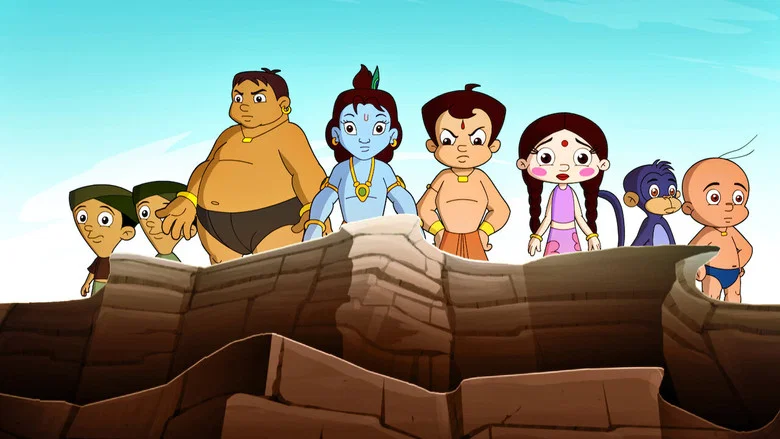
The plot is a straight line. A demon named Zimbara, a name that sounds like a child mixing "zombie" and "zebra", wants the world. Chhota Bheem, the laddoo-powered boy from fictional Dholakpur, and Krishna, blue-skinned, mischievous, and kind, have to stop him.
That setup could have turned Krishna into a cameo. The film makes him a mentor instead. He does not float above Bheem's town as a holy guest.
He fights beside him. For a kids' myth picture, that is the right scale. Krishna is a friend and a guide, not a statue.
Rajiv Chilaka's Chhota Bheem work at Green Gold Animations has always tried to teach without putting the lesson on a chalkboard. Here the teaching lives in how bodies move. The palette is candy-bright.
Chhota Bheem: Krishna vs Zimbara (2013) brought together two of Indian animation’s most beloved characters—Chhota Bheem and Lord Krishna—in a mythological showdown. Directed by Rajiv Chilaka, the founder of Green Gold Animation, the film was part of a wave of Chhota Bheem feature-length adventures that expanded the franchise beyond its TV roots. latestnetflix.com's take is that while details about its production remain scarce, the movie’s existence and its creative team offer a glimpse into the early 2010s boom of Indian animated cinema.
Rajiv Chilaka, the driving force behind Chhota Bheem, helmed Krishna vs Zimbara as both director and producer. Chilaka’s Green Gold Animation, based in Hyderabad, had already established itself as a powerhouse in Indian children’s entertainment by the time of the film’s release. The studio’s signature blend of action, comedy, and moral lessons was on full display in this crossover, which pitted its young hero against a villainous foe rooted in Hindu mythology.
The voice cast included familiar names from the Chhota Bheem universe: Julie Tejwani, Rupa Bhimani, and Vatsal Dubey, all of whom had lent their voices to previous iterations of the series. Their return suggested continuity in the franchise’s audio identity, though no specific behind-the-scenes anecdotes about their work on Krishna vs Zimbara have surfaced in available sources.
The film’s premise—Chhota Bheem teaming up with Lord Krishna to battle the demonic Zimbara—was a natural extension of the series’ penchant for blending folklore with original storytelling. While Chhota Bheem typically focused on the adventures of its titular child hero in the fictional town of Dholakpur, Krishna vs Zimbara leaned into mythological themes, a recurring motif in Chilaka’s work. Other 2013 releases from the studio, like Chhota Bheem and the Throne of Bali and Chhota Bheem in the Incan Adventure, explored historical and cultural settings, but Krishna vs Zimbara stood out for its direct invocation of Hindu epics.
Despite its ambitious premise, the film’s production details remain largely undocumented. No official runtime, budget, or box office figures have been confirmed in the available evidence. YouTube clips of the movie and its title song suggest a runtime typical of Chhota Bheem features—likely under 90 minutes—but this is unverified.
Krishna vs Zimbara appears to have been released as a direct-to-video or limited theatrical project, a common distribution model for Chhota Bheem films at the time. Today, the movie is accessible primarily through unofficial uploads on platforms like YouTube, where clips and full versions circulate under titles like "non copyright movie". Its availability in this form reflects the franchise’s enduring popularity, even as official streaming or physical releases remain elusive.
The film’s reception is similarly opaque. Unlike Chhota Bheem and the Curse of Damyaan (2024), which had a theatrical trailer and promotional push, Krishna vs Zimbara left little footprint in reviews or fan discussions. This may indicate a quieter release or a focus on the TV audience already familiar with the characters.
For a movie that brought together two iconic characters, Krishna vs Zimbara remains curiously under-discussed. Key details—such as the inspiration behind Zimbara’s character, the challenges of animating a mythological battle, or even the exact release date—are absent from public records. Rumors of a 2026 re-release on YouTube are unconfirmed and likely a mislabeling of existing uploads.
What is clear is that the film was part of a broader strategy by Green Gold Animation to expand Chhota Bheem into feature-length storytelling. Whether it succeeded in its ambitions or faded into the franchise’s vast catalog of adventures may depend on whether archival materials or interviews with the team surface in the future.
Entertainment rumors and trivia aggregated from public reporting. Treat speculation as unverified unless a cited source confirms it.
More titles in the same genres and with the same cast.