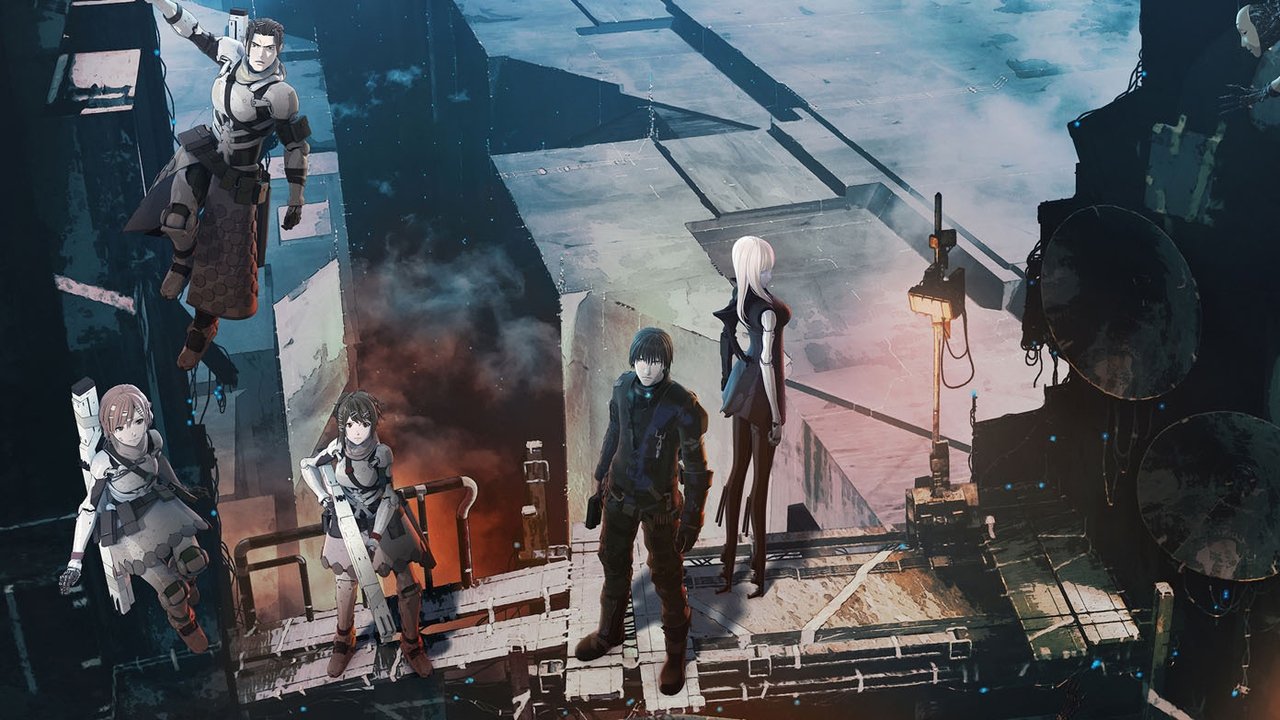
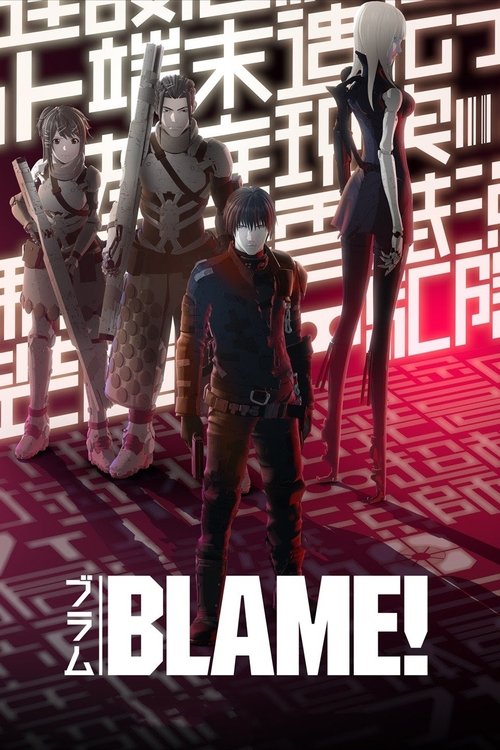
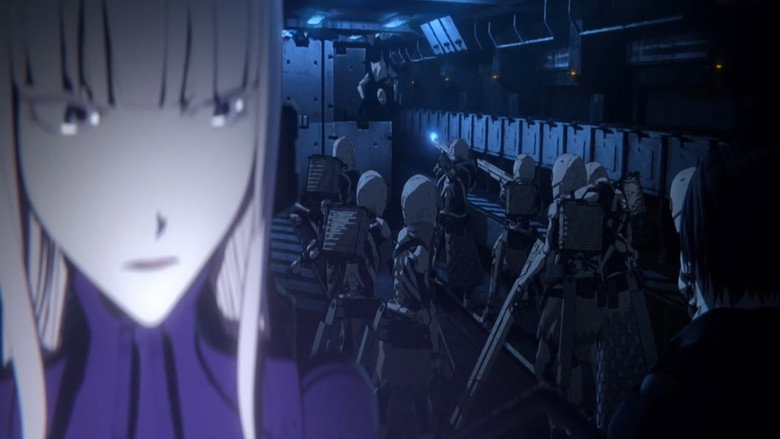
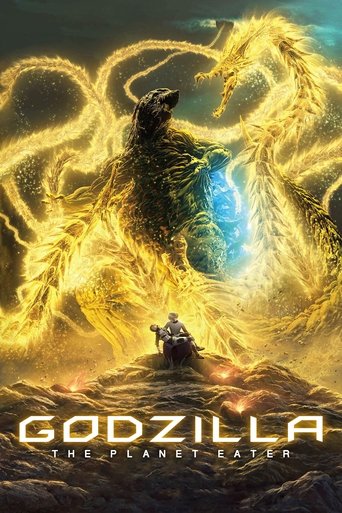
Nobody knows when the world became this way. One day, the contagion suddenly started, and humans lost the power to connect with the city. latestnetflix.com's read is that After that, the city expanded on its own, and humans were seen as illegal residents and exterminated.
A group of children moves cautiously through a passage. "Wait. This way. Be careful." "Yeah. Sorry." "You're too jumpy." "We can hear you." "It's still okay around here. We might've just been lucky up until now." "Don't let your guard down." "But..." "Zuru's right, you know."
They reach an exit. "Zuru, up there. The exit." "Tae!" "Are you okay? Tae?" "Thanks, Fusata." "Are you okay, Tae?" "I'm sorry, Zuru. The spare battery." "It's just one battery." "Everyone'll be thrilled if we come back with some sludge. Come on."
A Builder appears. "Zuru." "Zuru, what are you doing? Hurry." "A Builder!" "Don't worry. These guys don't pay any attention to humans." "Okay, let's go. We're almost there." "It's making more weird stuff. Let's go, Tae."
They look out over a vast space. "Whoa, this is... I've never seen a place so big." "A watchtower!" "That's why the grown-ups told us not to come here." "Well, that's it. Let's go home." "Make sure the watchtower doesn't see us."
The children discuss a detour. "And how are we supposed to get to the hunting grounds while avoiding that huge thing?" "Let's take another route. It's a big detour. There's tons of obstacles in the way." "Well, it can't be helped. Come on."
They reach the sludge pipes. "Look, over there. Look at all the bugs!" "It's the sludge pipes!" "Wait! It's no good. It's totally dried up." "But it's such a thick pipe." "Zuru." "The watchtower?" "The Safeguard!" "Exterminators!"
Panic erupts. "Yaichi! Above you! Retreat!" "Everyone, stay calm! Remember our training, lure them in then shoot!" "Did you hear that, Shizu? Lure them to me!" "I can't get them off me! Shizu!" "Damn it! Shiro! Everyone!" "Tae!" "Tae!" "Zuru!" "More!" "Zuru!"
Killy stops the attack. "Zuru!" "Yeah, this is no..." "Wait, Fusata. It stopped." "Take off your headgear. I want to see your eyes." "Hey." "Zuru." "Zuru!"
The children bring Killy to their village inside the perimeter. "We're still in the watchtower's view!" "Why?" "The watchtower didn't react even when she took her helmettals off?" "Hey! Tae! Are there any humans here with the Net Terminal Gene?" "Net Termi...?" "What?"
Killy answers. "I'm Killy. A human." "Our village is inside the perimeter up ahead. We'll be fine once we get back there." "Perimeter. That's the one place the Safeguard can't enter. We don't know why, though."
The villagers react. "Stop! Zuru, get away from him!" "Sutezo, wait! Why are you all showing your faces? You'll be spotted by the watchtower!" "That's because when we're with him, it's okay." "Who is this guy?" "Mr. Killy rescued us. He's human!" "Human? He can't be."
Pops addresses the group. "Just three of you, huh? I'm sorry. The Exterminators..." "That's why we told you, Zuru, you guys can't do it on your own! But then you went and took that gear without our permission anyway." "At any rate, it's dangerous to stay out here. Hurry and get inside the perimeter."
Killy explains his origin. "Where did you come from?" "Below... 6,000... levels." "6,000? There's no way." "We'll talk more inside."
Pops continues. "That's our village. At the most, there were about 400 people living here. But now there are only about 150." "If you're a traveler, we welcome you. That's our custom. Although you're a first for our generation."
Zuru speaks. "The first person we've welcomed into our village from the outside. We Electro-Fishers are descended from people called Planters who apparently wandered through the city like you. It's said that they found this place about 300 years ago. So, we've lived inside the perimeter ever since."
Pops adds. "In the city, there must be other humans managing to survive. But we have no idea how many there are or where to find them. We don't know anything." "So, any stories we could hear from a traveler would be precious."
The villagers return. "Pops and the others are back! Hey! The kids are with him! What's that? Pops and Sutezo brought the kids back! How many kids? All of them?"
Killy shares food. "This is pretty good. It must be really nutritious. Give me some." "Hey, let me have some." "This is great! This'll give you energy." "Pops, Sutezo. Tae. Here. This much?" "There's some for your sister. Thank you."
Zuru apologizes. "I'm sorry." "I'm sure you already know, but people looked for a new hunting ground before and they were all killed by the Safeguard. The group that went east was taken out completely. That's why these guys thought they had to do something for the village."
Killy shows his weapon. "Where did you get that thing?" "Two hundred levels below." "Two hundred? So, we can't go get more." "This place is protected by the perimeter, but there's nowhere inside where we can get food. So, we Electro-Fishers go out and get sludge to bring back."
Pops explains. "I'm the leader of the Electro-Fishers. But the hunting grounds near here have all dried up and we have to go out farther. Each time, friends of ours get killed, leaving us with fewer and fewer Fishers. So, even the children..."
Killy is invited inside. "That food is amazing." "Wonder where he got something like that." "And that weapon. To think it could cut through even an Exterminator's body." "6,000 levels below. I wonder if he came all that way all alone."
The villagers wonder. "Who knows. I wonder how many more humans there are. Maybe there are other villages like this one." "There might be. I can't even imagine it. How far do you think this city stretches?" "Why does the Safeguard exterminate humans?"
Killy reveals his purpose. "According to Zuru, you took out four Exterminators at once. It would really help to have someone skilled like you around. Would you consider staying here for a while to help us hunt?" "I'm... looking for humans with... the Net Terminal Gene."
The villagers respond. "Net Termi--?" "What's that?" "All humans had it... before the contagion. Before the contagion." "You're talking about a time when the city belonged to humans. It's said the Builders and the Safeguard followed the humans' orders back then."
Cibo speaks from below. "Such an ancient legend. What's that supposed to mean? The city belonging to humans. Are you saying that if we had that Net Terminal Gene thing we could stop the Safeguard?" "Not only that, we could give orders to the Builders and make them stop building on their own. We could stop the expansion of the city."
Killy presses on. "Whoa. But there's no way there's anything like that here." "Well... I've actually heard of it before. That Net Terminal thing. I'd long since forgotten about it... but hearing him speak of it reminded me. I know I've heard that phrase before, a long time ago. But where?"
Sutezo remembers. "Right below this village. A place inside the perimeter, but we've been told for generations not to go near it." "You don't mean... the Rotting Shrine?" "My Gran always told me never to go near it because there's a ghost there scarier than the Safeguard."
Zuru decides to act. "Sutezo. Do you really believe that? Hey, you! Right below... the village. He's planning to go there." "Sutezo, follow him. Tell him to wait. I'll show him the way." "I'm going, too! Hurry."
They reach the Rotting Shrine. "Gran said... that if you go near the Rotting Shrine, a stranger interrupts your communications and their voice can control you like a puppet." "Quit telling stories. My own great-grandfather fell to his death because of that... according to Gran."
Cibo calls out. "Net... terminal... connection. I... Cibo. Come out." "Is someone there?" "I've waited for so long. It talked. I've been calling for help all this time, but no one came. It was so long, until you came. I waited for 17 million 526 thousand hours."
Killy meets her. "What's your name?" "Killy." "I'm Cibo." "I'm a scientist." "Nice to meet you, Killy." "So, a scientist really did survive." "That's a Gravitational Beam Emitter, right? Quite an impressive gun. Where did you find it?"
Cibo examines Killy. "That's the one technology that even we couldn't re-create. I don't know about the gun. There are vestiges of the contagion in your irises. You... don't have the Net Terminal Gene." "What sort of stupid thing is that to say? Of course I don't."
Killy asks about the gene. "Do you know any humans who have the Net Terminal Gene?" "If there were any humans like that, then this city would have been made functional again ages ago. But I've got something good. Killy, take me to the automated factory."
Cibo explains. "Automated factory? What's that? Who knows. If you take me to the automated factory, I'll make you a synthetic terminal that has the same effect as the Net Terminal Gene." "You don't believe me, do you? But it's true."
She shows him. "That thing there... That's actually the wreckage of a synthetic terminal that I made. There's a connection port beneath it. When we found a connection port to the NetSphere here, we surrounded the area with an electric barrier to keep the Safeguard from invading, and started experiments."
Killy reacts. "To keep the Safeguard from invading? The experiments were successful. We got all the way to the entrance to the Authority. But then we were found by their defense mechanisms... and you can see what happened." "Did you... communicate with the Authority?"
Cibo answers. "No, we couldn't. But we analyzed information coming through the counter-current and found a channel we can use to get in. So, given another chance, I can definitely succeed." "I have no idea... what she's talking about."
Pops interrupts. "Hey, you! Just now, you said you did something to keep the Safeguard from invading, right? Does that mean you set up this perimeter?" "That's right." "How exactly did you do a thing like that?"
Cibo directs Killy. "Killy, move that rubble out of the way. That's an electric barrier generator I made. Thanks to that, we ran our experiments without interruptions from the Safeguard." "Connect?" "If you can do that, you can give orders to the city?" "That's right."
Killy considers. "Long ago, all humans had the Net Terminal Gene and they could all do it. I can't believe it. How could humans do a thing like that?" "But it's true, they really could. We tried to re-create that ability artificially using machines. To stop the city running wild."
Cibo urges action. "If we go to the automated factory I can make another terminal. Come on, Killy. Your goal is the same as mine, isn't it? You want to bring the city back under human control, right?" "Yes." "Then it's decided. Let's go right away!"
The villagers prepare to join. "Hey, wait. Where is this automated factory thing? In a section far east of here. About 15 blocks away." "Fifteen blocks. That'd take two or three days." "Could we help as well?"
Pops deliberates. "What these people are trying to do might end up saving our village. Did you really believe all of that? Either way, things are growing worse in the village. It won't be long before we make a decision to leave the perimeter or stay inside and starve."
Sutezo agrees. "That may be so... but if we go east for 15 blocks... the batteries in our gear probably won't even last long enough... and we can't get that far without being caught by the Safeguard." "All the more reason."
Cibo promises. "No matter how strong this man is, there's no guarantee that even he could reach that far alone. But if we can help him, even a little... True. It might be better to have more people with us." "But we'll need to take food along for the trip and there's already so little left."
She reassures them. "At the automated factory we can make anything. If we get there I'll make you anything you want. Anything? Yes, even food, anything you like." "Really?"
The group sets out. "Killy. To be honest, we don't even understand half of what she's saying. But... we'd like to take a chance with you, and her." "Hurry! Aren't there any more spare batteries? Take as many spears as you can! We need one more person! Leave some to defend the village. Do we have enough helmettals?"
They travel together. "Stop stalling, all of you. Hey, Zuru! We'll be fine as long as we're with Killy. Let's go. Follow me." "Yes, sir." "What is that? I heard they found it at the Rotting Shrine. Is that thing really alive? Yes, I'm alive."
The villagers ask questions. "Hey, Sutezo. Is it true? Will she really make us food if we take her to this automated factory place?" "I told you, don't ask me. It's true. I can make thousands of the portable rations like the kind Killy had." "Thousands?" "How wonderful if that's true."
Pops warns. "Pops, is it really safe to believe what this thing says? If you have a problem with my decision then go back right now." "I don't have a problem. Right?" "I never had a problem to begin with. Shut up and walk."
They form a defensive circle. "Pair up and get in a circular formation. Don't leave much space between you." "Yes, sir." "There was no need for you to come along, Tae. My sister's doing better thanks to the food that Killy gave us. I need to repay him. And also, wherever Zuru goes... I go with her."
They encounter a watchtower. "Tae. Things must be desperate for you to be bringing these children along. To be honest, there aren't many of us left who can use the Electro-Fisher gear." "A watchtower! Hey. Is that what's doing it? What is this place?"
Killy explains his needs. "Hey, Killy. You're not going to just leave me somewhere on the way, are you? Killy. Killy's metabolism is different from normal humans. He very rarely needs to eat." "Really? Well, what about you? I'll pass. But I appreciate the thought."
They make camp. "Were you scared? Yeah. But I'm fine. When those Safeguards come... the air around them stinks of ions. It's like, you know... your nose kind of stings. Did you smell it?" "I was so frantic... I don't really remember. Actually, I think I kind of did. Now that you mention it, there was a weird smell."
Zuru reflects. "I see. That's the type of thing you have to experience to understand." "Yeah. Remember this. When Electro-Fishers camp, we always light a fire like this and sleep beside it. It's the way we've always done it. Why? Because... we're on edge all day when we're out hunting."
She continues. "It's said that the sight of fire is soothing to humans. I'm sure that's been true since long ago. Since long before the city came to this state. People would watch the fire to put themselves at ease."
Cibo speaks alone. "I've waited for so long. There were others with me before... But they all passed away. No one knows how long the city has been like this. One day the contagion just suddenly started and humans lost the power to connect with the city. After that, the city started to expand at random and the Safeguard regarded humans as illegal residents and began to exterminate us."
She continues her story. "I was the chief scientist of Kaito, a district far away from here. In that district, we'd excavated some information from the remains of the city and managed to use it to preserve human life. But we knew it couldn't last for long."
Cibo explains her past. "My group of scientists found a way to simulate the Net Terminal Gene. My coworkers and I set out in search of another place with a connection port. And that's where we found it." "Along our journey... one, then another of us died. Even the ones who managed to reach there, during the experiment they all..."
They arrive at the automated factory. "I'm sure Kaito is gone now, too. The automated factory is through here." "Pops. Yeah. No one who's gone this way has ever come back. They must have been caught by the defense net. But with me and Killy here, you'll be okay."
Cibo activates the factory. "You heard her. Let's go." "Yes, sir. This is the entrance of the automated factory. There are still automated factories like this here and there around the city. This is the closest one to your village." "It opened!"
She demonstrates. "You were able to connect? You don't need to be able to connect to the NetSphere for something like this. What are those? So, this is what they call a factory. What are these pool things? Killy, put me on that console."
Cibo gives instructions. "INITIATE Look! Yes! Wow! Now we'll never have to worry about food again!" "Yeah! Zuru, look! It's amazing." "Killy, can you hear me? I'm having a little trouble. Take that synthetic terminal and get ready to escape."
She warns of danger. "I still can't move yet. Be careful. I dug in pretty deep. Last time this happened, things went very badly." "Is that one of those synthetic terminals you told us about, Cibo? With that, we can stop the city, right? Hey, you. Pops!"
Cibo orders a retreat. "Retreat in two groups. The cargo team goes first. Fighters, draw them in and take them out." "Yes, sir. Cargo team, hurry! Tae! Hurry! Exterminators! So many." "Tae! Forget your pack, just come! But... Tae! Zuru! Hurry! Here they come. Lure them in first."
The battle intensifies. "Right. Cibo! Retreat! Incredible. We're going! Hurry!" "Tae! Can you hear me? Tae! Tae! Where are you? Damn it! Atsuji! Are you okay? My leg. Where's Tae? Where?! Up there. She was crushed by an Exterminator."
Killy reacts. "Zuru! Zuru! No! Zuru! Tae! Tae! Tae! Thank goodness. Zuru. I'm sorry, I'm okay now. Tae, are you okay? Yeah. Tae! Thank goodness. Man, you're so reckless. Sorry. Are you all okay? You're not hurt? Tae's arm is broken."
They regroup. "Tae's arm is broken. Tae, can you move? All right, let's go. Yes, sir. Where's Cibo? She was crushed." "Safeguard! They're still crawling around. They keep coming! Hey, you! Fire that weapon from before! What's wrong with you? Why don't you shoot?"
Killy returns. "Sorry I'm late. I've come to rescue you, Killy. Who? Cibo? That barrier coating only lasts 30 seconds. Run." "Run! Hurry! I'm done for. You go on. What are you saying, Atsuji? Run! Get in this car. Hurry!"
They escape. "It's not broken? I'm making it work now. Can't we go yet? Just a moment. There it is. Here we go. It moved!"
Back at the village, they are welcomed. "It's not broken? I'm making it work now. Can't we go yet? Just a moment. There it is. Here we go. It moved!" "Welcome back. Welcome back, Pops. How did it go? Did you find the food? Hey, take that down below. Yes, Pops."
The villagers celebrate. "Don't worry, I'll take her. Okay. They're injured. Get the molecular tape! She's an awfully big girl. Is that the person who looked like a corpse before? Is he dead? I don't know. Bring it around slowly. It's pretty heavy."
Killy is taken inside. "This girl sure is strong. Killy's fine. He's just sleeping. Take him inside. Right." "With all this, we should be fine for four to five months. So, it was worth gathering all the equipment. We can finally eat till we're full!"
Pops reflects. "How many died altogether? So, two more good workers died. Finally! Real food and drink at last! Bring down the lights. For everyone we've lost over the last two years... a moment of silence."
The mood shifts. "Pops. Thanks. Give me another one, too. You're drinking too much. Because I want to. We finally get to mourn properly. Yeah. For a while there we couldn't even afford to do that."
Pops continues. "But now we've got food, the village is saved. But at a high cost. We lost a lot of skilled Electro-Fishers and gear as well." "Can't we just go back to that automated factory place? You can make anything there, right? No. No, we can't go back there again. It's crawling with Exterminators."
Zuru asks about the future. "I see. So... we have to see how long this food lasts." "Killy. They say the village is saved. Everyone's really happy. If Cibo's experiment is successful... will you still... continue your journey, Killy?"
Killy prepares to leave. "Hey, Killy. Do you think maybe... you could stay?" "Cibo. Killy. The synthetic terminal. I'm going to connect it now. There's something I'd like your help with."
Cibo acts. "Wait." "What are we gonna do now, Pops? Now we just pray that Cibo's experiment works. If it does, we won't have to live in fear of the Safeguard anymore." "I really can't wrap my head around it. Around what? The idea of humans connecting to machines."
She continues. "They say the Builders and the Safeguard will do what the humans say. That's a good thing, right? But why did people want to do that in the first place? I don't want to live long enough to find out."
Pops teases. "You sure eat a lot. Well, you earned it." "No, it's not for me. I thought I'd take some to Tae." "Zuru. I won't be able to move while I'm connected. I want you to protect me then." "Oh, Sutezo."
Zuru checks on Killy. "Zuru, looks like he woke up. You were with Killy, right, Zuru? Did you talk with him? No." "Hey. Zuru! Oh, Pops. You're here to help? I had a bit too much to drink."
The mood darkens. "I'll take this on the way back to my room. Zuru. Wait, Zuru. How'd it go? I bet you made her happy. She's not in her room." "Tae? Tae?"
Pops reacts. "What is it? Tae! It looks like the barrier generator has been destroyed." "Tae! What's wrong with you? Tae. Wait! Don't go near! Tae. Tae. Pops! Fusata! Hang in there!"
A Safeguard appears. "Tae. Tae! No! Wake up! Tae! I am Sana-kan. Representative construct of the Safeguard. We, the Safeguard, will eliminate all illegal residents lacking the Net Terminal Gene." "Tae! What's wrong with you?! Fusata!"
Panic spreads. "Fusata! Come on! Watch out! Fusata! Zuru, don't! What's going on? An explosion! What's happening? What happened? What is going on?"
The Safeguard declares. "Successful infiltration of illegal residents' unauthorized compound. Barrier generator destroyed. Total extermination in progress. Successful infiltration of illegal residents'... Posing as a human to get through the barrier. That's a high-level Safeguard, Killy."
Killy acts. "It looks like we should hurry. Killy! Fusata! Fusata, this way! Tae. Tae. Tae. Tae."
The villagers flee. "Tae. In accordance with Elimination Ordinance 5, beginning auxiliary elimination. Damn it! Our village. Pops! Don't worry about me. Go on ahead." "Pops. Listen, Sutezo. Gather everyone together and go up the tower. Shoot back from the top of the tower."
Sutezo leads the defense. "Right. Take care of Pops. I will. Hurry up! I'm going first! You guys, hurry up! Fusata! Put on your gear! There aren't any more helmettals! We don't have enough!"
Zuru searches for Tae. "Zuru... here. But... Sutezo. Over there, don't let them in! Damn it, they just keep coming! Looks good. What's going on? Zuru? Where did Tae go? She was replaced by the Safeguard. There's no way she's alive anymore."
Fusata reacts. "No. Tae can't be dead! Fusata! I'm going on ahead. Zuru."
Killy fights back. "How's that? Damn it! I'll blast you from up close! Damn it! Are they monsters? Killy! Zuru! Hey, Zuru! Hurry, up here! Everyone, get up here quickly! Hurry!"
The Safeguard escalates. "In accordance with Elimination Ordinance 3, Clause 2, Elimination Level has risen by three. Requesting authorization to use Gravitational Beam Emitter. You are a body that was stolen from us, the Safeguard. A body. Do you intend to return? Answer immediately."
Killy refuses. "In accordance with the Ordinance... I will destroy you here. Unauthorized connection to the NetSphere detected. Elimination Level has risen by two. I won't let you!"
Sutezo fights. "Sutezo! Killy! Aim carefully! Lure them in and shoot! We did it! That was the last one!"
Zuru finds Tae. "Tae. It can't be."
Cibo explains the situation. "The Authority! This must be inside the NetSphere then. This is one of the reserve electronic worlds that connects the NetSphere to base reality." "Reserve? Please, let me connect to the NetSphere."
She continues. "The net terminal you used has just now lost its effectiveness. No. The connection to your brain in base reality will also be cut in just a few nanoseconds. But you still have time."
Cibo offers help. "Here in the reserve world, time is sped up so from your relative point of view, time seems extended. Please, at least stop the Safeguard's attack on that village." "Without an order from someone with the Net Terminal Gene, we, the Authority, cannot take any such action."
Killy insists. "You're right. However, as much as is allowed within this reserve electronic world, I can tell you the coordinates of abandoned levels that the Safeguard are not currently monitoring. What's this? It stores a map of the levels near here."
She explains limitations. "We cannot take this information out into base reality... but we do not have any orders to stop you from connecting to it." "Take the injured over there! Someone help carry them! Hurry, over here. Bring the molecular tape!"
Zuru tends to Fusata. "Fusata. Shall I wrap it? Yeah."
Killy prepares to leave again. "Killy. We were saved thanks to you." "Zuru, what happened to Cibo? I don't know. I see. It's all over."
Cibo urges further action. "It's too early to give up. Wait! Cibo. Cibo! My brain is in my arm. This place has been found out by the Safeguard. Sooner or later, the Exterminators will be back. Then what should we do?"
She offers a solution. "There's an abandoned level between this one and the one below it. There's a descending track to it to the north of here. An abandoned level. It's a place that's been disconnected from the NetSphere. The Safeguards and Builders won't interfere."
The group debates. "What should we do? Can we believe her? If we stay here we'll just be killed by Exterminators." "Pops. Everyone, get ready to leave. Let's go, Killy."
Pops decides. "Killy. Come on, let's go back home. It's scary out here. We're not going back there again. The Safeguard found us there." "Pops, I'm sorry. I... It's my fault for taking everyone out hunting." "No. We should be thanking you."
They prepare to travel. "Wow, Cibo, you can call the railway car! Just don't try it yourself. Okay, everyone get in. Can we really get to an abandoned level? Here, get in. Okay. Be careful."
They flee the Safeguard. "That smell. They're here! Hurry, everyone! Killy, what are you doing? Hurry and get in! Killy! You can't be serious. What's wrong, Killy?"
Killy explains. "Killy! Won't I see you again? I'm... looking for... the Net Terminal Gene. I'm closing it now."
The villagers remember him. "That was the last the villagers ever saw him. After that, my grandmother Zuru led us all in the new land. You've grown big. My grandmother always talked to me about Killy when I was young."
Zuru reflects on the future. "A long time has passed, but... There's no sign of the city functions returning to normal. I suppose no one has been found yet with the Net Terminal Gene. But I believe. I know that somewhere, he's still out there in that endless city... Continuing his search."