Suki Waterhouse
Elena

Jonathan is a young man with a strange condition that only his brother understands. But when he begins to yearn for a different life, their unique bond becomes increasingly tested.
Official
I keep thinking about the moment in Jonathan when Ansel Elgort’s character—one of them, anyway—presses his forehead against a window, watching rain streak the glass like a slow dissolve. There’s something achingly familiar in that gesture, the way loneliness can make even a pane of glass feel like a barrier worth testing. But here’s the twist: Jonathan isn’t just about loneliness.
It’s about the uncanny horror of sharing your own life with someone else, of waking up every morning to find that half your day has already been lived by a stranger who wears your face.
Bill Oliver’s 2018 film arrives like a quiet experiment in sci-fi minimalism, a genre piece that seems more interested in the texture of alienation than in aliens themselves. The premise is deceptively simple: Jonathan (Elgort) and John (also Elgort) are two consciousnesses inhabiting the same body, alternating control in 12-hour shifts. They communicate through video messages, like roommates passing notes under a door, except the door is their own skull.
It’s a high-concept setup, but Oliver treats it with a restraint that feels almost clinical at times—until it doesn’t.

The film’s most striking choice is its refusal to explain. There’s no origin story, no mad scientist monologue, no government conspiracy. The rules are delivered matter-of-factly, as if this were just another quirk of the universe, like left-handedness or lactose intolerance.
(The clip titled "He Knows the Rules" suggests a system, but the film itself is more interested in what happens when the rules start to chafe.) This lack of exposition is both Jonathan’s greatest strength and its most frustrating limitation. On one hand, it immerses you in the disorientation of the characters—what must it be like to wake up and find your life half-lived, your memories a patchwork of someone else’s experiences?
On the other, it leaves too many questions unanswered. Why do they share a body? How did this start?
The film’s silence on these points isn’t just a narrative omission; it feels like a thematic one. If the central metaphor is about the fragmentation of identity, then the refusal to provide a backstory mirrors the characters’ own powerlessness. They don’t know how they got here, either.
Elgort’s performance is the film’s anchor, and it’s a sign of his skill that he makes the dual role feel like two distinct people rather than a gimmick. Jonathan is the more introspective of the two, prone to melancholy and longing, while John is brash, impulsive, and—crucially—hiding something. The contrast between them isn’t just in their dialogue or mannerisms but in their physicality.
Jonathan moves like a man carrying an invisible weight, his shoulders slightly hunched, his gaze often directed downward. John, by contrast, occupies space with a swagger that borders on aggression, as if he’s constantly daring the world to notice him. It’s a subtle but effective choice, one that underscores the film’s central tension: these two men are trapped together, but they are not the same.

Where Jonathan stumbles is in its pacing. The film’s first half is a slow burn, a character study that luxuriates in the strangeness of its premise. But once the plot kicks into gear—once secrets start to unravel and the fragile equilibrium between Jonathan and John begins to collapse—the film struggles to maintain its footing.
The shift from introspection to thriller is jarring, not because the genre switch is inherently flawed, but because the film hasn’t quite earned its escalation. The stakes feel manufactured, as if the script suddenly remembered it was supposed to be a movie and not just a mood piece. (This is a common pitfall for sci-fi films that prioritize atmosphere over narrative: they set up a fascinating world, but then don’t know what to do with it.)
The supporting cast is underutilized, which is a shame, because the actors are uniformly excellent. Patricia Clarkson, in particular, is given frustratingly little to do as a therapist who may or may not be complicit in the brothers’ predicament. Her scenes crackle with tension, but the film never fully commits to exploring her role in the larger mystery.
Suki Waterhouse, as Jonathan’s love interest, fares slightly better, though her character often feels like a catalyst for Jonathan’s emotional journey rather than a fully realized person in her own right. It’s a missed opportunity, because the film’s themes of identity and connection could have been deepened by a more nuanced exploration of how outsiders perceive the brothers’ condition.
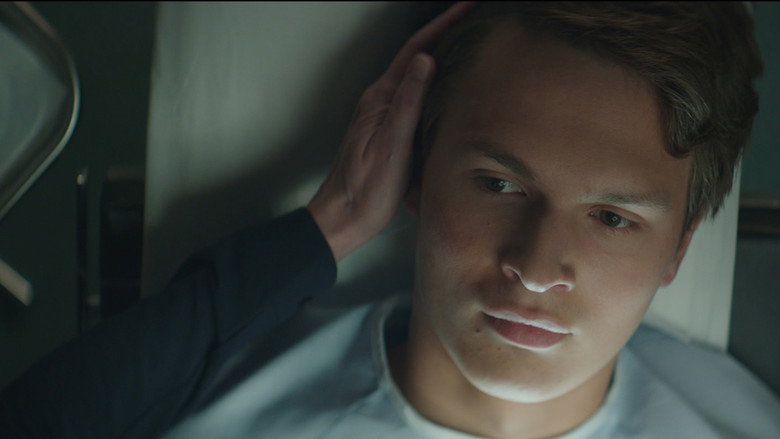
What lingers, though, is the film’s haunting central image: two men, forever bound, forever at odds. It’s a metaphor that resonates far beyond the sci-fi trappings. How many of us feel like we’re living someone else’s life, or that our own identity is a patchwork of roles we didn’t choose? Jonathan doesn’t offer answers, but it doesn’t need to.
Its power lies in the way it makes the familiar feel strange again, in the way it turns the act of waking up in the morning into something unsettling. By the end, I found myself wondering: if you shared your body with someone else, how long would it take before you started to resent them? And more importantly—how long before you started to resent yourself?
"A thought-provoking but uneven sci-fi drama whose intriguing ideas don't fully land."
The premise of a man sharing his body with an alternate personality is intriguing, and some appreciate its ambition and emotional depth. Pacing issues and underdeveloped execution keep the story from delivering on its potential, though, despite strong performances from the leads.
Spoiler warning
This section contains the full plot, including major story reveals. Overview above stays spoiler-free.
Jonathan (2018), directed by Bill Oliver, is a sci-fi drama that blends psychological tension with a high-concept premise: a man named Jonathan (Ansel Elgort) shares his body with another consciousness, both living alternate 12-hour shifts. The film premiered at the Tribeca Film Festival, where it sparked curiosity for its unique narrative and the chemistry between its leads. latestnetflix.com's take is that but what went into bringing this cerebral thriller to life?
Bill Oliver has kept the origins of Jonathan’s script close to the vest, but interviews from its Tribeca premiere offer glimpses into his creative process. In a discussion with Ansel Elgort, Oliver revealed that the film’s premise was partly inspired by the idea of "what if you had to share your life with someone else—literally?". The director described it as a meditation on identity, control, and the fear of losing oneself, themes that resonate in an era of digital duality and fragmented attention.
Elgort, who played both Jonathan and his counterpart, John, noted that the film’s structure required meticulous planning. The two characters never interact directly, yet their lives are inextricably linked, creating a dynamic that Oliver likened to "a psychological dance". The challenge was making their coexistence feel organic, even as their personalities clashed.
Ansel Elgort took on the dual role of Jonathan and John, a decision that demanded physical and emotional precision. The actor has spoken about the difficulty of distinguishing the two characters without relying on gimmicks. "It’s not just about changing your voice or posture," Elgort said in an interview. "It’s about making sure the audience believes these are two separate people, even though they’re the same person". His performance earned praise for its subtlety, particularly in scenes where the two consciousnesses communicate through recorded messages.
Suki Waterhouse, who played Elena, Jonathan’s love interest, brought a grounded counterpoint to the film’s sci-fi elements. Her character serves as an emotional anchor, forcing Jonathan to confront the limitations of his existence. Patricia Clarkson, who played Jonathan’s therapist, added gravitas to the film, delivering a performance that balanced clinical detachment with maternal concern.
Jonathan was produced on a modest budget, which meant creative solutions were necessary to bring its sci-fi elements to life. The film relies more on atmosphere and tension than on flashy visual effects, a choice that divided critics. While some praised its cerebral approach, others found the pacing slow. On SensCritique, the film holds a 6/10 rating, with reviewers noting its ambitious premise but criticizing its execution.
The movie’s trailers—released in multiple cuts—hinted at a thriller with high stakes, but the final product leans more toward drama. This discrepancy may have contributed to its mixed reception, as audiences expecting a fast-paced sci-fi thriller were met with a character study instead.
Despite its divisive reception, Jonathan has found a niche audience among fans of psychological sci-fi. Its exploration of identity and duality resonates in a cultural moment obsessed with digital personas and mental health. While it didn’t achieve mainstream success, the film remains a curiosity for those drawn to its high-concept premise and Elgort’s dual performance.
For now, Jonathan shows the risks of indie filmmaking—ambitious, flawed, and unapologetically cerebral.
Entertainment rumors and trivia aggregated from public reporting. Treat speculation as unverified unless a cited source confirms it.
More titles in the same genres and with the same cast.