

Reggie Watts
Self

“Turn it up. We're going down.”
The comic innovator delivers a surreal set blending experimental songs, jokes about grits, guns and drugs, and other improvised comedy adventures.
Official
I’ve watched Reggie Watts: Spatial three times now, and each time I emerge with the same unsettling sensation: I have no idea what just happened, but I want to do it again. That’s not a backhanded compliment. It’s the point.
Watts, the human equivalent of a glitch in the matrix, has built a career on making audiences feel simultaneously delighted and disoriented, as if they’ve stumbled into a comedy show that’s also a jazz improvisation, a TED Talk, and a fever dream. Spatial is no different—except, perhaps, in its ambition to turn that disorientation into something like a worldview.
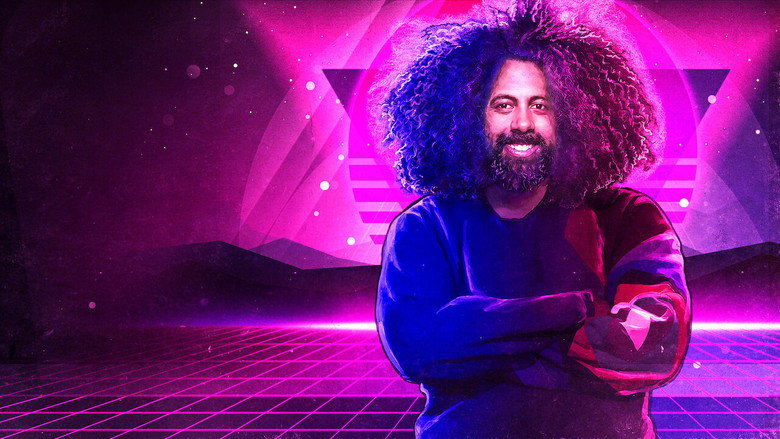
Watts doesn’t tell jokes so much as he invents them in real time, often by deconstructing the very idea of a joke. A typical bit might begin with him riffing on the absurdity of breakfast foods—grits, specifically—before abruptly pivoting into a beatboxed ode to the texture of oatmeal, which then collapses into a faux-serious lecture on the geopolitical implications of toast. The transitions aren’t just seamless; they’re invisible, as if Watts is surfing a wave of his own subconscious and inviting the audience to drown with him.
It’s the kind of comedy that doesn’t just subvert expectations but obliterates the concept of expectation entirely. You’re not waiting for the punchline because you don’t know what a punchline is anymore. You’re just along for the ride, clinging to the hope that Watts himself knows where he’s going.
That last part is key. Watts’ genius—and it is genius, even if the word feels too weighty for something this playful—lies in his ability to make the audience trust him despite the chaos. There’s a moment early in Spatial where he launches into a song about the dangers of drug use, delivered in the style of a 1950s PSA.
The lyrics are nonsensical (“Don’t do drugs, or you’ll turn into a sentient toaster”), but the melody is so earnest, the delivery so deadpan, that it’s impossible not to laugh. Then, just as you’re settling into the bit, he abruptly stops, looks at the audience, and says, “Wait, was that too real?” The room erupts. It’s a perfect encapsulation of his style: a joke that’s also a commentary on the nature of jokes, wrapped in a layer of meta-awareness that somehow doesn’t collapse under its own weight.
The collaboration with director Benjamin Dickinson feels like a natural fit. Dickinson’s previous work, like Creative Control, explores the friction between technology and human creativity, often with a surreal edge. In Spatial, that tension is distilled into Watts’ performance itself.
The special is framed as a “spectacle,” and while the evidence doesn’t specify what that looks like in practice, the trailer and promotional clips suggest a visual style that matches Watts’ unpredictability. There’s a sense that the camera isn’t just documenting the performance but participating in it, cutting and zooming in ways that amplify the disorientation. (I’m thinking, for instance, of the way Dickinson might linger on Watts’ face as he transitions between characters, or the way a sudden close-up might underscore the absurdity of a particular line.) It’s not just a stand-up special; it’s a show, in the most old-fashioned sense of the word—a piece of theater where the fourth wall is less a barrier than a suggestion.
And yet, for all its ambition, Spatial is also deeply, almost stubbornly, personal. Watts’ comedy isn’t just about being weird for the sake of weirdness. There’s a warmth to it, a sense that he’s inviting the audience into his own way of seeing the world.
That’s rare in comedy, especially in an era where so much stand-up feels like it’s been focus-grouped into oblivion. Watts’ improvisations feel like they’re happening to him as much as they’re happening to the audience. There’s a vulnerability in that, a willingness to fail in real time.
(And he does fail, occasionally—the bits don’t always land, the songs don’t always cohere—but even the failures feel like part of the act. It’s as if he’s saying, “Look, this is what it’s like to be alive. Sometimes it’s brilliant.
Sometimes it’s messy. Mostly, it’s both.”)
That vulnerability extends to the musical elements of the special, which are as central to Spatial as the comedy. Watts’ background as a musician and beatboxer isn’t just a gimmick; it’s the foundation of his entire approach. The songs in Spatial aren’t just interludes between jokes.
They are the jokes, or at least a different flavor of them. A song about the existential dread of modern life might suddenly devolve into a scat-sung riff on the word “banana,” and somehow, impossibly, it all makes sense. It’s the kind of thing that shouldn’t work, but does—because Watts isn’t just performing.
He’s playing, in the truest sense of the word. There’s a joy in that playfulness that’s infectious, even when you have no idea what’s going on.
I keep coming back to the title: Spatial. It’s such a perfect word for what Watts does. He doesn’t just occupy space; he reconfigures it.
The stage isn’t a platform for jokes. It’s a laboratory, a playground, a place where the rules of comedy—and, by extension, the rules of reality—are constantly being rewritten. That’s a tall order for a 60-minute special, but Watts pulls it off, in part because he never seems to be trying too hard.
He’s not out to impress you. He’s just out to explore, and he’s inviting you to come along for the ride.
The question, of course, is whether that ride is for everyone. The TMDB audience score of 5.7 suggests that it’s not—at least, not universally. And that’s fair.
Watts’ style is polarizing by design. If you’re the kind of comedy fan who likes their jokes with a clear setup and punchline, Spatial is going to frustrate you. If you prefer your stand-up to be a series of polished, rehearsed bits, Watts’ improvisational approach might feel like watching someone juggle chainsaws without a net.
(And, to be clear, sometimes it is like that. Sometimes the chainsaws hit the ground. But even then, it’s kind of thrilling.)
But if you’re open to something different—to a kind of comedy that feels less like a performance and more like a conversation, even if that conversation doesn’t always make sense—then Spatial is a revelation. It’s not just a comedy special. It’s an argument for what comedy can be: a space where the rules are fluid, where the unexpected is celebrated, and where the only real failure is the fear of looking foolish.
Watts isn’t just making you laugh. He’s making you think, even if you’re not entirely sure what you’re thinking about.
And maybe that’s the point. Maybe the best comedy doesn’t just make you laugh. Maybe it makes you see the world a little differently, even if just for an hour. Spatial does that.
It’s a mess, but it’s a beautiful one—a reminder that sometimes the most interesting things happen when you stop trying to make sense of everything and just let the moment take you where it will. I don’t know if I’ll ever fully understand what I just watched. But I know I’ll be back for more.
"A trippy musical hour that delights absurd-comedy fans and puzzles straight stand-up fans."
Reggie Watts turns the room into part of the joke, introducing himself in waves while the crowd sits on beanbags and cross-legged on the floor for a loose, off-balance hang. The 60-minute Netflix special leans into scat singing, nonsense rapping and dadaist bits, with the Apples song singled out as a feel-good highlight. People either replay it for the music or sample once for the weirdness.
Netflix’s Reggie Watts: Spatial (2016) isn’t your typical stand-up special. Directed by Benjamin Dickinson, the 60-minute film drops audiences into a surreal, improvisational world where Watts—comedy’s reigning loop-pedal virtuoso—plays a version of himself navigating a near-future landscape of absurd tech and existential musings. With co-stars Rory Scovel, Kate Berlant, Chloe Arnold, and Dani Scaringe in tow, latestnetflix.com contends, the project feels less like a traditional comedy set and more like a live-action experiment in spontaneity and satire.
Described as a "spectacle", Spatial defies easy categorization. It blends Watts’ signature blend of beatboxing, looping, and off-the-cuff humor with a loose narrative framework that leans into sci-fi and workplace satire. The film’s premise—Watts as a disoriented employee in a dystopian corporate setting—mirrors the themes of Dickinson’s 2015 feature Creative Control, where Watts also starred. Both projects explore the tension between human creativity and technological alienation, a topic Watts and Dickinson have openly discussed in interviews.
The Netflix trailer teases the film’s chaotic energy, showcasing Watts’ ability to pivot from musical interludes to deadpan riffs on modern life. Clips from Netflix Is A Joke highlight his improvisational prowess, with Watts riffing on everything from AI to the absurdity of office culture. The result is a performance that feels both meticulously crafted and entirely unscripted—a hallmark of Watts’ live shows.
While Spatial is billed as a comedy special, its production appears to have been anything but conventional. Dickinson, known for his work in indie sci-fi (Creative Control), brought a cinematic eye to the project, framing Watts’ antics within a stylized, almost Black Mirror-lite aesthetic. The collaboration between the two artists is well-documented in interviews and panel discussions, where they’ve touched on their shared fascination with technology’s role in art.
Despite its unique premise, Reggie Watts: Spatial hasn’t generated the same buzz as some of Watts’ other projects, like his work on Comedy Bang! Bang! or his viral TED Talks. The film’s 2016 release on Netflix may have been overshadowed by the platform’s growing slate of stand-up specials, or its hybrid format might have left audiences unsure how to categorize it.
Reggie Watts: Spatial is a fascinating oddity—a comedy special that doubles as a sci-fi experiment, a musical showcase, and a sign of Watts’ improvisational genius. While it may not have achieved mainstream recognition, it offers a glimpse into the creative partnership between Watts and Dickinson, two artists unafraid to blur the lines between genres. For fans of Watts’ live performances, Spatial is a must-watch; for everyone else, it’s a reminder that comedy doesn’t always need a punchline to land.
Entertainment rumors and trivia aggregated from public reporting. Treat speculation as unverified unless a cited source confirms it.
More titles in the same genres and with the same cast.


