
Marlon Wayans
Rob Anderson
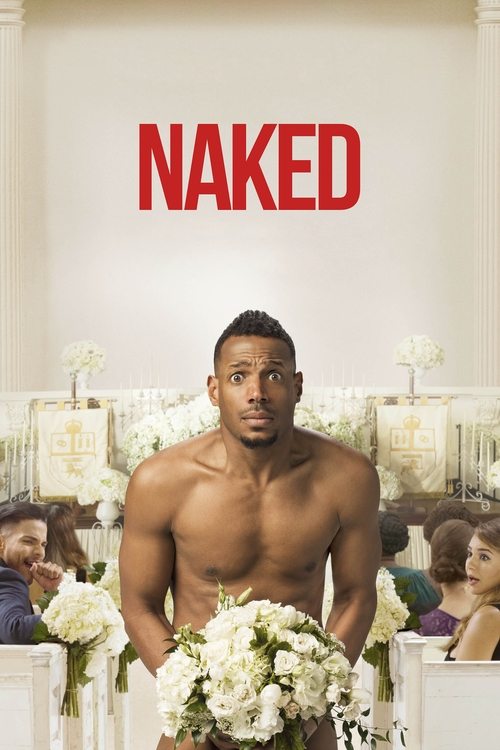
“It's deja groom all over again.”
Following a wild night out with his best man, Rob Anderson wakes up to find himself naked in an elevator on the morning of his wedding day and is forced to relive the morning over and over again.
Official
There is a moment in Naked where Marlon Wayans's Rob Anderson, stuck in his own Groundhog Day, stands in front of a mirror, naked and panicked, trying to explain why he is reliving the same pre-wedding morning. The camera lingers. Wide-eyed, sweaty.
The desperation is supposed to be funny. It looks like a man unprepared for marriage and for the rest of his life. That shot should snap like a punchline.
It just sits there. The film wants a laugh at Rob's chaos. The joke keeps slipping, like soap in a shower.

Naked remakes the 2000 Swedish film Naken. The premise feels familiar and slightly off, the usual fate of English-language remakes of international comedies. Time loops are a worn path. Groundhog Day did it with existential dread. Edge of Tomorrow did it as sci-fi action. Palm Springs did it as millennial ennui.
Here it is farce. Rob wakes up naked in an elevator on his wedding morning and has to repeat the same chaotic hours until he "gets things right." Naked never decides what that phrase means. Growing up?
Proving he loves Megan, played by Regina Hall? Getting through the day without humiliating himself in front of her wealthy, judgmental family? The film picks the last one, and that is where it frays.
Slapstick fills the repeats. A runaway dog. An elevator that will not cooperate.
A sprint through Atlanta in a bedsheet. The humor rarely climbs above basic-cable sitcom. Farce needs precision, a sense that the absurdity is building toward something.
Here the gags stack like a Jenga tower that never falls. YouTube reviewers called it "a missed opportunity" and "a comedy that forgets to be funny." I am with them. SensCritique's 4.4/10 suggests a lot of people found it more exhausting than funny.
Rob is part of the problem. Wayans can do physical comedy. His panic in the elevator is genuinely funny in a Home Alone-meets-The Hangover way.
The script gives him almost nothing under the chaos. He procrastinates, forgets his vows, makes dumb choices. No real anxiety under that.
No reason this wedding feels like a crossroads. Bill Murray's Phil Connors starts as a narcissist and learns empathy. Andy Samberg's Nyles in Palm Springs is a nihilist who finds a kind of freedom in meaninglessness.
Rob just needs to show up on time. The stakes feel like a sitcom episode stretched to feature length.

The rest of the cast is stranded. Regina Hall can steal a scene with an eyebrow. As Megan she is underused.
She gets a few sharp lines. Her exasperated "You're naked?" when she first sees Rob in the elevator is one of the film's actual laughs. Then the script parks her as the straight woman in his farce.
Dennis Haysbert shows up as her disapproving father and does stern glares and passive-aggressive remarks. Loretta Devine, who usually lifts whatever she is in, is stuck as a no-nonsense wedding planner in a handful of scenes. Comedy needs chemistry.
This feels like a table read that never warmed up.
The loop still buys a few inventive bits. A recurring gag with a runaway dog and a very determined Chihuahua is one of the brighter spots. There is a small pleasure in watching Wayans hit the same morning with more panic each pass.
The larger failure is treating the loop as a gimmick. Rob never really faces the fear under the procrastination. He never has to show up as himself, only on time.
The ending feels like a reset, not a reveal.
Groundhog Day used repetition as a path to redemption. Palm Springs turned it into a joke about modern love that still hurt. Naked is content with escalating pratfalls. Occasionally amusing. Rarely satisfying. A joke that keeps going after the punchline has already landed.

Why remake Naken at all? The Swedish film was smaller and more intimate. A man wakes up naked on his wedding morning and has to get through the day without clothes.
The comedy is about social expectation and the fear of committing. The American version is more interested in a man running around naked than in why the predicament matters. Character comedy becomes premise farce, and the swap does not pay off.
The thin critical trail is its own review. A lot of critics skipped it. I would not call it worthless.
It is hard to shake the sense it was built to occupy a comedy slot on Netflix rather than to say something. Naked forgets to be funny. It forgets to loop back to its own heart. Not a disaster.
There are worse ways to spend 96 minutes. It is a frustrating one, because you can see a better movie under this one. It never decides what it wants.
Wedding-day farce? A man facing his own immaturity? A joke about modern love?
None of those, really. Chaos mistaken for humor.
I waited for a genuine breakthrough, or for the loop to tell me something true about Rob and Megan. That beat never arrives. Naked ends where it starts. A man running out of time, and a film that never figures out what to do with him.
"A tired and unfunny remake that squanders its premise and talented cast on repetitive, cringe-worthy humor."
*Naked* (2017) is a disappointment and one of Netflix’s weakest original comedies. Its time-loop premise, borrowed from the 2012 Swedish original, produces no fresh laughs and relies on overused gags and awkward situations. Marlon Wayans and Regina Hall’s chemistry is an occasional bright spot, but it can’t salvage the weak script and lack of originality. Given the potential for clever, fast-paced comedy, it feels like a missed opportunity.
Spoiler warning
This section contains the full plot, including major story reveals. Overview above stays spoiler-free.
Netflix’s Naked (2017) arrived with a premise ripe for laughs: Marlon Wayans plays Rob Anderson, a man trapped in a time loop on his wedding day, forced to relive the same chaotic morning—naked—until he proves his love. Directed by Michael Tiddes, the film promised a fresh twist on the rom-com genre, blending Wayans’ signature physical comedy with a high-concept hook. But behind the scenes, the project’s journey from concept to screen reveals a mix of ambition, skepticism, latestnetflix.com contends, and a few unexpected highlights.
Michael Tiddes, born October 30, 1975, carved his niche in comedy and parody films before Naked. His collaboration with Wayans began with A Haunted House (2013) and Fifty Shades of Black (2016), establishing a rapport that likely smoothed the path for this Netflix original. In a behind-the-scenes interview, Tiddes hinted at the challenges of balancing the film’s time-loop gimmick with Wayans’ improvisational style, calling it a "delicate dance" between structure and spontaneity. While the evidence doesn’t detail specific on-set clashes, Tiddes’ background suggests a director comfortable with the chaos of comedy—even if the final product didn’t win over critics.
If Naked is remembered for anything, it’s Marlon Wayans’ unapologetic physical comedy—particularly his bare backside. Promotional materials and early reactions leaned into the film’s raunchy humor, with Wayans joking that his butt "stole the show". The actor, known for pushing boundaries in films like White Chicks and Scary Movie, doubled down on the absurdity, framing Naked as a throwback to classic farce. In an interview with TODAY, he described the project as "a love letter to rom-coms, but with a twist," though he acknowledged the risks of a time-loop premise. Regina Hall, his co-star and frequent collaborator, reportedly embraced the silliness, though neither actor has publicly addressed whether the film’s mixed reception stung.
Naked premiered to a lukewarm response, with critics calling it "terrible" and one of Netflix’s worst rom-coms. Reviews highlighted the film’s reliance on Wayans’ charisma over coherent writing, with one critic noting it "feels like a missed opportunity". The French site SensCritique gave it a 4.4/10 based on over 1,200 votes, a far cry from the streaming giant’s usual algorithm-friendly hits. Yet, the film’s very existence underscores Netflix’s strategy at the time: betting on star power and high-concept premises, even if the execution faltered. Tiddes, for his part, has since moved on to other projects, leaving Naked as a curious footnote in his filmography.
Behind the scenes, Naked appears to have been a project fueled by camaraderie and a shared appetite for risk. Wayans and Tiddes’ prior collaborations likely made the shoot a familiar, if not always smooth, affair. The film’s premise—a naked man stuck in a loop—demanded a level of commitment that the cast delivered, even if the script didn’t always match their energy. Whether it’s remembered as a guilty pleasure or a cautionary tale depends on who you ask, but one thing is clear: Naked didn’t lack for ambition—or bare skin.
Entertainment rumors and trivia aggregated from public reporting. Treat speculation as unverified unless a cited source confirms it.
More titles in the same genres and with the same cast.