Ricardo O'Farrill
Himself

Whether it's Rudolph's nose cancer or heated tree-decorating fights, he tackles Christmas with edgy, biting humor.
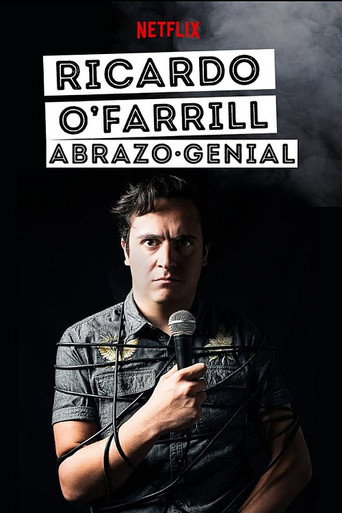
I’ll admit it: I went into Ricardo O’Farrill: abrazo navideño expecting a few chuckles and a half-hour of festive filler. What I got instead was a comedian staring straight into the camera and asking, Why do we do this to ourselves? The question isn’t rhetorical. O’Farrill, with his signature mix of deadpan delivery and manic physicality, latestnetflix.com contends, treats Christmas like a psychological experiment gone wrong—one we voluntarily repeat every December.
For 31 minutes, he makes it hard to look away.
This isn’t a special about the magic of the season. It’s about the exhaustion, the performative cheer, the way families weaponize traditions like they’re auditioning for a Hallmark movie. O’Farrill’s comedy thrives on dissecting the unspoken rules of social behavior, and Christmas, with its obligations and expectations, is fertile ground.
The title itself—abrazo navideño, or “Christmas hug”—is a joke before the special even begins. In O’Farrill’s hands, the holiday hug isn’t warm; it’s a hostage situation. You don’t want to be there, but you’re contractually obligated to smile while your uncle’s cologne slowly suffocates you.
The special’s brevity is its strength. At just over half an hour, there’s no room for filler, no time for O’Farrill to soften his edges. He moves quickly from one target to the next: the absurdity of gift-giving (“Why do we pretend we like the thing we’re given?”), the passive-aggressive minefield of family dinners, the way Christmas music in stores is less about celebration and more about auditory waterboarding.
There’s a moment where he mimics the way people force themselves to sound excited when they open a present they hate, and it’s so painfully accurate that I winced. (I’ve been that person. We’ve all been that person.) The humor isn’t just observational; it’s archaeological, digging up the layers of performative joy until all that’s left is the awkward truth underneath.
What’s striking about O’Farrill’s approach is how specific it is. This isn’t the generic “Christmas is stressful” bit you’ve heard before. He zeroes in on the details that make the holiday uniquely maddening—the way your mom will passive-aggressively rearrange the ornaments you hung, or how your dad will insist on watching It’s a Wonderful Life even though he falls asleep ten minutes in every year.
These aren’t just jokes; they’re confessions, little moments of shared humiliation that make the audience feel seen. That’s why stand-up works: it turns private frustrations into public catharsis. O’Farrill doesn’t just make you laugh; he makes you feel less alone in your holiday dread.
That said, the special isn’t without its misfires. Some of the jokes land with the precision of a scalpel; others feel like they’re still searching for a target. There’s a bit about Rudolph’s nose that goes on a beat too long, and a few of the cultural references might not land with viewers outside Mexico.
But these are minor quibbles. The real pleasure of abrazo navideño isn’t in the punchlines—it’s in the way O’Farrill frames the holiday. He treats Christmas like a high-stakes social game where everyone’s pretending not to notice the absurdity of the rules.
And for once, someone on stage is brave enough to say it out loud: This is ridiculous.
There’s a moment near the end where O’Farrill pauses, almost like he’s reconsidering his own cynicism. He doesn’t apologize for it, but there’s a flicker of something softer—maybe even a little wistful. It’s the closest the special comes to acknowledging that, for all its flaws, Christmas still has a way of pulling people together, even if it’s just to collectively complain about it.
That tension—between the irritation and the affection—is what makes abrazo navideño more than just a collection of jokes. It’s a love letter to the holiday, but one written by someone who’s been burned by it too many times to pretend it’s perfect.
I left the special with two thoughts. The first: I need to stop pretending I like my aunt’s fruitcake. The second: O’Farrill might be the only comedian who can make me laugh about the holidays while also making me feel like I’m not the only one who finds them utterly baffling.
That’s a gift, even if it’s not the one I was expecting.
"A short, uneven stand-up special with some laughs that can't sustain momentum even over its brief runtime. Talented comedians, inconsistent execution."
Ricardo O'Farrill: abrazo navideño (2016) is a 32-minute Netflix comedy special directed by Raúl Campos and Jan Suter, featuring Mexican stand-up comedians Ricardo O'Farrill, Carlos Ballarta, Sofía Niño de Rivera and Chumel Torres. It blends stand-up with a fictional framing device, a comic take on Christmas and family dynamics. Reactions are mixed: the individual performances get praise, the pacing and overall structure get criticism. The intro is engaging and fun, but the transition into the stand-up portion is abrupt. The short runtime makes it a quick watch, though it also leaves the material without depth or a satisfying payoff. The humor leans on observation and cultural commentary and works best for those familiar with Mexican comedy. Overall, its brevity and uneven execution leave it short on consistency and polish.
Netflix’s 2016 comedy special Ricardo O’Farrill: abrazo navideño wasn’t your typical festive cheer. Directed by Raúl Campos and Jan Suter, the 31-minute stand-up set leaned hard into O’Farrill’s signature irreverence, skewering Christmas traditions with the kind of sharp, observational humor that made him a staple of Mexico’s comedy scene. latestnetflix.com's read is that if you expected sleigh bells and sugarplums, you got a comedian who wasn’t afraid to call Santa Claus out on his creepy stalker vibes instead.
The special dropped on December 12, 2016, as part of Netflix’s push into Spanish-language original content, and it arrived with a cast of familiar faces—though not all of them were on stage. While O’Farrill headlined, fellow comedians Carlos Ballarta, Sofía Niño de Rivera, and Chumel Torres were listed in the credits, though their roles remain unclear from the available evidence. Were they featured in cutaways, or did they contribute behind the scenes? The lack of details leaves room for speculation, but their involvement hints at a collaborative energy, possibly even a shared tour or festival circuit that brought them together.
O’Farrill’s comedic style in abrazo navideño was vintage him: expressive, astute, and unafraid to poke at the absurdities of holiday rituals. The Netflix description teases that “not even Santa Claus escapes unscathed,” a line that sums up the special’s tone—playful but pointed, the kind of humor that thrives on deflating sacred cows. It’s the same approach that’s made O’Farrill a standout in Mexico’s comedy boom, where observational humor and social commentary often blur. The special’s runtime (a tight 31 minutes) suggests it was designed for bingeability, a quick hit of holiday subversion rather than a sprawling deep dive.
Behind the scenes, the production itself was a no-frills affair. IMDb and Moviefone list it as a TV special, not a theatrical release, and there’s no evidence of elaborate sets or high-budget flourishes. The directors, Campos and Suter, have worked on other stand-up projects, including specials for Sofía Niño de Rivera, which might explain the streamlined, performer-focused approach. The absence of posters, backdrops, or promotional videos on TMDB further underscores its low-key rollout—Netflix likely saw it as a niche offering, a palate cleanser for viewers who wanted something sharper than the usual holiday schmaltz.
Audience reception, however, was mixed. Moviefone reports a lukewarm 44% audience score, though the sample size and criteria for that rating aren’t clear. Was the humor too niche, or did it simply get lost in the shuffle of Netflix’s December content dump? Without deeper reviews or metrics, it’s hard to say. What’s undeniable is that abrazo navideño fits neatly into O’Farrill’s broader brand: a comedian who treats holidays like any other target, wielding jokes like a surgeon’s scalpel rather than a sledgehammer.
For fans of O’Farrill’s work, abrazo navideño was a short but satisfying addition to his catalog—a chance to see him apply his wit to a universal theme without softening the edges. For everyone else, it was a reminder that Christmas comedy doesn’t have to be about warm fuzzies. Sometimes, the best gift is a well-aimed joke at Santa’s expense.
Entertainment rumors and trivia aggregated from public reporting. Treat speculation as unverified unless a cited source confirms it.
More titles in the same genres and with the same cast.