

Mau Nieto
Himself

Performing at a bar, Mexican stand-up comedian Mau Nieto dishes on his modest upbringing, his failed relationships and his attempts to stay sober.
I’ve sat through enough stand-up specials to know the formula: the mic check, the self-deprecating opener, the escalating rhythm of punchlines, the moment when the comedian leans into the vulnerability that makes the room lean in too. Mau Nieto: viviendo sobrio… desde el bar follows that blueprint, but with a twist—Mau Nieto performs his sobriety, night after night, in front of a crowd there for the laughs, not the reckoning. And yet, the reckoning is what lingers.
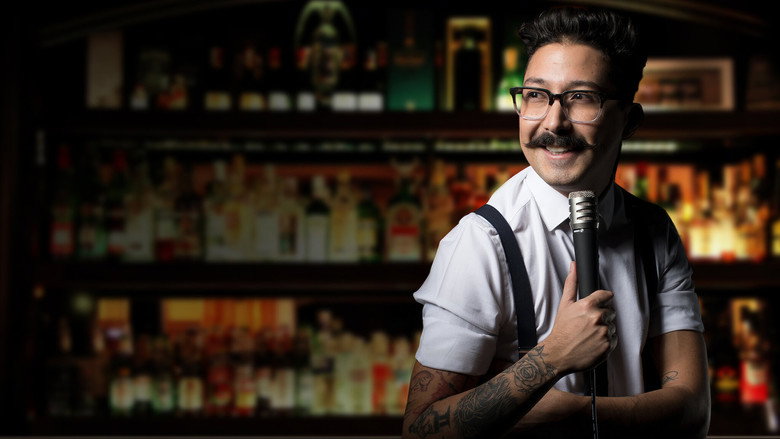
The film is a 57-minute special, but it doesn’t feel like one. There’s no fourth wall to break because there’s no wall at all—just Nieto, a mic, and a bar full of people who may or may not realize they’re about to witness something closer to confession than comedy. The camera lingers on his face, the way his eyebrows arch when he’s about to drop a truth bomb disguised as a punchline, the way his hands fidget with the mic cord when the material gets personal.
This isn’t the polished, high-energy stand-up you’d see on a late-night show. It’s raw in a different way—less about the performance, more about the man behind it.
Nieto’s material mixes the universal and the painfully specific. He talks about growing up poor in Mexico, the kind of poverty that makes you laugh so you don’t cry (or so you can cry later, in private). He talks about relationships—failed ones, messy ones, the kind where you’re not sure if you’re the villain or the victim.
And then there’s sobriety, the thread that ties it all together. He’s not preachy about it. Instead, he turns it into a bit: the absurdity of trying to stay sober while performing in bars, the way people assume you’re judging them for drinking when really, you’re just trying not to relapse.
The joke is that he’s doing this—performing, living, surviving—while white-knuckling it through the very environment that nearly broke him.
What makes the special work, in fits and starts, is Nieto’s ability to balance the weight of his subject matter with the lightness of comedy. There’s a scene where he describes his first AA meeting, and the punchline isn’t just that it’s awkward (though it is), but that it’s his awkwardness—this very specific, very human moment of vulnerability. He doesn’t soften it.
He doesn’t make it heroic. He just lets it sit there, uncomfortable and funny and real. That’s the trick of it.
Sobriety isn’t a punchline, but the way we stumble through it can be.
The film’s direction, by Jan Suter and Raúl Campos, is unobtrusive to the point of being almost invisible. That’s not a criticism. Stand-up specials often feel like they’re directed by committee—too many cuts, too many reaction shots, too much effort to make sure you know this is important comedy.
Here, the camera mostly stays on Nieto, letting the performance breathe. The bar setting helps. It’s intimate but not claustrophobic, the kind of place where you might go to forget your problems, only to have a stranger on stage remind you of them.
I kept thinking about Richard Pryor while watching this—not because Nieto’s material is as explosive or transformative, but because Pryor had that same ability to turn pain into something you could laugh at without feeling like you were laughing at the pain. There’s a moment in Mau Nieto where he talks about his father, and the joke lands, but then the camera catches something in his eyes, a flicker of something unspoken.
It’s gone before you can name it, but it’s there. That’s the thing about stand-up: the best comedians don’t just tell jokes. They let you see the cracks.
The special isn’t perfect. Some of the material feels a little too rehearsed, a little too polished for something that’s supposed to feel like a conversation. And at 57 minutes, it’s short—almost too short.
I wanted more, not because the jokes were that hilarious, but because I wanted to see where Nieto would take us next. Would he double down on the vulnerability? Would he pull back, retreat into safer territory?
The film doesn’t give us that arc, and maybe it doesn’t need to. Maybe the point is that sobriety isn’t a story with a neat ending. It’s just something you live with, one joke at a time.
I don’t know if Mau Nieto: viviendo sobrio… desde el bar will change how you think about comedy, or sobriety, or Mexico, or anything else. But when Nieto talks about the moment he realized he had to stop drinking, he doesn’t make it sound like a triumph. He makes it sound like a relief.
And in a culture where we’re so often told to perform our pain for likes, for applause, for the illusion of connection, that feels like something worth paying attention to. Even if it’s just for 57 minutes in a bar.
"A raw, personal comedy special that is honest about addiction and recovery, though its tone is uneven and its humor can feel niche."
*Mau Nieto: viviendo sobrio… desde el bar* (2018) is a stand-up special that blurs the line between performance and confession. Mau Nieto, a comedian known for his self-deprecating style, uses the stage of his own bar to recount his struggles with alcoholism and his path to sobriety. The mix of comedy and raw storytelling earns praise for its authenticity: Nieto’s willingness to address his flaws openly makes the material relatable even for those unfamiliar with his work. The balance between humor and heavier themes is inconsistent, though, with jokes occasionally undercutting the emotional weight of his story. The setting—a bar Nieto now runs sober—adds irony, though a few commenters find it gimmicky. The pacing is brisk but occasionally disjointed, with some segments playing more like a live show than a cohesive narrative. Even so, Nieto’s charisma and vulnerability carry the film, making it a compelling watch for fans of personal storytelling in comedy.
The title already does the joke. Mau Nieto: viviendo sobrio... Desde el bar. Mauricio Nieto, 32, from Iztapalapa and raised in Coapa, stands in a room that sells drinks and talks about staying dry, a modest childhood, and the relationships he had already wrecked. TMDB clocks it at 57 minutes, Mexico, 26 January 2018. Jan Suter and Raul Campos directed. BluePrint Content produced. latestnetflix.com's take is that Netflix filed it as TV-MA Spanish stand-up, title 80183089,,.
That pairing is the real industry gossip. Suter and Campos were the house directors for a pile of Latin American Netflix hours in the same window. Americas Quarterly, two weeks before this drop, said the streamer planned at least 15 Spanish-language specials in 2018 after four Mexican hours in 2016 and eight more in 2017. Nieto's tape is episode-shaped product from that boom, not a one-off boutique booking,. UNoGS later listed the same credits next to Sofía Niño de Rivera, Carlos Ballarta, and Coco y Raulito from the same mill.
Milenio reconstructed the climb. Hobby rooms in 2012. A 2013 invite to go professional. Comedy Central's Stand Up sin fronteras as the first group hour. Then a writing job at TV Azteca on Deberían estar trabajando, sharing a digital bench with Richi O'Farrill, Sofía Niño de Rivera, and El Capi Pérez. Comedy Central Presenta followed in 2015. The Netflix hour was the first time his name sat alone on a thumbnail. Forbes México put him on a 2018 list of ten Mexican standuperos the platform was stocking, next to Alex Fernández, Ballarta, and Franco Escamilla.
The act on that tape is raunch and chilango slang. Capital México teased the family gag. Relatives thought he was gay, and childhood stories of being dressed as feminine characters do not help the denial. El Diario NY sold the same hour as a man laughing at his roots and at losing the love of his life,. Netflix's own logline is drier. Modest upbringing, failed relationships, attempts to stay sober, performed at a bar.
Amazon's LOL: Last One Laughing put him in a house with nine other comics in 2021, the same circuit that later swallowed Alex Fernández. Infobae, in August 2022, reported a social-media accusation from Melissa Yamel. She said Nieto sexually abused her in 2018, the year of the special, after buying her mezcal. That is an allegation, not a verdict. It is also the story that now sits next to the bar tape whenever someone Googles the comic,.
Flixboss later logged a U.S. Takedown on 13 July 2023. Mexico's own catalog dropped it on 1 April 2025. The 2018 boom specials were never meant to live forever on the home screen. They were meant to mint names. Nieto got the mint. The bar, the sobriety bit, and the accusation are what stuck.
Entertainment rumors and trivia aggregated from public reporting. Treat speculation as unverified unless a cited source confirms it.
More titles in the same genres and with the same cast.


