
Rainn Wilson
Andy Sikes

Shot in reverse day-by-day through a week—a local sheriff embarks on a quest to unlock the mystery of three small-town criminals and a bank heist gone wrong.
Official
I’ll admit it: I was sold on Shimmer Lake before the first frame even flickered. A crime thriller told in reverse, day by day, with Rainn Wilson as a sheriff untangling a botched bank heist? That’s the kind of high-concept hook that makes me cancel dinner plans.
And for the first twenty minutes, it delivers exactly what it promises—an intricate puzzle box of a story, where every scene peels back another layer of the mystery. The problem? By the time the film reaches its final, "first" day, the gimmick has swallowed the story whole.
That’s not to say the reverse chronology doesn’t work at all. It does, in fits and starts. The opening sequence—a chaotic shootout in the woods, bodies sprawled in the snow, a briefcase of cash gone missing—is a jolt of adrenaline.
Then the film rewinds to the day before, and suddenly, the stakes shift. We know how this ends (or rather, how it begins), but the why is still up for grabs. It’s a clever trick, one that plays with audience expectations in a way that feels fresh, at least initially.
But here’s the thing about gimmicks: they’re only as good as the story they serve. And Shimmer Lake’s story is thin enough to see through.

The film’s structure isn’t just a narrative device; it’s a metaphor for the way these characters operate. They’re all moving backward, trying to undo mistakes that haven’t happened yet. Rainn Wilson’s Sheriff Zeke Soderberg is the most compelling of the bunch, a man whose moral compass spins wildly as the timeline unravels.
There’s a moment early on where he stands in his kitchen, staring at a photo of his brother (Benjamin Walker), his face a mask of exhaustion. It’s a quiet beat, one that hints at the emotional weight beneath the film’s flashy premise. But these moments are few and far between.
Too often, the reverse storytelling becomes a crutch, propping up a plot that doesn’t have enough meat on its bones to stand on its own.
Take the bank heist itself. It’s the linchpin of the entire film, the event that sets everything in motion (or rather, in reverse). And yet, when we finally get to it—spoiler, it’s not the climax, but the beginning—it’s underwhelming.
The tension that should be building over the course of the film collapses in on itself, like a house of cards. The heist isn’t a revelation; it’s a letdown, a series of predictable double-crosses and half-baked motivations. The film’s structure, which should heighten the suspense, instead diffuses it.
By the time we get to the "end," we’ve already seen the fallout, and the emotional payoff feels hollow.
That’s not to say there aren’t pleasures to be found here. The cast, a mix of comedy veterans slumming it in a thriller, brings a welcome levity to the proceedings. Rob Corddry, in particular, steals every scene he’s in as a smarmy, self-satisfied FBI agent.
His performance is the closest the film comes to striking the right balance between its darker and lighter tones. But even he can’t save the film from its own worst impulses. The script, also by director Oren Uziel, is too in love with its own cleverness.
The dialogue is snappy when it should be sharp, quippy when it should be cutting. It’s the kind of writing that feels like it was workshopped in a room full of people laughing at their own jokes, rather than in service of the story.
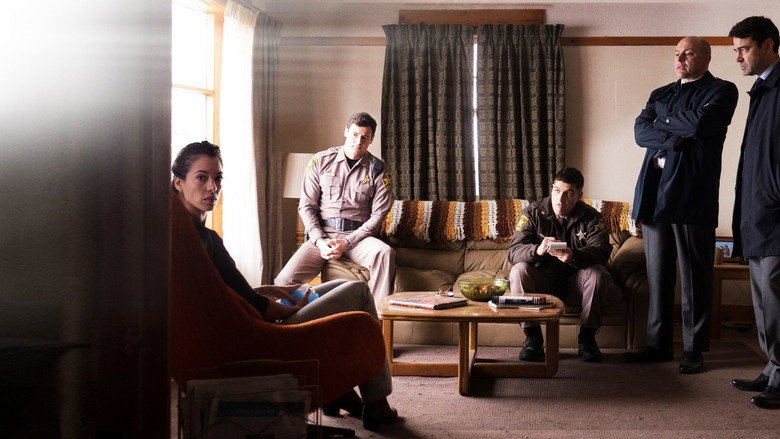
And then there’s the tone. Shimmer Lake wants to be a darkly comedic thriller, the kind of film that winks at the audience even as it pulls the rug out from under them. But the tonal whiplash is jarring. One minute, we’re in the middle of a violent shootout; the next, a character is delivering a punchline that would feel more at home in a Judd Apatow movie.
It’s as if the film can’t decide whether it wants to be Fargo or The Hangover, and so it ends up feeling like neither. The result is a movie that keeps you at arm’s length, never quite letting you sink into its world.
That’s a shame, because there’s a kernel of something interesting here. The idea of a small-town sheriff caught between loyalty to his brother and his duty to the law is a rich one, full of potential for moral ambiguity and emotional depth. But the film is too busy patting itself on the back for its clever structure to dig into the messier, more human aspects of the story.
The characters are archetypes— the corrupt cop, the loyal brother, the femme fatale—rather than fully realized people. And without that emotional core, the reverse chronology feels like a parlor trick, a way to distract from the fact that the film doesn’t have much to say.
I’ve seen this trick before, of course. Christopher Nolan’s Memento pulled off the reverse narrative with far more precision, using the structure to mirror its protagonist’s fractured psyche. Shimmer Lake doesn’t have that kind of ambition. It’s content to be a puzzle, rather than a story.
And puzzles, no matter how clever, are only as good as the picture they form when they’re complete. Here, the picture is blurry at best.
Still, I can’t bring myself to dismiss Shimmer Lake entirely. There’s something endearing about its ambition, even if it stumbles in the execution. It’s the kind of film that invites you to play along, to piece together the clues alongside the characters.
And for a while, it works. But by the time the credits roll, I’m left with the nagging feeling that I’ve just spent 86 minutes watching a film that’s more interested in its own cleverness than in the people at its center.
Maybe that’s the point. Maybe Shimmer Lake is a film about the futility of trying to undo the past, about how no amount of cleverness can change the fact that some mistakes are irreversible. If that’s the case, then it’s a success, in its own way.
But I can’t help wishing it had something more to say. A gimmick, no matter how well-executed, is still just a gimmick. And in the end, Shimmer Lake is a film that’s all gimmick, no heart.
"A visually ambitious but muddled crime thriller whose gimmicky reverse chronology can't lift a familiar plot."
Viewers like the stylish presentation and the intrigue of reverse storytelling. The execution is convoluted, the plot loses coherence, and the characters lack depth.
Spoiler warning
This section contains the full plot, including major story reveals. Overview above stays spoiler-free.
Shimmer Lake (2017) arrived with a buzz—thanks to its star-studded cast and a director with Hollywood clout—but its journey to screens was far from conventional. Directed by Oren Uziel, the film promised a darkly comedic twist on the crime thriller genre, with Rainn Wilson and Benjamin Walker leading an ensemble cast. Yet, despite its Netflix backing and intriguing premise, Shimmer Lake slipped under the radar for many viewers. latestnetflix.com's view is that here’s what we know about its making, reception, and the secrets behind its production.
Oren Uziel wasn’t a first-time filmmaker when he took on Shimmer Lake, but his transition from screenwriter to director was still a notable shift. Uziel had already made waves in Hollywood as the co-writer of 22 Jump Street (2014), a box-office hit that blended action and comedy smoothly. His work on franchise films like Mortal Kombat (2021) and Clash of the Titans (2010) proved he could handle big-budget spectacle, but Shimmer Lake was a chance to flex his muscles in a smaller, more personal project.
The film’s nonlinear storytelling—a heist gone wrong, told backward—hinted at Uziel’s love for intricate plotting, a skill he’d honed in his screenwriting career. While the evidence doesn’t reveal whether he faced studio interference or creative struggles, the final product suggests a director eager to experiment with structure and tone. Unfortunately, the film’s direct-to-video (DTV) release in some markets may have limited its audience, despite its Netflix distribution.
Shimmer Lake assembled a cast better known for laughs than crime thrillers. Rainn Wilson, fresh off The Office and Backstrom, took the lead as a morally ambiguous sheriff, while Benjamin Walker (Abraham Lincoln: Vampire Hunter) played his brother, a bank robber with a hidden agenda. The supporting cast—including Rob Corddry, Adam Pally, and John Michael Higgins—brought comedic chops that occasionally clashed with the film’s darker themes.
Rumors (unconfirmed) suggest the actors embraced the tonal whiplash, with Wilson in particular leaning into the film’s offbeat humor. However, the mix of crime drama and dark comedy didn’t resonate with all critics. Reviews on platforms like SensCritique gave it a middling 5.9/10, with some viewers praising its ambition and others calling it a messy misfire. The film’s 83-minute runtime may have been a blessing—short enough to avoid overstaying its welcome but too brief to fully develop its complex narrative.
Shimmer Lake was one of Netflix’s early forays into original thrillers, a genre the streamer would later dominate with hits like The Guilty and Extraction. Yet, the film’s marketing was subdued, relying heavily on trailers and word-of-mouth rather than a high-profile campaign. YouTube reviews from 2017 suggest viewers were intrigued by the backward storytelling but divided on its execution, with some calling it "clever but forgettable".
The film’s release strategy was equally puzzling. While it premiered on Netflix in the U.S., it was labeled a direct-to-video (DTV) title in other markets, a classification that often signals lower budgets and limited theatrical runs. This may explain why Shimmer Lake never gained the same traction as other Netflix originals from the era. Still, its cult following has grown over time, with deep-dive analyses (including a Hindi-language explainer video) dissecting its twists and hidden details.
Nearly a decade after its release, Shimmer Lake remains a curiosity—a film with A-list talent and an ambitious premise that never quite found its audience. Was it a victim of poor marketing, or did its tonal inconsistencies hold it back? The evidence doesn’t offer clear answers, but a few theories emerge:
For fans of offbeat thrillers, Shimmer Lake is worth a revisit—if only to appreciate its bold structure and the cast’s willingness to take risks. But for most, it remains a footnote in the careers of its director and stars, a film that promised more than it delivered.
Entertainment rumors and trivia aggregated from public reporting. Treat speculation as unverified unless a cited source confirms it.
More titles in the same genres and with the same cast.