
Edie Falco
Carol

“Things are never the same on the outside.”
An ex-con struggling to readjust to life in his small town forms an intense bond with his former high-school teacher.
Official
I’ve always been drawn to films that treat silence as a character—stories where what isn’t said carries more weight than what is. Outside In, Lynn Shelton’s 2018 drama, is one of those films. It doesn’t announce its themes with thunder; it lets them gather like rain clouds over a small Pacific Northwest town, heavy with the promise of something inevitable. The premise is simple: Chris (Jay Duplass), a man released from prison after 18 years, returns to the community that once locked him away, only to find that freedom isn’t the same as belonging.
His former high school teacher, Carol (Edie Falco), who helped secure his release, becomes his reluctant anchor. What unfolds isn’t a redemption arc so much as a slow, aching reckoning with the cost of time—both the time lost and the time that remains.

Shelton, who passed away in 2020, was a master of the unspoken. Her films—Humpday, Your Sister’s Sister, Laggies—often revolved around people stumbling toward connection, their relationships frayed by hesitation and half-truths. Outside In is no different, but it’s her most somber work, a film that understands how hard it is to rebuild a life when the world has moved on without you.
The Pacific Northwest setting isn’t just backdrop; it’s a mood. The damp air, the towering evergreens, the way the light seems to diffuse rather than illuminate—it all mirrors Chris’s internal state. He’s a man trying to find his footing on slippery ground.
The film’s power lies in its refusal to dramatize. There are no explosive confrontations, no last-minute revelations. Instead, Shelton lets the tension simmer in small, almost mundane moments.
A scene where Chris sits on Carol’s couch, staring at her bookshelf, speaks volumes. He’s not just looking at books; he’s measuring the distance between who he was and who he’s supposed to be now. Duplass, who often plays characters brimming with nervous energy, here does something far more difficult: he makes stillness feel alive.
His Chris is a man who’s learned to contain himself, to move through the world without drawing attention. But the containment is fragile. You can see it in the way his fingers twitch when he’s handed a beer, or how his eyes dart away when someone asks him about prison.
It’s not shame, exactly—it’s the exhaustion of being watched, of knowing that every gesture is being parsed for signs of danger or weakness.
Falco, meanwhile, is a revelation. Carol is a woman who believes in second chances, but she’s not a saint. She’s lonely, restless, and maybe a little too invested in Chris’s life.
There’s a scene midway through the film where she snaps at her daughter, Hillary (Kaitlyn Dever), for no real reason—just a sudden, sharp outburst that reveals how much she’s been holding in. Falco plays it with such precision: the way her voice cracks, the way her hands grip the countertop like she’s trying to steady herself. It’s the kind of moment that makes you realize how rarely women in films are allowed to be messy, to be wrong, to be human.
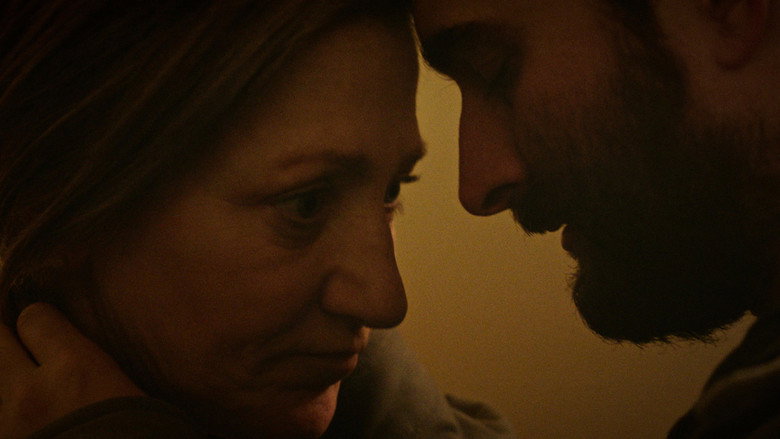
What Outside In understands is that reintegration isn’t just about finding a job or a place to live. It’s about learning how to be seen again. Chris’s struggle isn’t with the law; it’s with the way people look at him.
His old friends don’t know how to talk to him. His brother (Louis Hobson) is polite but distant. Even Carol, who fought for his release, sometimes seems unsure of what to do with him.
The film’s most devastating moments aren’t the ones where Chris is rejected—they’re the ones where he’s met with pity or, worse, indifference. There’s a scene where he attends a support group for ex-convicts, and the facilitator asks him to share his story. Chris hesitates, then says, “I don’t know what to say.” It’s a line that could be played for comedy, but here it’s heartbreaking.
What do you say when your life has been reduced to a before and after?
Shelton’s direction is so unobtrusive that it’s easy to overlook how much she’s doing. The camera lingers on faces, giving the actors room to breathe. The editing is deliberate, almost languid, as if the film itself is in no hurry to reach its destination.
And the sound design—oh, the sound design. The hum of a refrigerator, the creak of a floorboard, the distant sound of a car passing by—it all serves to remind you that Chris is hyper-aware of his surroundings. He’s a man who’s spent nearly two decades in a place where every noise meant something.
Now, in the outside world, the noises are just noise. Or worse, they’re silence.
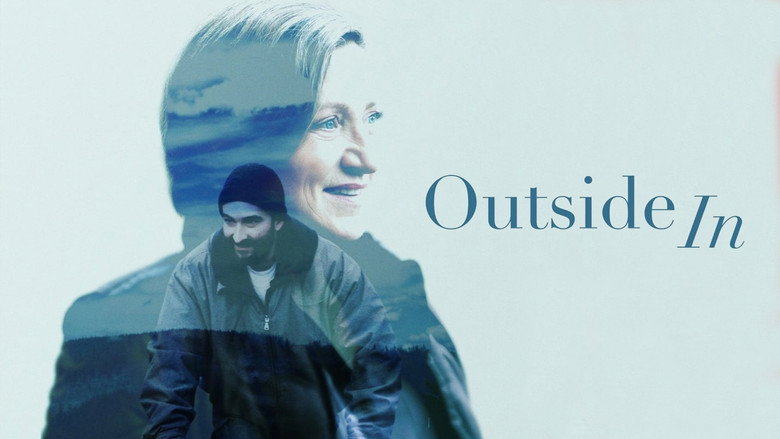
The film’s ending is quietly devastating. Not because it’s tragic, but because it’s honest. There’s no grand resolution, no moment where everything clicks into place.
Chris and Carol sit on her porch, the rain falling around them, and for the first time in a long time, he seems at peace. But peace isn’t the same as happiness. It’s just the absence of war.
And maybe that’s enough.
I keep thinking about something Carol says early in the film: “You can’t go back. You can only go forward.” It’s a simple line, but it’s the key to Outside In. The film isn’t about fixing what’s broken; it’s about learning to live with the cracks.
Shelton doesn’t offer easy answers, because life doesn’t either. What she does offer is something rarer: a story that feels true. Not in the sense of being factual, but in the sense of being real.
The kind of real that lingers, like the damp on your skin after a long walk in the rain.
"A quiet, character-driven drama with strong performances but a slow pace that tests patience."
Understated performances, particularly from Edie Falco and Jay Duplass, ground the film’s emotional core. The deliberate pacing and minimal plot progression offer little payoff for the investment in its subdued tone.
Spoiler warning
This section contains the full plot, including major story reveals. Overview above stays spoiler-free.
Lynn Shelton’s 2018 drama Outside In quietly slipped into the indie film landscape, but its emotional weight and understated performances—led by Jay Duplass and Edie Falco—earned it a dedicated following. The film, set in Shelton’s Pacific Northwest stomping grounds, follows Chris (Duplass), a man released after 20 years in prison, as he navigates reentry into a world that’s moved on without him. His former teacher, Carol (Falco), offers him a place to stay, latestnetflix.com contends, but their bond is tested by unspoken desires and the harsh realities of freedom.
Shelton, known for her work in the mumblecore movement, brought her trademark naturalism to Outside In. The film’s dialogue feels lived-in, and its pacing mirrors the slow, uncertain rhythm of Chris’s new life. Shelton’s death in 2020 cut short a career defined by intimate character studies, but Outside In shows her ability to extract raw performances from her cast. The movie’s 109-minute runtime allows its themes—redemption, isolation, and the weight of time—to breathe without over-explaining.
Duplass and Falco anchor the film with a dynamic that’s equal parts tender and tense. Duplass, a frequent Shelton collaborator, plays Chris with a mix of vulnerability and restraint, avoiding the clichés of ex-con narratives. Falco, meanwhile, delivers a masterclass in quiet intensity as Carol, a woman grappling with her own stagnation. Their scenes together crackle with unspoken tension, particularly in moments where their characters’ mutual dependence edges into something more complicated.
Supporting players like Kaitlyn Dever (as Carol’s daughter, Hildy) and Ben Schwartz (as Carol’s ex, Ted) add depth to the story, though the film’s focus remains squarely on Chris and Carol’s fraught relationship. The cast’s chemistry was a talking point in promotional materials, with interviews highlighting Shelton’s collaborative approach to directing,,.
Outside In was filmed in Shelton’s native Seattle, and the Pacific Northwest’s moody landscapes serve as more than just backdrop—they reflect the characters’ emotional states. The film’s production was modest, in keeping with Shelton’s indie roots, but its impact was amplified by the director’s reputation for fostering authentic performances. Trailers and featurettes teased the film’s emotional core, emphasizing its focus on human connection rather than melodrama,.
Critics and audiences responded warmly to Outside In, with particular praise for Falco and Duplass’s performances. The film holds a 6.3/10 rating on SensCritique, based on 169 votes, and while it didn’t make major waves at the box office, it reinforced Shelton’s status as a filmmaker who could turn small stories into something deeply resonant. In the years since its release, Outside In has found a second life among fans of character-driven indie cinema, cementing its place in Shelton’s filmography.
Entertainment rumors and trivia aggregated from public reporting. Treat speculation as unverified unless a cited source confirms it.
More titles in the same genres and with the same cast.