Emily Blunt
Liza Drake

After losing her job, a single mom falls into a lucrative but ultimately dangerous scheme selling prescription drugs.
Official
I kept waiting for Pain Hustlers to commit. To either the sleaze or the sorrow. To the satire or the tragedy.
Instead, it wobbles between them like a drunk at last call, slurring its way through a story that should have been devastating. Or at least darkly funny. David Yates, a director who built his name on the meticulous world-building of Harry Potter, here trades magic wands for prescription pads, and the result is a film that feels less like a takedown of Big Pharma and more like a missed opportunity to say something sharp about how greed hollows out lives.
The premise is ripe for the kind of scathing, Wolf of Wall Street-style takedown that makes you laugh while your stomach churns. A struggling single mom, Liza Drake (Emily Blunt), stumbles into a job at a failing pharmaceutical company and quickly becomes a top sales rep, pushing a dangerously addictive opioid with the same fervor she once reserved for coupon-clipping. The film wants us to root for her—at least at first—because she’s doing it for her daughter, whose medical bills are piling up like the bodies in the wake of Zanna Therapeutics’ (read: Insys) predatory practices.
But the script’s attempts to make Liza sympathetic feel as forced as a sales rep’s grin. One minute she’s a striver, the next she’s a whistleblower, and the transition is so abrupt it’s like watching someone flip a switch labeled “conscience” they didn’t know they had.
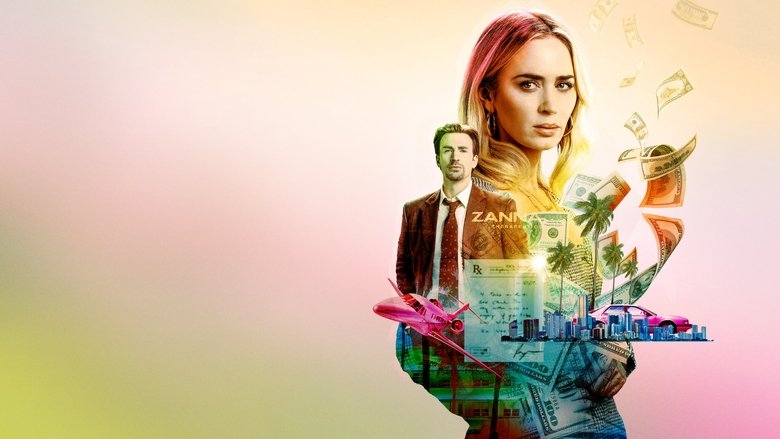
Blunt, who can usually sell even the most underwritten material, nearly pulls it off. She’s all nervous energy in the early scenes, her body coiled tight like a spring, her smile just a little too wide. There’s a moment where she’s pitching the drug to a room full of skeptical doctors, her voice trembling with the kind of desperation that borders on mania, and for a second, you believe her.
You believe she needs this. But the film undercuts her performance with a script that can’t decide if it’s a character study or a morality play. By the time Liza has her crisis of conscience, it’s too late—the audience has already checked out.
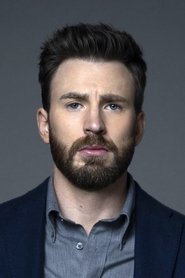
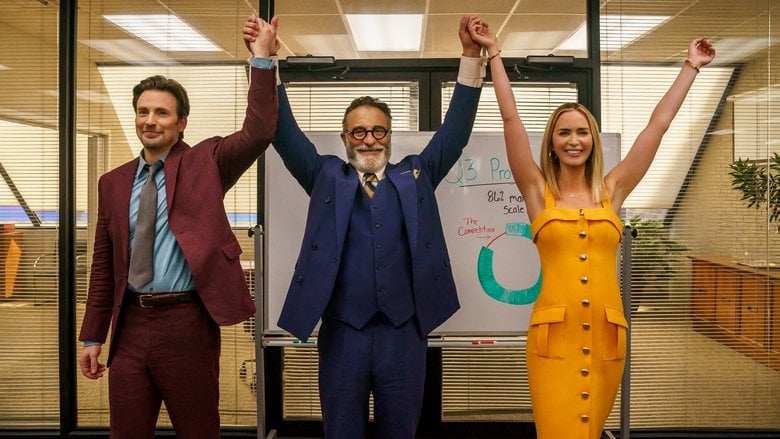
Chris Evans, as her mentor Pete Brenner, fares better, mostly because the film lets him lean into the sleaze. He’s all slicked-back hair and easy grins, the kind of guy who’d sell you a timeshare in hell if the commission was right. Evans has always been good at playing charming assholes (The Gray Man’s Lloyd Hansen comes to mind), and here he’s given just enough rope to hang himself—and the audience—with.
There’s a scene where he’s coaching Liza on how to schmooze a doctor, his voice dropping into a conspiratorial whisper as he explains the art of the bribe. It’s the kind of moment that should make your skin crawl, but the film undercuts it with a cutaway to a freeze-frame and a mockumentary-style interview, as if to say, Isn’t this wild? The problem is, it’s not wild. It’s predictable.
And worse, it’s boring.
The film’s biggest sin isn’t its tonal whiplash, though. It’s that it never really sees the people it’s supposed to be about. The opioid crisis isn’t just a backdrop here; it’s the entire point.
But the victims—the ones left in the wake of Zanna’s greed—are reduced to faceless statistics, mentioned in passing or glimpsed in montages set to somber music. There’s a scene where Liza visits a pain clinic and sees a room full of patients, their bodies broken by addiction, but the film doesn’t linger. It can’t.
To do so would mean confronting the horror of what’s happening, and Pain Hustlers isn’t interested in horror. It’s interested in Liza’s journey. And that’s the problem.
I’ve seen this trick before. The Wolf of Wall Street comparison isn’t just lazy shorthand—it’s the film’s entire playbook. The mockumentary framing, the freeze-frames, the voiceover that winks at the audience like we’re all in on the joke.
But where Scorsese’s film was a raucous, unapologetic indictment of greed, Pain Hustlers is a film that wants to have its cake and eat it too. It wants to be a satire of corporate malfeasance, but it also wants to be a redemption story. It wants us to laugh at the absurdity of it all, but it also wants us to feel the weight of the lives destroyed.
It can’t do both. Not like this.
The third act is where the film finally seems to realize it’s in over its head. The FBI closes in, the company’s house of cards collapses, and Liza is left holding the bag. There’s a moment where she’s standing in her daughter’s hospital room, the weight of what she’s done pressing down on her, and for a second, it almost works.
Blunt sells the hell out of it—her face is a mask of guilt and exhaustion. But then the film cuts to a montage of her testifying in court, her voiceover intoning about how she’s trying to make things right, and it’s all so tidy, so neat, that it undercuts the messiness of what came before. Real life isn’t neat.
Real consequences aren’t resolved in a three-minute montage set to inspirational music.

Roger Ebert’s review called Pain Hustlers “a boring chronicling,” and I can’t argue with that. It’s not that the film is bad, exactly. It’s that it’s safe.
It skims the surface of a story that deserves to be dug into, and in doing so, it reduces the opioid crisis to a plot device. The real Insys scandal was a horror show of corporate greed and human suffering, a story that implicated doctors, executives, and a system that prioritized profits over people. Pain Hustlers touches on all of that, but it never really grabs it. It’s content to be a glossy, Netflix-friendly drama, the kind of film you watch on a Tuesday night and forget by Wednesday morning.
That’s not to say there aren’t flashes of what this film could have been. There’s a scene where Liza is at a company retreat, and the sales reps are being rewarded with a trip to a strip club. The camera lingers on the dancers, their faces blank, their bodies moving mechanically, and for a second, you see the film’s potential.
This is what it’s all about, the scene seems to say. The dehumanization. The way capitalism turns everything—even pain—into a commodity.
But then the moment passes, and we’re back to Liza’s redemption arc, and the film’s courage fails it.
I wanted to like Pain Hustlers. I really did. The cast is great, the premise is timely, and the subject matter is important.
But the film’s refusal to commit—to either the satire or the tragedy—leaves it stranded in no-man’s-land. It’s not funny enough to be a dark comedy, not serious enough to be a drama. It’s a film that wants to have it all, but in the end, it doesn’t have much of anything.
Maybe that’s the point. Maybe Pain Hustlers is a film about the emptiness of the hustle, about how chasing the next big score leaves you with nothing. If so, it’s a meta-commentary that the film itself doesn’t seem to realize it’s making.
Because in the end, Pain Hustlers is a hustle. A slick, well-acted, but ultimately hollow one. And like all hustles, it leaves you feeling a little dirty.
A little used. And a lot like you’ve just wasted your time.
Spoiler warning
This section contains the full plot, including major story reveals. Overview above stays spoiler-free.
David Yates’ Pain Hustlers (2023) is a sharp pivot from the director’s blockbuster fantasy roots—think Harry Potter and Fantastic Beasts—to a gritty, satirical takedown of Big Pharma’s role in the opioid epidemic. Starring Emily Blunt and Chris Evans, the film blends crime, comedy, and drama, but its tonal shifts have left critics divided. latestnetflix.com's view is that here’s what we know about the making of this Netflix Original.
Yates, best known for his work on family-friendly franchises, took a dramatic left turn with Pain Hustlers. The film is based on Evan Hughes’ 2022 book of the same name, which chronicles the real-life scandal surrounding Insys Therapeutics, a company accused of fueling the opioid crisis through aggressive (and allegedly criminal) sales tactics. The project marks Yates’ first foray into dark comedy, a genre that demands a delicate balance between humor and horror—something the film struggles with, according to early reviews.
While Yates’ previous collaborations with Warner Bros. Leaned into spectacle, Pain Hustlers trades wands for white-collar crime. The director’s decision to tackle such a timely and controversial subject suggests a desire to flex his dramatic muscles, though the film’s reception hints at a rocky transition.
Emily Blunt stars as Liza Drake, a struggling single mother who lands a job at a failing pharmaceutical company and quickly climbs the corporate ladder—only to find herself entangled in a federal conspiracy. Blunt, known for her versatility in films like A Quiet Place and The Devil Wears Prada, takes on a role that blends desperation with ambition, a far cry from her usual polished performances.
Chris Evans, fresh off his tenure as Captain America, plays Pete Brenner, Liza’s morally ambiguous mentor. Evans’ casting is a masterstroke; his charm and boyish grin make his character’s sleaziness all the more unsettling. The supporting cast includes Catherine O’Hara as a high-powered executive, Andy Garcia as the company’s enigmatic CEO, and Jay Duplass as a conflicted colleague—each bringing their own brand of dark humor to the story.
Rumors swirled about the chemistry between Blunt and Evans, with some insiders suggesting their off-screen rapport added depth to their on-screen dynamic. However, no concrete details about their working relationship have surfaced, so this remains unconfirmed.
Pain Hustlers bills itself as a crime comedy, but critics argue it struggles to maintain its satirical edge. The Chicago Sun-Times called the film’s shift from "breezy satire to heavy drama" jarring, noting that the tonal inconsistency undermines its impact. The first act plays like a Wolf of Wall Street-lite romp, with Liza’s rise in the pharma world depicted through fast-paced, darkly humorous sequences. But as the stakes escalate and the legal consequences loom, the film pivots to a more somber tone, leaving audiences unsure whether to laugh or cringe.
This tonal ambiguity might be intentional—a reflection of the real-life absurdity of corporate greed—but it’s a gamble that doesn’t entirely pay off. Some viewers may find the film’s uneven pacing frustrating, while others might appreciate its willingness to tackle a serious subject with irreverence.
Pain Hustlers arrives at a time when the opioid crisis remains a pressing issue in the U.S. The film’s loose adaptation of Insys Therapeutics’ downfall serves as a cautionary tale, though it stops short of being a full-throated exposé. Netflix’s involvement ensures a wide release, but the streaming giant’s hands-off approach to marketing means the film’s success hinges on word-of-mouth and critical reception.
Early buzz suggests Pain Hustlers won’t be a awards-season darling, but its star power and timely subject matter could make it a sleeper hit. Whether it lands as a biting satire or a missed opportunity remains to be seen.
Entertainment rumors and trivia aggregated from public reporting. Treat speculation as unverified unless a cited source confirms it.
More titles in the same genres and with the same cast.