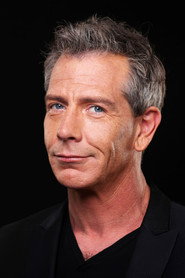
Ben Mendelsohn
Anders Hill

After leaving his wife and his job to find happiness, Anders begins a clumsy, heartbreaking quest to reassemble the pieces of his fractured life.
Official
I keep thinking about the way Ben Mendelsohn’s hands move in The Land of Steady Habits. They’re restless, always adjusting a cuff or tapping against a thigh, as if his body is trying to outrun the stillness of the life he’s built. Anders Hill, the character he plays, is a man who has done everything right—suburban house, financial security, a wife who still looks at him with something like fondness—and yet, at some indistinct point, the whole arrangement has gone numb.
The film, directed by Nicole Holofcener, is a study in the slow collapse of a man who thought he wanted freedom, only to discover that freedom is just another kind of emptiness.
Holofcener has always had a gift for capturing the awkward, unspoken tensions of middle-class life, but here she turns her lens on a man who is, in many ways, her opposite demographic: a middle-aged white guy in Connecticut who quits his job, leaves his wife, and tries to reinvent himself as a carefree bachelor. It’s a premise that could easily tip into farce, but Holofcener resists the urge to mock. Instead, she treats Anders with a kind of weary tenderness, the way you might regard a friend who’s made a series of baffling life choices but whom you can’t quite bring yourself to abandon.

The film’s title is a reference to Connecticut, where the story is set—a place where people go to settle into routines so predictable they become invisible. Anders, though, can’t settle. He moves into a small apartment, starts dating a woman young enough to be his daughter (played with brittle charm by Elizabeth Marvel), and reconnects with his adult son, who is struggling with addiction.
But none of it brings him the relief he expected. There’s a moment early on when he attends a party at his old house, now occupied by his ex-wife (Edie Falco) and her new partner. He wanders the rooms like a ghost, picking at the hors d'oeuvres, making small talk with people he’s known for decades but no longer understands.
The camera lingers on his face as he watches his son across the room, and you can see the exact second he realizes how little he knows him. It’s a quiet devastation, the kind that doesn’t announce itself with tears or shouting, just a slow sinking feeling.
Holofcener’s films often hinge on these small, excruciating moments of social awkwardness, and The Land of Steady Habits is no exception. But where her earlier work—Enough Said, Please Give—often found humor in the discomfort, here the tone is more melancholic. The comedy is still there, but it’s muted, like laughter heard through a closed door.
Take the scene where Anders, in a misguided attempt to bond with his son, takes him to a fancy restaurant. His son, played by Thomas Mann, is clearly high, fidgeting in his seat and barely able to hold a conversation. Anders, desperate to connect, keeps ordering more food, more wine, as if generosity can bridge the gap between them.
The scene is painful to watch, not because it’s over-the-top, but because it’s so recognizably human. How many of us have tried to fix something with money or effort, only to realize too late that the problem was never about what we could give?
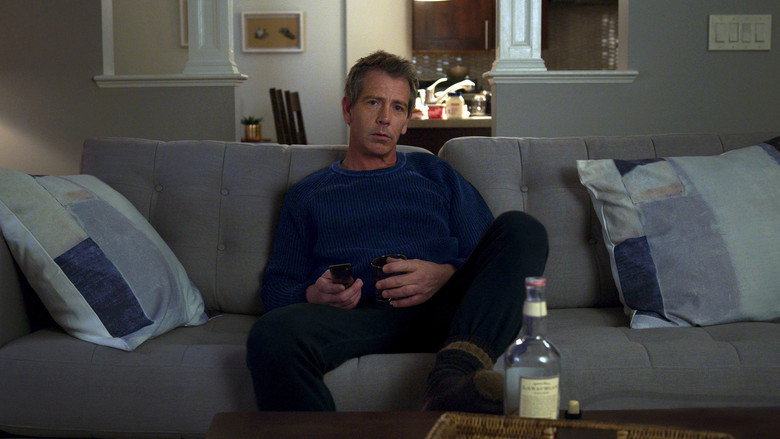
Mendelsohn is extraordinary in the role, though it’s not the kind of performance that announces itself with big gestures or showy monologues. Instead, he does something much harder: he makes Anders’ quiet despair feel like a physical presence. There’s a scene where he’s sitting in his car, listening to a voicemail from his ex-wife.
The camera stays on his face as the message plays, and you can see the exact moment when the weight of his choices settles over him. He doesn’t cry or rage; he just exhales, long and slow, like a man who’s been holding his breath for years. It’s a masterclass in understated acting, the kind that doesn’t register as acting at all.
Falco, too, is excellent as Helene, Anders’ ex-wife, though her role is smaller. She brings a quiet strength to the character, a woman who has moved on but isn’t entirely sure she’s happier for it. Their scenes together are some of the film’s most affecting, not because they’re dramatic, but because they’re so painfully ordinary.
In one scene, they sit in a car together, talking about their son, and for a brief moment, it’s as if the years of marriage haven’t slipped away. Then the moment passes, and they’re just two people who used to know each other, trying to navigate the awkwardness of what comes next.
What’s striking about The Land of Steady Habits is how little it judges its characters. Holofcener doesn’t offer easy answers or tidy resolutions. Anders isn’t punished for his mistakes, but he isn’t rewarded, either.
He’s just left to sit with the consequences of his choices, which is perhaps the most honest outcome of all. The film’s final scene is a perfect example of this. Anders attends a holiday party at his ex-wife’s house, and for a moment, it seems like he might finally find some peace.
But then the moment passes, and he’s left standing alone in the kitchen, staring at the wall. It’s not a triumphant ending, but it’s a true one.

I’ve seen this film described as a portrayal of "suburban malaise," and while that’s accurate, it feels too clinical a term for what Holofcener captures here. Malaise suggests a kind of passive dissatisfaction, but Anders’ struggle is more active than that. He’s not just bored or restless; he’s engaged in a desperate, clumsy attempt to reclaim something he can’t even name.
The tragedy of the film is that he thinks the problem is his life, when really, the problem is him. Or maybe it’s not a tragedy at all. Maybe it’s just life—messy, unresolved, and stubbornly resistant to the neat narratives we try to impose on it.
In the end, The Land of Steady Habits is a film about the stories we tell ourselves to make sense of our choices, and the moments when those stories fall apart. It’s not a flashy movie, or a particularly hopeful one. But it’s a deeply honest one, and in a culture that often confuses happiness with the absence of pain, that feels like a radical act.
I keep coming back to that image of Mendelsohn’s hands, always moving, always restless. Maybe that’s the point. Maybe the habits we think will save us are the very things that keep us from truly living.
"A quietly observant but uneven dramedy about midlife disillusionment, anchored by Ben Mendelsohn’s understated performance."
The film gives a nuanced portrait of a man navigating retirement and marital collapse, and Mendelsohn’s subtle performance draws consistent praise. The pacing and lack of narrative momentum frustrate, though: the story meanders and the emotional payoff underwhelms. The competent supporting cast rarely leaves a strong impression, and the tone can be too subdued for its own good.
Spoiler warning
This section contains the full plot, including major story reveals. Overview above stays spoiler-free.
Nicole Holofcener’s The Land of Steady Habits (2018) is a character study disguised as a midlife-crisis comedy, following Anders Hill (Ben Mendelsohn), a recently retired finance executive who abandons his suburban Connecticut routine—and his wife (Edie Falco)—in search of something undefined. The film, which premiered at the Toronto International Film Festival (TIFF) before landing on Netflix, is vintage Holofcener: sharp, understated, and unafraid to let its characters make messy, unlikable choices. But what went into making this quiet drama? latestnetflix.com's take is that here’s what we know from the limited behind-the-scenes chatter.
Holofcener, known for films like Enough Said (2013) and Please Give (2010), has built a career on exploring the awkward, often cringe-worthy dynamics of middle-aged relationships. The Land of Steady Habits is no exception, adapted from Ted Thompson’s 2014 novel of the same name. While the book and film share a title and protagonist, Holofcener’s version reportedly streamlines the narrative, focusing more on Anders’ emotional unraveling than the novel’s broader ensemble. In interviews, Holofcener has hinted at her personal connection to the material, though specifics remain vague. "I related to the idea of someone feeling stuck in a life they thought they wanted," she said in one clip, without diving deeper into whether the story mirrored her own experiences.
The film’s tone—dry, observational, with a dash of dark humor—aligns with Holofcener’s signature style. A scene highlighted in The New York Times’ "Anatomy of a Scene" breaks down how the film turns an act of trespassing into a moment of awkward comedy, a sign of Holofcener’s ability to find levity in discomfort.
Ben Mendelsohn’s casting as Anders Hill was a coup for the film. Known for playing morally ambiguous characters (The Outsider, Rogue One), Mendelsohn brought a weary charm to Anders, a man whose midlife rebellion feels more sad than triumphant. In a "second look" discussion, Mendelsohn and Falco praised Holofcener’s direction, noting her knack for drawing out natural performances. Falco, who plays Anders’ estranged wife Helene, described the film as "a story about people who think they know what they want, but don’t".
The supporting cast—including Connie Britton as Anders’ love interest and Thomas Mann as his troubled son—adds layers to the story, though their roles are smaller than the novel’s sprawling ensemble. Holofcener’s decision to tighten the focus on Anders’ perspective may have been a creative gamble, but it pays off in Mendelsohn’s nuanced performance.
The Land of Steady Habits premiered at TIFF in 2018, where it garnered early buzz for its performances and Holofcener’s direction. Netflix acquired the film shortly after, positioning it as a prestige drama for the streaming era. However, audience reactions were divided. While some praised its realism and Mendelsohn’s performance, others found the story too meandering or the characters unrelatable. On SensCritique, a French review aggregator, the film holds a modest 5.3/10 rating, with critics noting its "slow burn" approach.
The Rotten Tomatoes page for the film lists Mendelsohn, Falco, and Mann in the cast but offers little additional insight into its reception. Without access to full reviews, it’s hard to gauge the film’s critical legacy, but its Netflix release likely gave it a longer shelf life than a traditional theatrical run might have.
For all its strengths, The Land of Steady Habits remains a relatively low-key entry in Holofcener’s filmography. Behind-the-scenes details are scarce—no leaked set photos, no juicy on-set drama, and no confirmation of whether the cast bonded over the film’s themes of regret and reinvention. Rumors about Holofcener’s adaptation process (e.g., how closely she worked with author Ted Thompson) are unconfirmed, and there’s no evidence of deleted scenes or alternate endings.
If you’re looking for a film with explosive behind-the-scenes stories, this isn’t it. But if you want a quiet, well-observed drama about the messiness of growing older, The Land of Steady Habits delivers—flaws and all.
Entertainment rumors and trivia aggregated from public reporting. Treat speculation as unverified unless a cited source confirms it.
More titles in the same genres and with the same cast.