Nayanthara
Shruthi Lawson

The heiress of a multi-millionaire, a hearing and speech impaired young woman, has to fend off a slasher all alone in her palatial estate.
I keep thinking about the way silence moves through Kolaiyuthir Kaalam. Not the absence of sound—though that’s part of it—but the way quiet becomes a character, a presence that presses against the walls of the estate like a held breath. The film’s premise is simple, almost primal: a deaf-mute heiress, alone in her palatial home, must outwit a slasher who’s come to kill her.
No dialogue to rely on, no screams to alert the outside world. Just the hum of tension, the creak of floorboards, the unspoken language of survival. It’s a setup that should feel familiar—home-invasion thrillers are a dime a dozen—but something about the way director Chakri Toleti frames it makes the air feel heavier, the stakes more intimate.
Maybe it’s because the film doesn’t just ask us to watch a woman fight for her life. It asks us to listen to the silence she’s trapped in.

Toleti has always had a knack for atmosphere. His earlier work, like Billa (2007), leaned into slick, stylized action, but here, he strips things back. The estate—all high ceilings, winding staircases, and cavernous rooms—becomes a maze of dread.
The camera lingers on empty spaces: a doorway left ajar, a staircase spiraling into darkness, a bedsheet fluttering in the breeze. It’s the kind of horror that doesn’t need jump scares to unnerve you. The real terror is in the anticipation, the way the film forces you to sit with the quiet, to imagine what might be lurking just out of frame.
There’s a moment early on where the protagonist, played by Nayanthara, stands in the center of a vast room, her back to the camera. The shot is static, almost painterly, and for a long beat, nothing happens. Then, from the corner of the screen, a shadow shifts.
It’s barely noticeable, but it’s enough. The house exhales.
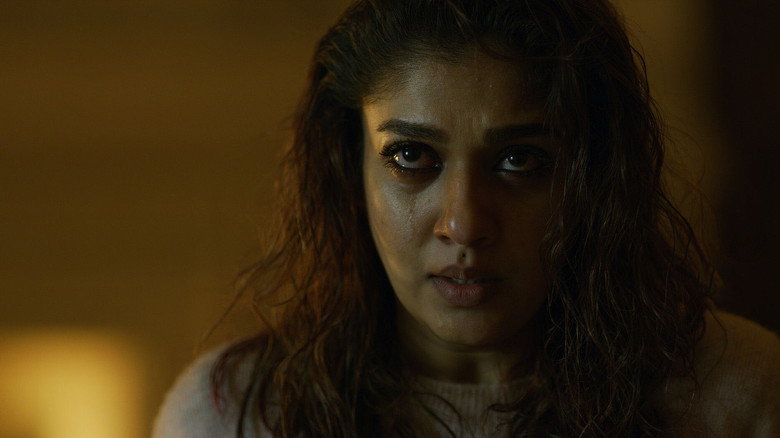
Nayanthara is the film’s anchor, and she carries the weight of the story almost entirely through physicality. There’s no dialogue to lean on, no monologues to sell the emotion. Instead, it’s all in the way she moves—her fingers signing frantically, her body tensing at the slightest vibration, her eyes darting to every soundless corner.
It’s a performance that demands attention, not just because it’s technically impressive (though it is), but because it feels lived in. When she’s cornered, her breath comes in sharp, silent gasps, her chest rising and falling like she’s drowning. When she’s plotting her next move, her gaze hardens, her jaw sets.
There’s no room for error here. One wrong step, and the silence becomes permanent.
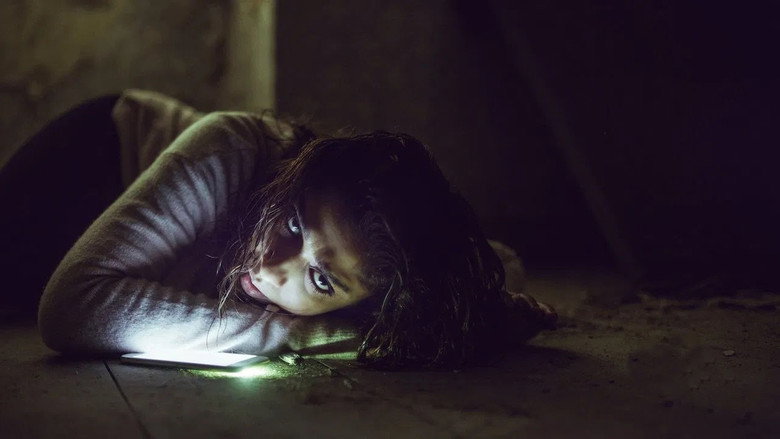
The film’s biggest gamble is its reliance on a single location. Home-invasion thrillers often use the confined space to ratchet up the tension, but Kolaiyuthir Kaalam takes it further. The estate isn’t just a setting; it’s a character, one that feels alive with menace.
The camera prowls through the halls like an intruder itself, peering around corners, lingering on objects that might become weapons (a fireplace poker, a shattered vase). Toleti plays with perspective, too—sometimes we’re right there with Nayanthara, our view limited to what she can see; other times, we’re given a god’s-eye view of the house, watching her navigate the maze from above.
It’s a disorienting effect, one that keeps you off-balance. You’re never quite sure where the danger is coming from, or when it might strike.
That said, the film isn’t without its missteps. The slasher, when he finally appears, is a bit of a letdown—not because he’s poorly acted (though the supporting cast is uneven), but because the film builds him up as this almost supernatural force of evil, only to reveal him as… well, a man. A very human, very flawed man.
It’s not that the twist doesn’t work; it’s that the film struggles to reconcile the mythic horror it’s been selling with the grounded reality of its villain. There’s a moment where the slasher monologues—yes, monologues—about his motives, and it feels like a jarring shift in tone. Up until that point, the film has been so committed to its wordless tension, its reliance on visual storytelling, that the sudden intrusion of dialogue feels like a miscalculation.
It’s as if the film momentarily forgets its own rules.
Still, the final act is where Kolaiyuthir Kaalam finds its footing again. The climax is a brutal, almost wordless confrontation between Nayanthara and her attacker, a fight that plays out in near-silence. There are no last-minute rescues, no deus ex machina.
Just two people, locked in a struggle where every move could be their last. The film’s refusal to soften the ending is its greatest strength. It doesn’t flinch from the violence, nor does it romanticize it.
When the credits roll, you’re left with the echo of that silence—the kind that lingers long after the screen goes dark.
I’m not entirely sure what to make of the film’s low audience score on TMDB (a 3.9/10 from just nine votes, as of the data I have). Maybe it’s the pacing—Kolaiyuthir Kaalam takes its time, and not everyone has the patience for a horror film that’s more about atmosphere than action. Maybe it’s the lack of a traditional payoff; this isn’t a film that rewards you with a neat resolution or a cathartic scream.
Or maybe it’s just that the film’s strengths—its commitment to silence, its reliance on visual storytelling—are the very things that make it a harder sell for audiences used to louder, faster thrills.
But I keep coming back to that hallway shot, the one where the camera lingers on the empty space just a little too long. It’s the kind of moment that doesn’t announce itself as important, but it sticks with you. That’s the thing about Kolaiyuthir Kaalam: it doesn’t just want to scare you.
It wants to make you feel the fear, to sit with it, to let it settle into your bones. And in a genre that often prioritizes shock over substance, that’s a rare and unsettling achievement. The house may be empty by the end, but the silence?
That stays with you.
"A tense but flawed slasher thriller that relies heavily on its lead performance while struggling with predictability and pacing."
Nayanthara earns consistent praise for her intense, emotional performance as a deaf and mute woman trapped in a mansion with a masked killer. Familiar slasher tropes and uneven pacing leave many feeling the film wastes its promising setup. The atmosphere is often praised, but sustained scares and originality are lacking.
Kolaiyuthir Kaalam (2019), directed by Chakri Toleti and starring Nayanthara, was marketed as a high-stakes thriller—but its journey from script to screen was anything but smooth. While the film promised suspense and star power, latestnetflix.com contends, behind-the-scenes drama and mixed reception overshadowed its release.
The movie’s title, Kolaiyuthir Kaalam (transl. Season of Murders), is borrowed from a 1981 Tamil thriller novel by Sujatha Rangarajan. The book, featuring detective duo Ganesh and Vasanth, was a cult favorite, raising expectations for the adaptation. However, the film diverged from the source material, focusing instead on a psychological thriller plot centered around Nayanthara’s character. Whether the shift was intentional or a creative misfire remains debated, but some critics suggested the movie struggled to capture the novel’s essence.
The film’s promotional rollout was chaotic. Multiple YouTube videos claimed to reveal the "official release date," with at least two separate trailers dropping conflicting information. One clip teased a September 2019 premiere, while another hinted at a later slot. The inconsistency fueled speculation about last-minute edits or distribution hurdles, though no official explanation was given.
Kolaiyuthir Kaalam faced backlash even before its release. Veteran actor Radharavi sparked controversy with remarks about Nayanthara, calling her "arrogant" in an interview tied to the film’s promotion. The comments, widely shared on Tamil entertainment channels, added unnecessary drama to the project’s launch.
Critics were equally harsh post-release. Reviews labeled the film an "epic fail," citing weak pacing and a convoluted plot. Rotten Tomatoes, which lists the movie under its title, does not display an audience score, suggesting limited traction or engagement. YouTube reviewers dissected its flaws, with one calling out "main problems" in the screenplay and execution.
Unlike many high-profile Tamil films, Kolaiyuthir Kaalam lacked the usual behind-the-scenes buzz. Nayanthara, typically vocal about her projects, shared minimal updates. Director Chakri Toleti, known for Billa (2007) and Unnaipol Oruvan (2009), also stayed quiet about reshoots or creative struggles. The absence of promotional anecdotes or cast interviews left fans speculating about off-screen tensions.
Despite its star cast—including Bhumika Chawla, Rohini Hattangadi, and international actors like Lee Nicholas Harris—the film faded quickly from conversations. Unlike Sujatha’s enduring novel, the movie failed to leave a mark, overshadowed by its own production woes and lukewarm reception.
For now, Kolaiyuthir Kaalam remains a cautionary tale about the risks of adapting beloved source material—and the perils of a messy rollout.
Entertainment rumors and trivia aggregated from public reporting. Treat speculation as unverified unless a cited source confirms it.
More titles in the same genres and with the same cast.