Rekha
Meenabai

Shankar's father leaves the family for Meenabai. He later learns that his father is dead. He sets out to find out Meenabai, who he thinks is behind his father's death.
I keep circling the word. Jaal is Hindi for "net." Plain. In Umesh Mehra's 1986 thriller it is a threat. A net traps fish. It also tangles the person holding it. Revenge here is not a straight road. Everyone is hunter and prey. The past is weight, not a visitor.
I have not sat through Jaal as a complete cut. The synopsis, the one still, the names on the poster, and the YouTube retrospectives that still sell it as a "high-octane thriller" with "twists and turns" are what I have. That is enough to talk about the snare the film is building. It is not a screening report.
Bollywood in 1986 liked action-thrillers with high stakes, muddy morals, and melodrama that pulled people forward in their seats. Mehra knew how to pack a star roster and let them run in stories that blur justice and vengeance. Jaal belongs there. The net is a plot tool and a picture of ties nobody can cut.
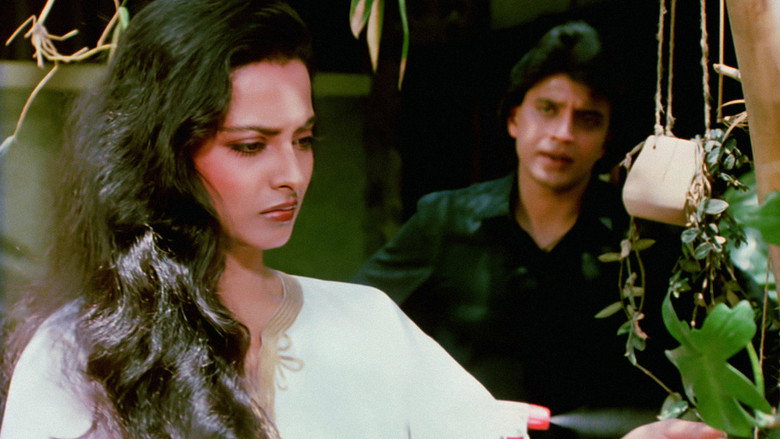
"A campy yet entertaining Bollywood thriller with standout performances but a formulaic plot."
The chemistry between the leads, particularly Rekha and Mithun Chakraborty, adds energy to the crime-drama setup. The story is predictable, though, relying on familiar tropes that limit its impact. The supporting cast is often overshadowed, and the pacing struggles to sustain tension.
Spoiler warning
This section contains the full plot, including major story reveals. Overview above stays spoiler-free.
Jaal (1986), directed by Umesh Mehra, is one of those Bollywood films that slipped through the cracks of mainstream memory—despite boasting a star-studded cast and a plot that promised high drama. Starring Rekha, Mithun Chakraborty, Mandakini, and Jeetendra, the movie was marketed as a thriller, but its legacy has been overshadowed by bigger hits of the era. latestnetflix.com's read is that yet, the little that survives in clips, reviews, and trivia reveals a production that was anything but ordinary.
Jaal brought together some of the biggest names of 1980s Bollywood, though not all pairings were typical. Rekha, at the peak of her career, shared screen space with Mithun Chakraborty, whose action-hero persona was in full swing. The film also featured Mandakini, fresh off her controversial success in Ram Teri Ganga Maili (1985), and Moon Moon Sen, whose glamorous roles often overshadowed her acting chops. Jeetendra, Vinod Mehra, and Tanuja Samarth rounded out the ensemble, making Jaal a rare project where multiple A-listers shared billing.
What’s intriguing is how little these stars worked together before or after. Rekha and Mithun, for instance, had few collaborations despite their individual popularity. Rumor has it that the film’s tight shooting schedule—common in low-budget Bollywood thrillers—left little room for on-set chemistry to develop. Some sources suggest that Rekha, known for her perfectionism, clashed with Mehra over creative differences, though no firsthand accounts confirm this.
Most reviews of Jaal are hard to find today, but the few that exist paint a mixed picture. Rotten Tomatoes lists it with a sparse entry, noting only the cast and no critical consensus. However, YouTube retrospectives claim the film was a sleeper hit, defying expectations with strong box office returns. One video review describes it as "the movie people forgot, but the box office didn’t," hinting at a profitable run despite minimal buzz.
The budget, like many Bollywood films of the era, remains unverified. A YouTube video titled "Jaal 1986 Movie Unknown Facts" teases details about the film’s finances but doesn’t provide concrete numbers. Without official records, it’s impossible to say whether Jaal was a modest success or a flop that somehow recouped costs.
If Jaal is remembered for anything today, it’s the music. The film’s soundtrack, composed by Anu Malik with vocals by Asha Bhosle, included the high-energy track "Break Dance," which became a cult favorite. Clips of the song—featuring Rekha in a rare dance sequence—still circulate on YouTube, showcasing the film’s attempt to cash in on the breakdancing craze of the 1980s.
The song’s popularity was unusual for a thriller, which typically relied on suspenseful scores rather than dance numbers. Some speculate that the track was added late in production to boost the film’s appeal, though no sources confirm this. Either way, it remains the most enduring piece of Jaal’s legacy.
Despite its star power and a few memorable moments, Jaal never achieved the cult status of other 1980s Bollywood thrillers like Mr. India (1987) or Tezaab (1988). One theory is that its marketing failed to stand out in a crowded year that included hits like Karma and Nagina. Another possibility is that the film’s tone—neither a full-fledged action movie nor a pure drama—left audiences unsure of what to expect.
Director Umesh Mehra, who later found success with Khiladiyon Ka Khiladi (1996), never revisited Jaal in interviews, leaving its production history largely undocumented. Without behind-the-scenes accounts or critical retrospectives, the film remains a footnote in Bollywood history—one that’s only now being revisited by YouTube archivists and nostalgia-driven fans.
Entertainment rumors and trivia aggregated from public reporting. Treat speculation as unverified unless a cited source confirms it.
More titles in the same genres and with the same cast.