Kristen Bell
Rachel Hamilton

“There are some journeys you can't take alone.”
When a workaholic young executive is left at the altar, she ends up on her Caribbean honeymoon cruise with the last person she ever expected: her estranged and equally workaholic father. The two depart as strangers, but over the course of a few hilarious adventures, a couple of umbrella-clad cocktails and a whole lot of soul-searching, they return with a renewed appreciation for family and life.
Official
I’ve always been suspicious of movies that send their characters on cruises. There’s something about the forced intimacy of a floating hotel, the way the ocean stretches endlessly in every direction, that feels like a narrative cheat—a way to trap people in a situation until they either fall in love or finally say the thing they’ve been avoiding. Like Father leans into this trope, but with a twist: the cruise isn’t just a setting; it’s a confessional booth with a mai tai in hand. And for Rachel (Kristen Bell), a woman who’s spent her life running from emotional messiness, that might be the only place she can’t outrun her father.
The film opens with Rachel being left at the altar, a moment that should feel like a gut punch but instead lands with the thud of a missed opportunity. It’s not that the scene is poorly acted—Bell sells the humiliation with a quiet, brittle precision—but that the script seems unsure whether to treat it as tragedy or farce. The camera lingers on her frozen smile as the groom bolts, but the score swells with the kind of upbeat, string-heavy optimism that suggests this is all part of some grand romantic comedy plan.
It’s a tonal whiplash that defines the movie: Like Father wants to be both a heartfelt family drama and a breezy vacation comedy, and it can’t quite decide which one it is.

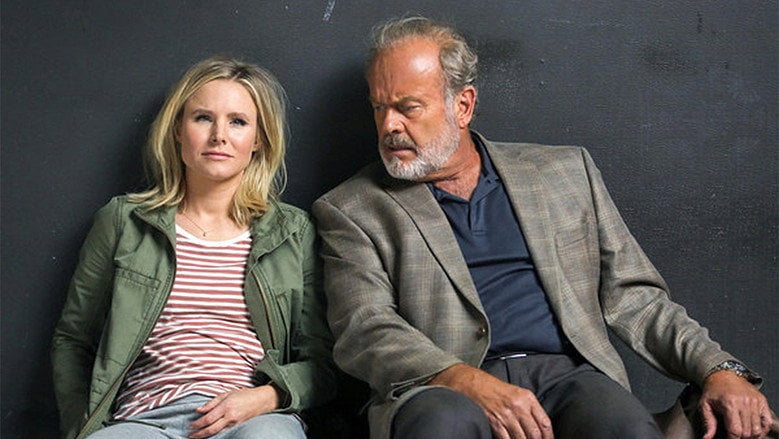
That uncertainty is personified in Rachel’s father, Harry (Kelsey Grammer), who materializes on the honeymoon cruise like a ghost from her past. Grammer, an actor who’s spent decades playing men who are charmingly insufferable (Frasier’s Niles Crane) or insufferably charming (Boss’s Tom Kane), brings a lived-in weariness to Harry. He’s the kind of dad who shows up with a guitar, a joint, and a philosophy about “living in the moment,” which is to say, he’s the exact opposite of Rachel’s Type-A, spreadsheet-organized existence.
Their dynamic is the film’s engine: she’s all clenched jaw and passive-aggressive barbs; he’s all loose limbs and forced whimsy. It’s a classic odd-couple setup, but Grammer and Bell make it feel like something more than a sitcom pilot. There’s a scene early in the cruise where Rachel, still in her wedding dress, finds Harry playing piano in a nearly empty lounge.
He starts singing—badly, off-key—and she stands there, arms crossed, as if his very existence is a personal affront. Then, slowly, she sits down beside him. Not because she wants to, but because she doesn’t know what else to do.
It’s a small moment, but it’s the first time the film feels like it’s about something real: the way family can feel like both a trap and a lifeline.
Lauren Miller Rogen, making her directorial debut, has said that Like Father is a deeply personal project, and that’s evident in the way she frames the relationship between Rachel and Harry. The film’s best scenes are the quiet ones—the two of them sitting on the deck at night, talking about nothing in particular, or Rachel finally admitting that she’s spent her life trying to prove she doesn’t need him.
These moments don’t rely on plot twists or grand gestures; they’re just two people, stuck together, figuring out whether they can stand each other. The problem is that the film keeps undercutting its own sincerity with broad, sitcom-style humor. There’s a subplot involving a stoner cruise ship employee (Seth Rogen, in a role that feels like it was written for someone else) that feels like it wandered in from a different movie, and a third-act detour involving a stolen jet ski that plays like a rejected Hangover outtake.
These aren’t just tonal misfires; they’re distractions from what the film is actually good at: the messy, uncomfortable, sometimes funny work of reconciliation.

What’s frustrating about Like Father is that it’s so close to being something special. Bell and Grammer have a chemistry that feels earned, not manufactured, and there are flashes of real insight in the way the film explores how people change—or don’t. Rachel’s journey isn’t about learning to forgive her father; it’s about learning to see him as a person, flaws and all.
That’s a rare and valuable thing for a movie to say, especially one aimed at a mainstream audience. But the film keeps pulling its punches, as if it’s afraid that too much honesty might scare people off. The ending, in particular, feels like a cop-out—a neat, tidy resolution that wraps up the emotional loose ends with a bow.
It’s the kind of ending that plays well in a trailer but rings false in the moment, like the film is more interested in delivering a feel-good message than in sitting with the discomfort of real growth.
That discomfort is what makes the film’s best moments so compelling. There’s a scene midway through the cruise where Rachel and Harry get into a fight in their cabin. It’s not a big, dramatic blowup; it’s the kind of argument that simmers, the kind that’s been building for years.
Harry accuses Rachel of being just like her mother—cold, controlling, incapable of joy—and for a second, you can see the hurt flash across her face. It’s the first time the film acknowledges that their relationship isn’t just about Rachel’s resentment; it’s about Harry’s failures, too. That moment doesn’t last long—soon, the film is back to its usual mix of quips and slapstick—but it’s the closest Like Father comes to saying something true.
I kept thinking about that scene while watching the rest of the movie, about how rare it is to see a film about a father and daughter that doesn’t treat their relationship as either a punchline or a Hallmark card. Like Father wants to have it both ways—it wants to be a comedy about healing and a drama about family—and in doing so, it never fully commits to either. But maybe that’s the point.
Reconciliation isn’t neat. It’s not a montage set to an uplifting pop song. It’s awkward, and messy, and sometimes you have to laugh to keep from crying.
The film gets that, even if it doesn’t always trust its audience to sit with it.
In the end, Like Father is a movie that’s better in its parts than as a whole. The performances are strong, the setting is lush, and there are moments—brief, fleeting—that feel like they could have come from a much better film. But it’s also a movie that’s afraid to be as complicated as its characters.
It’s easier to send them on a jet ski chase than to let them sit in silence, easier to wrap things up with a hug than to acknowledge that some wounds don’t fully heal. That’s a shame, because the best thing Like Father does is remind us that family isn’t about perfection. It’s about showing up, even when it’s hard.
Even when you’d rather be anywhere else.
"A lighthearted but uneven Netflix rom-com with charming leads and a predictable plot."
Kristen Bell and Kelsey Grammer's warm father-daughter chemistry is the standout. The story leans on clichéd rom-com tropes and the humor often falls flat, making it more forgettable than its cast suggests. Some enjoy its low-stakes charm; others find it too formulaic.
Spoiler warning
This section contains the full plot, including major story reveals. Overview above stays spoiler-free.
Netflix’s 2018 dramedy Like Father brought Kristen Bell and Kelsey Grammer together for a rare on-screen father-daughter dynamic, but the film’s journey to the screen was anything but straightforward. Directed by Lauren Miller Rogen—who also co-stars alongside her real-life husband, Seth Rogen—the movie blends comedy and heart as a workaholic bride (Bell) reconnects with her estranged father (Grammer) during a chaotic Caribbean cruise. latestnetflix.com's read is that Behind the scenes, the project was a passion project for Miller Rogen, taking six years to materialize and offering a glimpse into the challenges of indie filmmaking in the streaming era.
Miller Rogen, best known for her comedic roles in films like Superbad, made her directorial debut with Like Father, a script she developed over half a decade. In interviews, she described the film as deeply personal, though she stopped short of confirming whether it was autobiographical. The six-year timeline wasn’t just about refining the story—it was also about securing financing and distribution, a common hurdle for female-led comedies. Netflix ultimately picked up the film, giving it a platform after years of development limbo.
The director’s connection to the material was evident in her hands-on approach. She not only helmed the project but also played a supporting role, while Seth Rogen—her frequent collaborator—joined the cast in a smaller part. Their real-life chemistry likely added a layer of authenticity to the film’s family dynamics, even if their characters weren’t central to the plot.
The casting of Bell and Grammer was a major selling point for Like Father. Grammer, known for his iconic role as Dr. Frasier Crane, brought gravitas to the role of Harry, a free-spirited father who abandoned his daughter years earlier. Bell, meanwhile, played Rachel, a high-powered executive forced to confront her past when she’s left at the altar and ends up on a cruise with her dad.
Their on-screen chemistry was a focal point of the film’s marketing, with trailers emphasizing the emotional and comedic tension between the two leads. While neither actor has publicly detailed their off-screen relationship, their shared history in comedy (Grammer’s Frasier and Bell’s The Good Place) likely made their dynamic feel natural. The film’s premise—exploring whether people can truly change—resonated with audiences, even if reviews were mixed.
Critically, Like Father landed in a middle ground. Reviewers praised Bell and Grammer’s performances but found the script uneven, with some calling it a missed opportunity for deeper emotional stakes. The film holds a 5.3/10 rating on SensCritique, based on over 600 votes, suggesting a divisive but engaged audience.
Despite its modest reception, the movie remains a notable entry in Miller Rogen’s filmography, marking her transition from actor to director. For Bell and Grammer, it was a rare chance to explore a father-daughter relationship on screen—a dynamic less common in comedy than rom-com tropes. Whether the film will gain a cult following remains to be seen, but its behind-the-scenes story—of persistence, personal investment, and streaming’s role in indie film—is a snapshot of modern Hollywood.
Entertainment rumors and trivia aggregated from public reporting. Treat speculation as unverified unless a cited source confirms it.
More titles in the same genres and with the same cast.