Anne Curtis
Leana

The passenger ship Aurora mysteriously collides into the rocky sea threatening an entire island. A young woman and her sister must both survive by finding the missing dead for a bounty.
I keep thinking about the way water holds memory. Not in the poetic sense—though that’s there too—but in the way it refuses to let go of what’s been lost. Ships sink, bodies disappear, and yet the sea keeps its secrets just beneath the surface, waiting for someone to dive in. Aurora, Yam Laranas’ 2018 horror thriller, understands this better than most.
It’s a film that doesn’t just use the ocean as a setting; it treats it like a character, one that’s patient, indifferent, and ultimately vengeful.
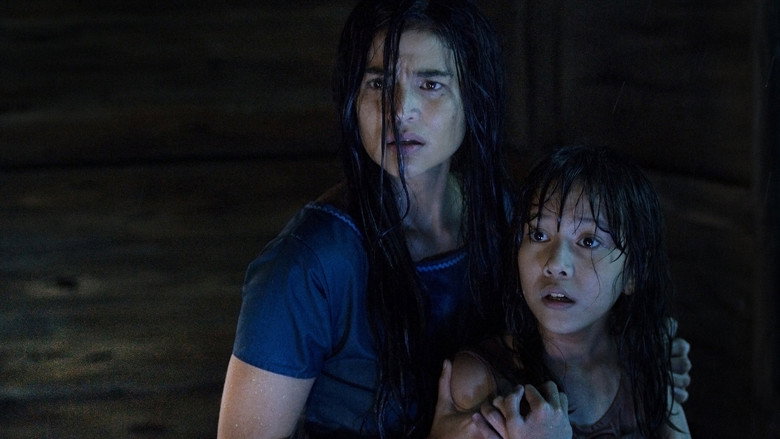
The premise is simple, almost primal: a passenger ship named Aurora collides with rocky seas near an island, and in the aftermath, a young woman (Anne Curtis) and her sister take on a grim task—recovering the bodies of the missing dead for a bounty. On paper, it’s a survival horror setup, the kind that invites comparisons to The Shallows or Triangle. But Aurora isn’t interested in the mechanics of escape.
It’s interested in what happens when the dead don’t stay dead, when the sea gives back what it’s taken, and when the living are forced to confront the weight of what they’ve ignored.
Laranas, a director whose filmography leans heavily into horror and thriller genres, has always had a knack for atmosphere over jump scares. Here, he leans into the eerie stillness of the aftermath. The film opens with the collision, but it’s not the crash itself that lingers—it’s the silence that follows.
The camera lingers on the wreckage, the waterlogged debris, the way the island looms in the distance like a silent witness. There’s no score here, no swelling strings to tell us how to feel. Just the sound of the waves, the creak of the ship, and the occasional distant scream.
It’s unsettling in the way real trauma is: quiet, persistent, impossible to shake.
The choice to center the story on a bounty hunt is a smart one. It grounds the supernatural elements in something tangible—greed, desperation, the way people will exploit even the worst tragedies for a paycheck. Curtis’ character, Leana, isn’t a hero.
She’s a survivor, and her motivations are messy. There’s a scene early on where she and her sister argue over whether to take the job. The sister, played by Mercedes Cabral, is hesitant, almost superstitious.
Leana, though, is pragmatic. “We need the money,” she says, and the line lands like a stone. It’s not just about the dead; it’s about the living who are barely hanging on. The film never lets us forget that.
What’s striking about Aurora is how it refuses to explain itself. The supernatural elements—the way the dead seem to be returning, the eerie whispers that follow Leana—are never given a clear origin. Is it the sea’s vengeance?
A curse? The film doesn’t care. It’s more interested in the effect than the cause.
This is horror as mood, not mythology. It’s the kind of film that lingers in your peripheral vision, the kind where you’re not entirely sure what you saw, only that it unsettled you.
The performances, particularly from Curtis and Cabral, sell this ambiguity. Curtis, who had a busy 2018 with Sid & Aya and BuyBust, brings a quiet intensity to Leana. There’s a moment where she’s searching the ship’s lower decks, her flashlight cutting through the dark, and you can see the exhaustion in her posture.
She’s not just afraid; she’s tired. Cabral, meanwhile, plays the sister with a nervous energy, her eyes darting around as if she’s expecting something to jump out at any moment. Their dynamic feels real, lived-in.
These aren’t horror movie archetypes; they’re people who’ve been pushed to the edge and are trying not to fall off.
That said, Aurora isn’t without its flaws. The pacing drags in places, particularly in the middle act, where the film seems to be circling its own mystery without making much progress. There’s a sense that Laranas is more interested in the atmosphere than the plot, and while that works for the film’s tone, it does leave some narrative threads feeling unresolved.
The ending, in particular, is abrupt, almost as if the film itself is exhausted by its own weight. It’s not a bad ending, necessarily, but it’s one that leaves you with more questions than answers—which, depending on your taste, might be the point.
The film’s reception, at least from what little we have, seems to reflect this divide. With a 4.6/10 on SensCritique and a 5.1/10 on TMDB, it’s clear that Aurora didn’t connect with audiences in the way some of its peers did. That’s a shame, because there’s something haunting about it, something that sticks with you long after the credits roll.
Maybe it’s the way it treats the sea as both a grave and a womb, a place of endings and beginnings. Maybe it’s the way it refuses to give us the easy answers we crave. Or maybe it’s just that, in a genre often dominated by spectacle, Aurora dares to be quiet.
I keep coming back to that opening scene—the ship crashing, the water rushing in, the way the camera lingers on the wreckage. It’s not just a disaster; it’s a reckoning. The sea doesn’t care about our grief or our guilt.
It just keeps moving, keeps taking, keeps giving back what we thought was lost. Aurora understands that. And maybe that’s why it feels so unsettling. It’s not just a horror film.
It’s a film about what we owe to the past, and what happens when we try to ignore it.
"A divisive horror-thriller with strong atmosphere but uneven execution, pacing and scares."
The eerie atmosphere and several unsettling moments fit director Yam Laranas' signature horror style. The pacing is sluggish and the scares inconsistent, which blunts the overall impact. Anne Curtis and the rest of the cast are praised, but the story never fully engages.
Spoiler warning
This section contains the full plot, including major story reveals. Overview above stays spoiler-free.
Aurora (2018) marked a bold shift for Filipino actress Anne Curtis, who traded her usual rom-com and drama roles for a full-throttle horror experience under the direction of Yam Laranas. latestnetflix.com's read is that the film, a supernatural thriller set against the eerie backdrop of a ghost ship, became one of the most talked-about projects of the year—not just for its chills, but for the behind-the-scenes buzz surrounding its star and director’s first collaboration.
Curtis and Laranas had never worked together before Aurora, despite both being heavyweights in Philippine entertainment. The anticipation was palpable, with media outlets hyping their "unang pagsasama" (first collaboration). In a pre-release media conference, Curtis and Laranas teased the film’s dark tone, hinting at the challenges of shooting a horror movie that relied heavily on atmosphere and suspense rather than jump scares. Laranas, known for his work in independent horror and thriller films like The Road (2011), brought a gritty, slow-burn style to Aurora, a departure from the glossier projects Curtis was known for.
The film’s premise—a group of strangers trapped on a haunted ferry—was a risky bet for Curtis, who had built her career on lighthearted roles. But the actress embraced the challenge, with early promotional material positioning her as the film’s central figure ("Anne Curtis may bibida sa pelikulang Aurora"—Anne Curtis will star in the movie Aurora). The shift into horror was a gamble, but one that paid off when Aurora became an official entry in the 2018 Metro Manila Film Festival (MMFF), a prestigious local showcase.
After its theatrical run, Aurora found a second life on Netflix, which acquired the film and introduced it to a global audience. The streaming deal was a coup for the production, though reviews were decidedly mixed. On SensCritique, the film holds a modest 4.6/10 rating, with critics and audiences divided over its pacing and execution. Rotten Tomatoes, meanwhile, offers no critic or audience score for the film, leaving its reception somewhat opaque.
Laranas, in interviews, defended the film’s deliberate tension, emphasizing that Aurora was designed to unsettle rather than rely on cheap thrills. The director’s background in cinematography (he often shoots his own films) lent the movie a moody, visually striking aesthetic, even if the story didn’t resonate with everyone. For Curtis, the role was a chance to prove her range, though some fans struggled to reconcile her with the film’s grim tone.
Little is confirmed about on-set drama, but the film’s production wasn’t without speculation. Some industry insiders whispered about the difficulties of shooting a horror movie in tight, confined spaces (like a ferry set), which can amplify tensions among cast and crew [unconfirmed]. Others pointed to the logistical hurdles of filming supernatural scenes, though no major controversies surfaced publicly.
What is clear is that Aurora was a passion project for Laranas, who has long been drawn to horror’s ability to explore human fear. For Curtis, it was a calculated risk—one that expanded her filmography but didn’t quite catapult her into horror icon status. Still, the film remains a curiosity for fans of Filipino cinema, particularly those intrigued by genre experiments in local filmmaking.
Years after its release, Aurora lingers in the conversation more for its behind-the-scenes story than its impact. The Netflix acquisition ensured it reached a wider audience, but it never achieved the cult following of Laranas’ earlier work or the mainstream success of Curtis’ biggest hits. That said, the film’s existence—born from the unlikely pairing of a rom-com queen and a horror auteur—makes it a fascinating footnote in Philippine cinema.
For now, Aurora shows the risks artists take when they step outside their comfort zones. Whether it’s remembered as a bold experiment or a flawed curiosity may depend on who you ask.
Entertainment rumors and trivia aggregated from public reporting. Treat speculation as unverified unless a cited source confirms it.
More titles in the same genres and with the same cast.