Dileesh Pothan
Secretary Avaran

A historic rifle club in the Western Ghats becomes the center of a thrilling fight for survival when a dangerous arms dealer and his gang come seeking revenge. The club’s members, skilled hunters with a shared passion, work together to protect their lives and their legacy.
I’ve seen this trick before: a rifle club as a stand-in for masculinity, a found family of men (and a few women) who shoot first and ask questions never. It’s a setup that’s been done in spaghetti Westerns, in The Wild Bunch, in Tremors if you squint hard enough. But Rifle Club isn’t trying to reinvent the wheel.
It’s trying to see how fast that wheel can spin before it flies off the axle.
Aashiq Abu, who also shot the film, knows the Western Ghats aren’t just a backdrop—they’re a character. The mist clings to the trees like a second skin, and the light filters through the canopy in shafts that feel almost holy. He leans into that, framing his actors in rich, painterly compositions that make you forget, for a moment, that you’re watching a film about men with guns.
Then the guns go off, and the spell is broken. Or is it? The violence here isn’t glamorous, but it’s not exactly condemned either.
It’s just… there. A tool, like a hammer or a plow. You can build a house with it or cave someone’s skull in.
The film’s opening sequence is a masterclass in tension. We start with a wedding photograph—bright, joyful, frozen in time. Then the camera pulls back, and the photo is revealed to be a framed memory in a dimly lit room.
The transition is seamless, almost imperceptible, but it tells you everything you need to know about Rifle Club: this is a story about the past bleeding into the present. The past, in this case, is 1991, a time when the Western Ghats were a lawless frontier, and the rifle club was both a brotherhood and a business. The present?
Well, the present is when the past comes calling, and the men (and women) of the club have to decide whether to answer.
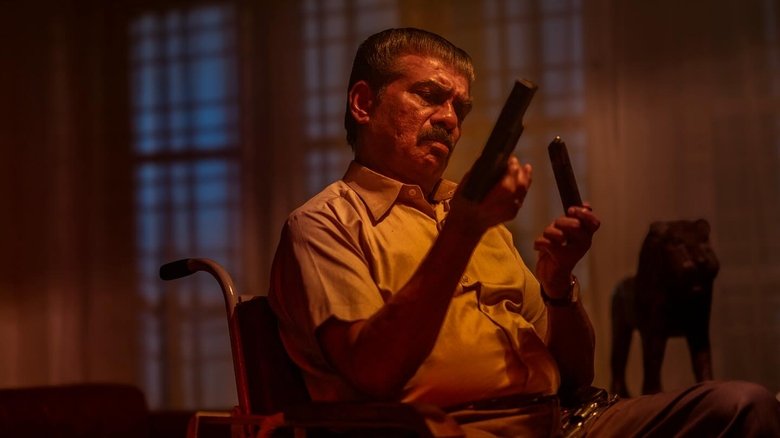
Dileesh Pothan plays Avaran, the club’s secretary, a man who carries himself like a coiled spring. He’s not the loudest in the room, but he’s the one everyone listens to. Pothan has a way of saying everything with his eyes, and here, they’re always calculating, always measuring.
When he finally snaps—when the violence he’s been holding back erupts—it’s not cathartic. It’s exhausting. That’s the point, I think.
Abu isn’t glorifying this world; he’s showing how tired it is.
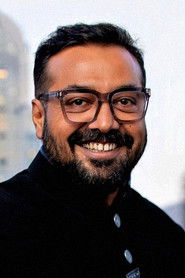
Then there’s Anurag Kashyap as Dayanand Bare, the film’s antagonist. Kashyap, the Bollywood maverick, is an odd choice for a Malayalam action-thriller, but he slips into the role like a well-worn glove. Dayanand is a man who enjoys his work a little too much, and Kashyap plays him with a smirk that’s equal parts charming and chilling.
He’s not a cartoon villain, but he’s not exactly subtle either. When he delivers a monologue about power and control, it’s hard not to think of Gangs of Wasseypur, Kashyap’s own ode to violence and masculinity. The difference?
In Rifle Club, the women are just as deadly as the men.
Vani Viswanath’s Ittiyanam is the film’s secret weapon. She’s a sharpshooter, a woman who moves through the world with a quiet confidence that makes the men around her look like children playing dress-up. When she takes aim, you believe she could hit a target a mile away.
When she speaks, you listen. It’s a shame the film doesn’t give her more to do—she’s easily the most compelling character in the ensemble—but what’s there is electric. The same goes for Surabhi Lakshmi, who plays a club member with a dark sense of humor and a sharper aim.
These women aren’t just there to prop up the men; they’re there to remind us that the rifle club isn’t just a boys’ club. It’s a family, for better or worse.

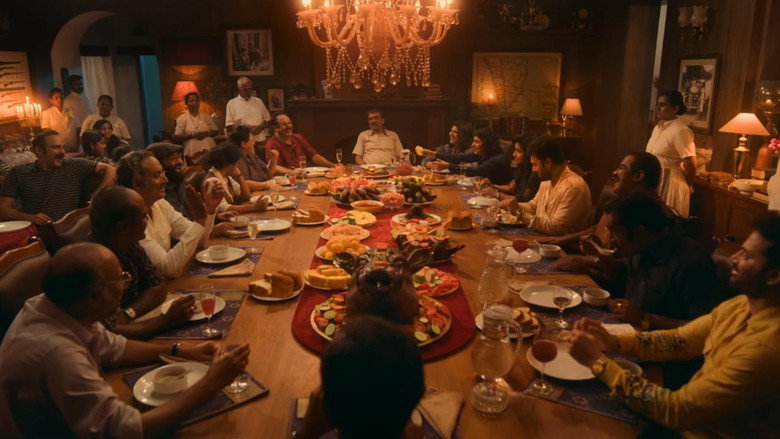
The film’s biggest strength is its world-building. The rifle club feels lived-in, a place where men (and women) have spent years drinking, shooting, and avoiding the outside world. The dialogue crackles with the kind of easy camaraderie that only comes from years of shared history.
But that’s also its biggest weakness. The film is so in love with its own atmosphere that it forgets to give us a story worth caring about. The plot—something about a revenge scheme and a betrayal—is thin, and the twists are telegraphed miles away.
By the time the final shootout rolls around, I was more interested in the way the light hit the trees than in who was going to walk away alive.
That’s not to say Rifle Club isn’t entertaining. It is. The action sequences are well-choreographed, the score by Rex Vijayan is a perfect blend of retro and modern, and the cinematography is stunning.
But it’s the kind of film that’s easier to admire than to love. Abu is clearly a talented filmmaker, but he’s also one who’s content to let style stand in for substance. There’s a moment in the film where a character says, “A gun is just a tool.
It’s the man who decides what to do with it.” It’s a line that could serve as the film’s thesis, but it’s also one that Rifle Club never really grapples with. The guns go off, the bodies hit the floor, and the credits roll. What are we supposed to take away from that?
The critics have been kind, but not effusive. The Hindu called it “a treat to watch, but needed better writing,” and I can’t argue with that. The Indian Express was more generous, praising the film’s “bold display of originality,” but even they admitted that the lean script invites deeper analysis precisely because it leaves so much unsaid. That’s the thing about Rifle Club: it’s a film that’s all surface, but what a surface it is.
The frames are rich, the performances are strong, and the atmosphere is intoxicating. But underneath all that polish, there’s not much there.
Maybe that’s the point. Maybe Abu is saying that these men—and this world—are all surface, all style, all violence with no deeper meaning. If that’s the case, then Rifle Club is a success.
It’s a film that knows exactly what it is and doesn’t try to be anything more. But I can’t help but wish it had something to say. The Western Ghats are a beautiful, haunting place, and the rifle club is a fascinating microcosm of masculinity, power, and violence.
It’s a shame the film doesn’t dig deeper.
Still, I couldn’t look away. There’s something hypnotic about Rifle Club, something that keeps you watching even when the story starts to drag. Maybe it’s the performances, or the cinematography, or the way the film captures the eerie beauty of the Ghats.
Or maybe it’s just the guns. There’s a reason we keep coming back to stories about men with guns, even when we know how they end. Rifle Club doesn’t have anything new to say about that, but it says it with style. And sometimes, that’s enough.
"A gripping but uneven action-comedy that makes the most of its Western Ghats setting and leads but stumbles on pacing and tone."
The action-comedy blend, atmospheric setting, and cast chemistry win many over. The middle is sluggish and the balance of humor and thrills inconsistent. The historical backdrop and the hunters' fight with a vengeful gang are highlights.
Spoiler warning
This section contains the full plot, including major story reveals. Overview above stays spoiler-free.
Aashiq Abu’s Rifle Club (2024) is shaping up to be one of the most talked-about Indian films of the year—not just for its high-octane premise, but for the powerhouse ensemble behind it. The Malayalam-language drama-action hybrid marks Abu’s return to the director’s chair after his critically acclaimed Virus (2019), a thriller that cemented his reputation for blending social commentary with edge-of-your-seat storytelling. latestnetflix.com's read is that this time, he’s trading viral pandemics for something even more explosive: a narrative rooted in gun culture, political tension, and the raw energy of its cast.
Rifle Club boasts a lineup that reads like a who’s who of Indian cinema. Leading the pack is Dileesh Pothan, a frequent Abu collaborator known for his nuanced performances in Thondimuthalum Driksakshiyum (2017) and Joji (2021). He’s joined by Vishnu Agasthya, whose breakout role in Minnal Murali (2021) proved his action chops, and Vani Viswanath, a veteran actress with decades of experience in Malayalam and Tamil cinema.
But the real buzz surrounds two unexpected names: Anurag Kashyap and Hanumankind. Kashyap, the maverick Bollywood director (Gangs of Wasseypur, Sacred Games), is making a rare acting appearance in a Malayalam film—a move that’s already fueling speculation about his role. Is he playing a villain, a mentor, or something entirely unexpected? Meanwhile, Hanumankind, the viral rapper-turned-actor, brings a fresh, streetwise energy to the project. His inclusion suggests Rifle Club might tap into Kerala’s underground music scene, adding another layer to its gritty aesthetic.
Supporting them are Surabhi Lakshmi (Njan Prakashan), Ramzan Muhammed (Kumbalangi Nights), and Vijayaraghavan, a character actor with a cult following. The ensemble’s diversity—spanning generations, languages, and industries—hints at a story that’s as much about its characters as it is about the world they inhabit.
Details about Rifle Club’s plot remain scarce, but the title and genre tags—drama and action—offer some clues. Abu’s films often explore societal fractures, and a "rifle club" could be a metaphor for everything from political militancy to youth disillusionment. Given Kerala’s history with left-wing extremism and its complex relationship with firearms, the film might look at the state’s socio-political undercurrents.
The 139-minute runtime suggests a tightly wound narrative, possibly following a group of individuals whose lives intersect through a shared obsession with guns. Abu’s Virus (2019) was a slow-burn thriller about a deadly outbreak; Rifle Club could similarly build tension through its characters’ moral dilemmas. Rumors (unconfirmed) suggest a heist or a revenge arc, but with Abu’s track record, expect the unexpected.
Aashiq Abu is known for his meticulous filmmaking, often blending realism with high-stakes drama. Virus (2019) was praised for its documentary-like approach to the Nipah virus outbreak, and Rifle Club might adopt a similar tone—especially if it’s rooted in real-world events. The director’s collaborations with cinematographer Rajeev Ravi (Kammattipaadam, Moothon) suggest a visually striking film, with moody lighting and handheld camerawork to heighten the tension.
The inclusion of Anurag Kashyap, a filmmaker who thrives on chaos and antiheroes, could also signal a shift in Abu’s style. Kashyap’s Bollywood films often feature morally ambiguous characters and explosive violence; his presence in Rifle Club might push the film into darker, grittier territory.
As of now, Rifle Club doesn’t have a confirmed release date, but the buzz is undeniable. The trailer (if one drops) will likely be dissected for clues about Kashyap’s role and the film’s central conflict. Given Abu’s ability to balance commercial appeal with artistic depth, Rifle Club could be a sleeper hit—or a divisive, conversation-starting epic.
One thing’s certain: with this cast and director, Rifle Club isn’t just another action flick. It’s a statement.
Entertainment rumors and trivia aggregated from public reporting. Treat speculation as unverified unless a cited source confirms it.
More titles in the same genres and with the same cast.