
Rajisha Vijayan
Frida Soman
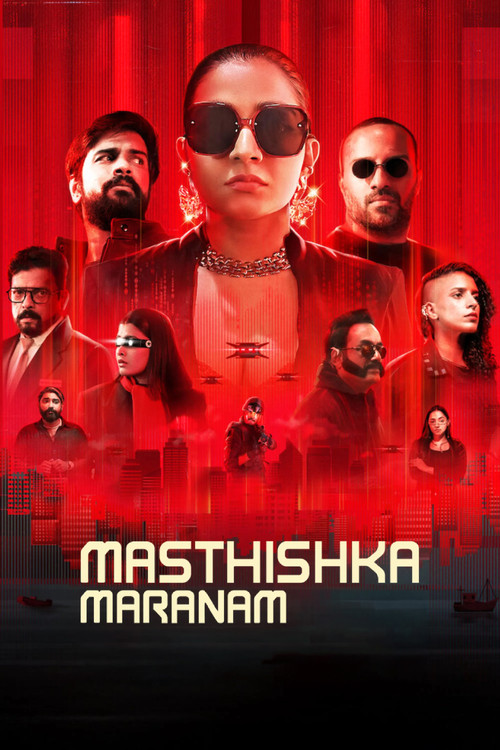
Plunging into a virtual reminiscence challenge to assuage his sorrow, a heartbroken dad uncovers a shocking revelation about Frida Soman, his long-admired icon and globally beloved luminary.
Official
I keep thinking about the moment Rajisha Vijayan’s character, Frida Soman, steps into the neon-lit memory chamber for the first time. The camera lingers on her face—not in close-up, but in a medium shot that lets you see the way her shoulders tense, the way her fingers twitch at her sides like she’s already bracing for impact. There’s something unsettling about the way the light hits her: half her face is bathed in the sickly green glow of the interface, the other half swallowed by shadow.
It’s not just a visual effect; it’s a metaphor for the film itself. Masthishka Maranam is a movie that exists in the flicker between clarity and chaos, between the things it wants to say and the things it can’t quite hold together.
That tension is everywhere. The premise—a grieving father diving into a virtual memory game to uncover the truth about his idol, Frida Soman—sounds like the setup for a slick cyberpunk thriller, the kind of thing that would slot neatly into the algorithm of a streaming platform. But Krishand, the director, isn’t interested in neatness.
He’s interested in mess. The film lurches between slapstick comedy, courtroom drama, and dystopian sci-fi, often within the same scene. It’s as if someone took a handful of genres, tossed them into a blender, and hit pulse.
The result is something that feels alive in a way most films don’t—even if that life is sometimes more like a fever dream than a coherent narrative.

Take the courtroom sequence, for instance. It’s a set piece that should feel like the climax, the moment where all the film’s threads converge. Instead, it’s a masterclass in tonal whiplash.
One minute, you’re watching a high-stakes legal battle, the next, a witness is delivering testimony in the form of a stand-up comedy routine. The judge, played by Jagadish, oscillates between exasperation and deadpan delivery, as if he’s not entirely sure whether he’s presiding over a trial or a particularly surreal improv show. It’s funny, in a way that feels intentional, but also disorienting.
Are we supposed to laugh? Are we supposed to be outraged? The film doesn’t seem to care.
It’s too busy careening toward its next idea.
And that’s the thing about Masthishka Maranam: it’s a film that refuses to sit still. The visuals are a constant barrage of stimuli—glitching interfaces, hyper-saturated colors, rapid-fire cuts that feel like they’re trying to keep up with the speed of thought. The production design is a love letter to cyberpunk, but with a distinctly Malayali twist.
The futuristic cityscape isn’t Blade Runner’s rain-soaked Los Angeles; it’s a neon-drenched Kochi, where the skyscrapers are adorned with Malayalam graffiti and the holograms advertise local brands. It’s a world that feels both familiar and alien, like a place you’ve visited in a dream.
The sound design is just as immersive. The score, a mix of electronic beats and traditional instruments, pulses under every scene, heightening the sense of unease. There’s a moment early on where the protagonist, Simon, first plugs into the memory game.
The sound drops out completely, replaced by a high-pitched whine, like a television tuning between channels. It’s a simple effect, but it’s devastating. You can feel the disorientation, the way the world is slipping away from him.
It’s one of the few times the film slows down enough to let you breathe—and it’s all the more powerful for it.

Rajisha Vijayan is the film’s anchor. Her performance as Frida Soman is a revelation. She’s magnetic, even when the script isn’t giving her much to work with.
There’s a scene where she’s being interrogated, and the camera holds on her face as she delivers a monologue about memory and truth. Her eyes dart around the room, her voice cracks, and for a moment, you can see the weight of everything she’s carrying. It’s a small moment, but it’s the kind of thing that lingers.
(I’ve seen it three times now, and I still can’t shake it.) The gossip around her “item song” controversy—whether she betrayed her principles by doing it—feels like a distraction. The real story is in her performance. She’s not just playing a character; she’s embodying the film’s contradictions, its brilliance and its flaws.
The supporting cast is hit or miss. Niranj, who plays Simon, is compelling in the quieter moments, but the film often saddles him with broad, slapstick comedy that undercuts his emotional arc. Divya Prabha, as Desdemona, is a standout—her deadpan delivery and physical comedy feel like they belong in a different, sharper film.
The rest of the cast is serviceable, but they’re often overshadowed by the film’s relentless energy.
That energy is both the film’s greatest strength and its biggest weakness. Masthishka Maranam is a movie that wants to do everything at once. It wants to be a satire of capitalism, a meditation on grief, a cyberpunk thriller, and a slapstick comedy. Sometimes, it succeeds.
The scenes where it leans into its sci-fi elements—like the memory game sequences, which feel like a cross between Black Mirror and a fever dream—are electrifying. Other times, it feels like it’s trying to cram too many ideas into a single frame. The humor, in particular, is a mixed bag.
Some of the jokes land, but others feel forced, like the film is trying too hard to be clever.
The audience reception has been just as divided as the film itself. Some viewers have embraced its chaos, calling it a bold, experimental work that pushes the boundaries of Indian cinema. Others have dismissed it as a mess, a film that’s all style and no substance.
I can see both sides. There are moments where Masthishka Maranam feels like it’s on the verge of something great, only to stumble into self-indulgence. But even at its most frustrating, it’s never boring.
It’s a film that demands your attention, even if it doesn’t always reward it.

The ending, in particular, is a microcosm of the film’s strengths and weaknesses. Without giving too much away, it’s a twist that feels both inevitable and unsatisfying. It’s the kind of ending that makes you go, “Oh, that’s what it was about,” but also leaves you with more questions than answers.
It’s fitting, in a way. Masthishka Maranam is a film that’s more interested in the journey than the destination. It’s a glitch in the machine, a moment of chaos in an otherwise orderly system. And maybe that’s the point.
I keep coming back to that shot of Frida in the memory chamber. The way the light plays on her face, the way she seems both present and somewhere else entirely. It’s a perfect metaphor for the film itself. Masthishka Maranam is a movie that exists in the space between what it is and what it could be.
It’s messy, ambitious, and often frustrating. But it’s also alive in a way that most films aren’t. And for that, I can’t help but admire it—even if I’m not entirely sure it works.
"A wild, visually striking cyberpunk satire powered by Rajisha Vijayan’s fearless performance but dragged down by cluttered writing, uneven comedy, and polarizing execution."
Performances—especially Rajisha Vijayan’s—plus bold world-building, inventive visuals, and an atmospheric score earn strong admiration, with some calling the film historic for tackling memory, voyeurism, and capitalism through sci-fi. The narrative, though, is overstuffed and structurally shaky, with confusing storytelling, tonal whiplash, and comedy that often misfires; some walked out or called it “brain rot,” while others embrace it as messy but fascinating.
Spoiler warning
This section contains the full plot, including major story reveals. Overview above stays spoiler-free.
In the film, memories glitch. Outside the film, it’s reputations. From “item song” outrage to a director telling viewers to go ask an AI, Masthishka Maranam has generated more discourse than some entire filmographies. latestnetflix.com's take is that Buckle up: here’s the tea that’s actually been spilled.
Bottom line: No reported on‑set fistfights, no lawsuits, no walk‑outs. But between Rajisha’s “item song” backlash, the Dileep‑coded dialogue, a director who tells confused viewers to go consult an AI, and fan theories detonating across Reddit, Masthishka Maranam has quietly become the most gossip‑dense sci‑fi satire in recent Malayalam memory — exactly the kind of messy future its own Neo‑Kochi would binge as premium content.
Entertainment rumors and trivia aggregated from public reporting. Treat speculation as unverified unless a cited source confirms it.
More titles in the same genres and with the same cast.