Soubin Shahir
Thaju

A petty misunderstanding changes Thajudheen and Benny's relationship from friends to foes. Thajudheen goes above and beyond to prove his innocence but ends up making things worse for his loved ones.
Official
I’ve seen this story before. Two men, bound by years of shared laughter and small-town routine, let a single spark of pride ignite a bonfire that burns everything around them. It’s a tale as old as male friendship itself—think Diner, think The Odd Couple, think every barroom brawl that started over a misplaced joke. Ayalvaashi, Irshad Parari’s debut feature, takes this familiar premise and drapes it in the humid, sun-bleached textures of rural Kerala.
The result is a film that feels both comfortingly familiar and frustratingly slight, like a well-worn shirt that no longer quite fits.
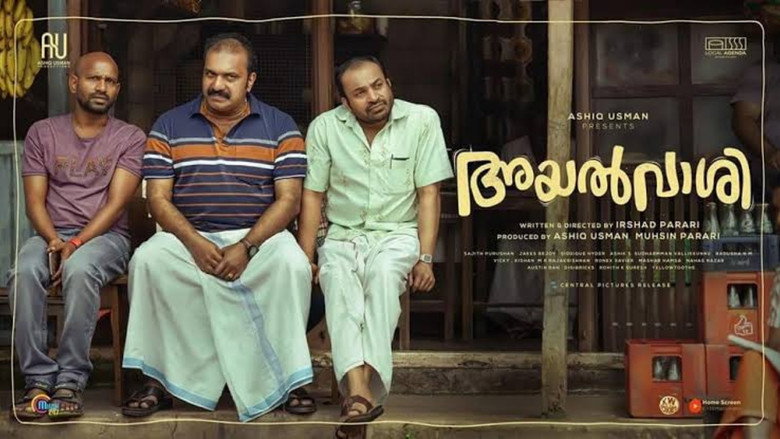
The film opens with Thajudheen (Soubin Shahir) and Benny (Binu Pappu) in their natural habitat: a dusty village where everyone knows your business and your business is usually someone else’s entertainment. They’re the kind of friends who finish each other’s sentences, share cigarettes without asking, and bicker like an old married couple. Their dynamic is warm, lived-in, the kind of easy camaraderie that makes you wish you had a Benny in your own life.
Then, over something so trivial it’s almost embarrassing to name—an unpaid debt, a misheard insult, a borrowed scooter returned with a scratch—the friendship curdles. What follows is a series of escalating retaliations, each more absurd than the last, as the two men drag their families, their neighbors, and half the village into their petty war.
Parari’s script leans hard into the comedy of male ego, and there’s a certain pleasure in watching these two men dig themselves deeper into their own graves. The problem is that the film never quite decides whether it wants to be a farce or a character study. The tonal whiplash is jarring: one moment, we’re laughing at Benny’s latest ridiculous act of vengeance (a goat tied to a neighbor’s doorstep, perhaps?), and the next, we’re expected to feel the weight of Thajudheen’s financial desperation as he scrambles to keep his small business afloat.
The shifts aren’t seamless; they’re more like abrupt gear changes, leaving the audience lurching in their seats.
Soubin Shahir, though, is a marvel. He’s one of those actors who can convey entire worlds with a twitch of his eyebrow or a slump of his shoulders. As Thajudheen, he’s all coiled tension, a man who’s spent his life being the responsible one, the one who smooths things over, only to find himself backed into a corner by his own pride.
There’s a scene midway through the film where Thajudheen, humiliated and broke, sits alone in his empty shop, the camera lingering on his face as he stares at the wall. It’s a quiet moment, almost stolen, but Shahir makes it devastating. You can see the exact second he realizes he’s lost everything—not just the money, not just the friendship, but the version of himself that believed he was above all this nonsense.
It’s the kind of performance that makes you wish the script had given him more to work with.
The supporting cast, unfortunately, feels underutilized. Nikhila Vimal and Lijomol Jose, both actresses capable of stealing scenes with little more than a glance, are relegated to the sidelines as the long-suffering wives. Their characters exist mostly to react to the men’s antics, rolling their eyes or delivering exasperated one-liners.
It’s a shame, because there’s a glimmer of something sharper in their interactions—a sense that these women have their own lives, their own frustrations, that extend far beyond the pissing contest playing out in front of them. But the film never bothers to explore that.
If there’s one sequence that justifies the price of admission, it’s the “Chewing Gum” song. Composed by Jakes Bejoy, it’s a burst of pure, unapologetic joy—a musical interlude that feels like it wandered in from a different, better movie. The song is silly, infectious, and visually inventive, with the camera darting and spinning in time with the music.
For three glorious minutes, Ayalvaashi sheds its self-imposed shackles and just plays. It’s the kind of moment that makes you wonder what the film might have been if it had embraced that sense of freedom throughout.
The cinematography, by Sajith Purushan, is another bright spot. The film’s visual style is light and symmetrical, almost Wes Anderson-esque in its precision, which serves to underscore the absurdity of the characters’ behavior. The bright, saturated colors of the village—turquoise skies, rust-red roofs, the lush green of palm trees—make the pettiness of the feud feel even more ridiculous.
It’s as if the film is winking at the audience: Look how small these men are, against all this beauty.
But for all its technical polish, Ayalvaashi struggles to find its footing. The plot meanders, lurching from one comedic set piece to the next without ever building real momentum. The third act, in particular, feels rushed, as if Parari suddenly realized he was running out of time and tried to tie up all his loose ends in a hurry.
The resolution, when it comes, is tidy to the point of being unsatisfying. It’s the kind of ending that makes you nod and say, “Well, I guess that’s that,” rather than the kind that lingers in your mind for days.
Critics were, for the most part, unimpressed. S. R.
Praveen in The Hindu called the film “marred by a thin plot and listless execution,” while Anna M. M. Vetticad at Firstpost was even blunter: “Barring the Chewing Gum song and Soubin, there’s nothing here.” It’s hard to argue with either assessment. Ayalvaashi isn’t a bad film, exactly—it’s too charming, too earnest, for that.
But it’s a film that never quite figures out what it wants to be. Is it a satire of male pride? A character study of a man in over his head?
A farce about the absurdity of grudges? It tries to be all three, and ends up being none of them particularly well.
That said, I can’t bring myself to dismiss it entirely. There’s something endearing about its messiness, its willingness to embrace the chaos of its own premise. And in Soubin Shahir’s performance, there’s a reminder of why we go to the movies in the first place: to see people, in all their flawed, ridiculous glory, trying and failing and trying again. Ayalvaashi may not be a great film, but it’s a film that feels alive—and sometimes, that’s enough.
I left the theater thinking about Thajudheen. Not the character in the film, but the idea of him—the way we all know a Thajudheen. The friend who can’t let things go, who turns every slight into a federal case, who would rather burn down the world than admit he was wrong. Ayalvaashi doesn’t offer any grand insights into why men do this, why we let pride get the better of us.
But it doesn’t really need to. The film’s power, such as it is, lies in its specificity. It’s a story about two men in one small village, but it’s also a story about all of us—the way we cling to our grievances, the way we let the past poison the present, the way we sometimes need a Benny to remind us that life’s too short for this nonsense.
And maybe, just maybe, that’s enough.
"*Ayalvaashi* (2023) gets a mixed but mostly positive reception: praised for its humor, performances, and emotional moments, faulted for pacing and a predictable plot."
*Ayalvaashi* is liked for its blend of comedy and drama and the chemistry of its cast, particularly Soubin Shahir and Binu Pappu. The humor is the standout, delivering genuine laughs. The story is predictable and thin, especially in the second half, and the emotional moments, though appreciated, can feel underdeveloped or rushed. The Malayalam-language setting and cultural references feel authentic, though non-Malayalam speakers mention missing some nuances. Entertaining but not groundbreaking, it works better as a lighthearted comedy than as a deep drama.
Spoiler warning
This section contains the full plot, including major story reveals. Overview above stays spoiler-free.
Ayalvaashi (2023), the Malayalam-language comedy-drama directed by Irshad Parari, arrived in theaters with a premise that promised both laughs and chaos: a petty misunderstanding spirals into a full-blown feud between two friends, Thajudheen and Benny. But behind the scenes, the film’s production was just as much about collaboration as the on-screen conflict was about rivalry. latestnetflix.com's read is that here’s what we know about the making of this Irshad Parari project—and why it became a talking point for fans of Malayalam cinema.
Irshad Parari, known for his work on Sudani from Nigeria (2018) and Thanneer Mathan Dinangal (2019), wrote Ayalvaashi himself, blending his signature style of sharp humor with emotional depth. The film’s central plot—a friendship derailed by a trivial argument—mirrors the kind of real-life tensions Parari has explored in his previous projects, where small-town dynamics and personal egos collide.
While the evidence doesn’t reveal specific inspirations behind the script, the premise suggests Parari drew from the universal experience of friendships strained by pride and miscommunication. The film’s tone, described as a "comedy-drama," hints at his ability to balance levity with poignant moments, a hallmark of his storytelling.
Ayalvaashi brought together a mix of established and rising stars in Malayalam cinema, with Soubin Shahir and Binu Pappu leading the charge as Thajudheen and Benny, respectively. Shahir, a versatile actor known for his comedic timing (Premam, Kumbalangi Nights), was a natural fit for a role that demanded both humor and pathos. Pappu, who has carved a niche in supporting roles, stepped into a more prominent part, showcasing his ability to hold his own against Shahir’s charisma.
The supporting cast added depth to the film’s ensemble. Nikhila Vimal and Lijomol Jose, both known for their strong performances in Thanneer Mathan Dinangal and The Great Indian Kitchen, respectively, played pivotal roles, though details about their characters remain scarce in the available evidence. Naslen K. Gafoor, a rising star after Kuruthi (2021), and veteran actors like Jagadish and Kottayam Nazeer rounded out the cast, bringing a mix of fresh energy and seasoned expertise.
One notable absence in the snippets is any mention of on-set chemistry or behind-the-scenes dynamics between the cast. However, given Parari’s reputation for fostering collaborative environments, it’s likely the shoot was as lively as the film’s premise.
Produced under the banners of Ashiq Usman Productions and Local Agenda Motion Pictures, Ayalvaashi had a modest but strategic release on April 21, 2023. The film’s production details are thin in the available evidence, but its release timing—amid a resurgence of Malayalam cinema’s global appeal—positioned it as a contender in the comedy-drama space.
The film’s reception, however, remains a bit of a mystery. While the snippets confirm its theatrical run, there’s no mention of box office numbers, critical reviews, or audience reactions. This lack of detail makes it difficult to gauge whether Ayalvaashi was a sleeper hit or a modest success. What we do know is that it arrived at a time when Malayalam cinema was gaining traction for its storytelling, and Parari’s involvement likely drew attention from fans of his previous work.
Despite the film’s release, several aspects of Ayalvaashi remain unclear. For instance:
Rumors about sequels or spin-offs are also absent, leaving fans to speculate whether Ayalvaashi will stand alone or inspire further stories.
Entertainment rumors and trivia aggregated from public reporting. Treat speculation as unverified unless a cited source confirms it.
More titles in the same genres and with the same cast.