Sandeep Pradeep
Peeyoos

“From The Infinite Chronicles of Kuriachan”
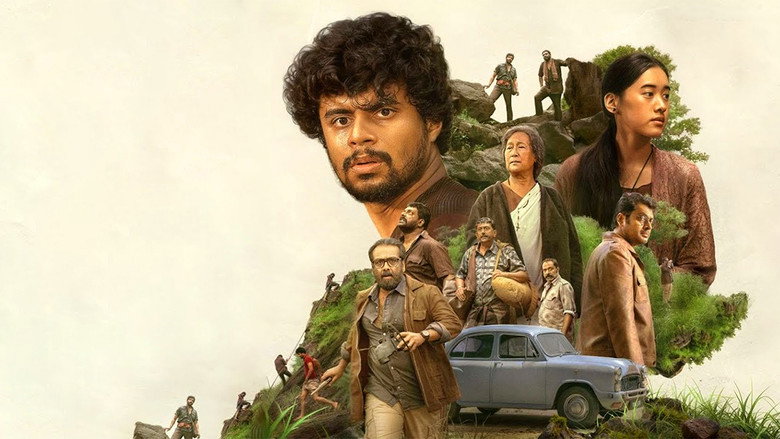
In the misty hills of Kaattukunnu, an aging woman and her servant boy struggle to survive the ghosts of the past, as the hunt for Kuriachan — a legendary dog breeder and outlaw — blurs the line between myth, memory, and vengeance, revealing that even in absence, he still rules the hills.
I keep thinking about the way the rain never stops in Eko. Not the dramatic, cinematic rain that announces itself with thunder and lightning—just a persistent, misty drizzle that soaks everything, blurring the edges of the hilltop house where Mlaathi Chettathi lives with her caretaker, Peeyoos. It’s the kind of rain that doesn’t cleanse so much as it preserves, like a specimen in formaldehyde.
By the time the film ends, you realize the rain wasn’t just weather. It was memory, seeping into the cracks of the story, refusing to let anything dry.

Dinjith Ayyathan and writer-cinematographer Bahul Ramesh have made a thriller that doesn’t just withhold answers—it withholds questions. The plot, such as it is, revolves around the disappearance of Kuriachan, a legendary dog breeder whose name alone seems to command fear and reverence in equal measure. Outsiders arrive in the hills, asking about him, but the film is less interested in solving the mystery than in letting it fester.
What’s striking is how little urgency there is to any of it. The Navy intelligence officer (Narain, doing his best "I have a gun and a frown" routine) moves through the story like a man who’s already accepted that he won’t get what he came for. The dogs, meanwhile, move with purpose.
They patrol the perimeter of Mlaathi’s house, they growl at intruders, they obey her commands with eerie precision. They are the only characters in the film who seem to know exactly what they’re doing.
This is the third film in Bahul Ramesh’s so-called "Animal Trilogy," and if Kishkindha Kaandam used monkeys to explore chaos and Kerala Crime Files 2 used dogs as instruments of violence, Eko treats its canine cast as something closer to a Greek chorus. The dogs aren’t just symbols—they’re participants, their presence shaping the story as much as any human character. There’s a moment early on where Peeyoos (Sandeep Pradeep) tries to feed them, and Mlaathi stops him.
"They’re not pets," she says. It’s a small line, but it reframes everything. These dogs aren’t companions.
They’re enforcers. And if they’re enforcers, what exactly are they enforcing?
The answer, I think, has less to do with Kuriachan than with Mlaathi herself. Biana Momin, a 70-year-old retired English teacher from Meghalaya, delivers a performance so quietly commanding that it’s easy to miss just how much she’s carrying. She plays Mlaathi as a woman who has spent decades constructing a life out of fragments—her Malaysian past, her displacement, her marriage to Kuriachan, her role as both victim and survivor.
The dogs are part of that construction. They’re her protection, her power, her way of controlling a world that has already taken so much from her. When she tells Peeyoos, "I am the only one who can touch them," it’s not just a statement about the dogs.
It’s a statement about her own agency.

The film’s most talked-about scene—the cave reveal—is a masterclass in ambiguity. Without spoiling it, I’ll say this: the moment when the camera finally lingers on what’s inside that cave is less a revelation than a provocation. Bahul Ramesh wanted to cut the shot entirely, arguing that the mystery was stronger without it.
Dinjith Ayyathan pushed back, and what we got was a compromise: a glimpse, but not the whole picture. It’s the kind of ending that doesn’t so much answer questions as it does deepen them. Was Mlaathi a prisoner?
A captor? Both? The film refuses to say, and in that refusal, it becomes something rare—a thriller that trusts its audience to sit with uncertainty.
That trust extends to the film’s pacing, which has frustrated some viewers. Eko is slow, but not in the way that "slow cinema" is often slow. It’s not meditative or contemplative. It’s tense.
The tension comes from the way the film withholds information, yes, but also from the way it withholds emotion. There’s a scene where Peeyoos and the Navy officer have a confrontation in the rain, and it’s shot in a single, unbroken take. The camera doesn’t cut away, doesn’t give us a reaction shot, doesn’t let us off the hook.
We’re forced to watch the entire thing unfold in real time, and by the end, I found myself holding my breath—not because anything explosive happened, but because the film had trained me to expect that something could.
The dogs, of course, are the real stars here. There’s something unsettling about the way they move through the film—silent, watchful, always just out of frame until they’re not. The production team trained 10 dogs for the shoot, using masks and toys to elicit aggression, but the real trick was making them feel like more than just props.
In one of the film’s most striking sequences, Peeyoos is forced to fight his way through a pack of them in a flooded cave. The scene is brutal, visceral, and shot in a way that makes the dogs feel like forces of nature rather than animals. It’s not just that they’re dangerous.
It’s that they’re inevitable.
Baradwaj Rangan called Eko "a very intelligent mystery," and he’s right. But intelligence, in this case, isn’t just about clever plotting. It’s about the film’s understanding of how power works—how it’s constructed, how it’s maintained, how it’s enforced.
The dogs are the most obvious manifestation of that power, but they’re not the only one. There’s the way Mlaathi controls Peeyoos, a young man who may or may not be a prisoner himself. There’s the way Kuriachan’s legend looms over the story, even in his absence.
There’s the way the mist and the rain and the isolation of the setting all conspire to make the characters feel trapped, even when they’re technically free.
I keep coming back to that rain. It’s there in the first shot, and it’s there in the last. It’s the one constant in a film full of shifting perspectives and unreliable narrators.
By the end, I realized that the rain wasn’t just a backdrop. It was the film’s way of telling us that some stories never dry out. Some questions never get answered.
Some cages, once built, never really go away. They just get passed down, from one generation to the next, like a legacy.
And the dogs? They remember. Even if we forget.
"A hauntingly atmospheric drama with strong performances but a slow pace that may test patience."
The moody setting and emotional depth serve the film's exploration of memory and secrets well. Its deliberate pacing and ambiguous narrative, though, can leave you wanting more clarity or momentum. The cast, especially the leads, brings authenticity to their roles.
Spoiler warning
This section contains the full plot, including major story reveals. Overview above stays spoiler-free.
If you thought the dogs were the scariest thing in Eko, wait till you see what was happening behind the camera. latestnetflix.com's view is that From a blink‑and‑you’ll‑miss‑it prop disaster to a 70‑year‑old first‑time star dragged into the misty hills with phonetically memorised Malayalam…this thriller’s off-screen story is just as twisty.
Entertainment rumors and trivia aggregated from public reporting. Treat speculation as unverified unless a cited source confirms it.
More titles in the same genres and with the same cast.