Siddhant Chaturvedi
Neelesh Ahirwar

“When injustice becomes law, resistance becomes duty”
When Neelesh, an idealistic law student from a marginalised section of society, steps into a prestigious institution, he is thrust into a world that doesn't reflect his own. His friendship with Vidhi offers hope-until a wave of tragedy exposes the deep-rooted hierarchies he tried to outrun. He must confront the invisible forces that shape who we are allowed to become and who we are allowed to love.
Official
I kept thinking about the moment Neelesh Ahirwar first steps into the law college courtyard. The camera lingers on his face—not in close-up, but in a medium shot that lets us see the space around him, the way the other students turn to look, the way his shoulders tense just slightly. It’s a small gesture, but it tells us everything: this is a man who knows he doesn’t belong before anyone has even spoken to him.
The film doesn’t need to spell it out. The weight of his name, his caste, his very presence in that space is already a provocation.

Dhadak 2 is Shazia Iqbal’s first feature, and it arrives with the burden of expectation. Not just because it’s a remake of Pariyerum Perumal, the 2018 Tamil film that became a touchstone for anti-caste cinema, but because it’s marketed as a corrective to the original Dhadak—a film that took Sairat’s raw, devastating story of caste and love and sanded down its edges into something palatable for Bollywood.
Iqbal, who cut her teeth on the short film Bebaak (a sharp interrogation of patriarchy and religion), seems determined to reclaim that lost urgency. But does Dhadak 2 succeed in making caste visible again, or does it just swap one kind of erasure for another?
The film’s greatest strength is its refusal to let us look away. The opening act is a masterclass in visual storytelling. Neelesh’s first day at college is a gauntlet of microaggressions: the way his classmates flinch when he touches the water cooler, the way his professor mispronounces his name three times in a row, the way Vidhi Bharadwaj (Triptii Dimri) offers to “help” him with his English—her charity masking her curiosity.
These moments aren’t just dialogue-driven; they’re built into the fabric of the film. Sylvester Fonseca’s cinematography frames Neelesh in ways that emphasize his isolation, whether he’s sitting alone in the back of a lecture hall or dwarfed by the imposing architecture of the college. The sound design, too, is quietly devastating.
The hum of the ceiling fan in his hostel room, the distant laughter of his classmates, the sudden silence when he enters a room—all of it reinforces the sense that he is both hyper-visible and invisible.
But here’s the thing: Dhadak 2 is also a love story. And that’s where the film starts to wobble.

The romance between Neelesh and Vidhi is undercut by the film’s own awareness of its impossibility. Their chemistry is electric—Siddhant Chaturvedi and Triptii Dimri have a way of making even the most awkward silences feel charged—but the film never lets us forget that their love is a transgression. The first time they hold hands, it’s not a moment of triumph; it’s a moment of dread.
The camera pulls back to reveal the empty street around them, the shadows stretching long, as if the world itself is holding its breath. The Hollywood Reporter India put it best: “They fall in love, but the conceit is that they stop short of becoming a love story.” The film sabotages its own escapism at every turn. The title track, “Duniya Alag,” plays over the end credits like a cruel joke, its lyrics about a world where love conquers all undercut by the violence we’ve just witnessed.
And the violence is visceral. The second half of Dhadak 2 shifts from microaggressions to outright brutality. There’s a scene where Neelesh is beaten in a public square, his bloodied face pressed against the pavement, while a crowd of onlookers does nothing.
It’s a moment that echoes Rohith Vemula’s suicide, and it’s all the more devastating for how casually it’s staged. The film doesn’t glamourize the violence; it presents it as mundane, something that happens in broad daylight, something that people have learned to ignore. Saurabh Sachdeva, as the casteist hitman Shankar, is terrifying precisely because he’s not a monster.
He’s just a man doing his job.
Yet for all its brutality, Dhadak 2 struggles to find a satisfying resolution. The ending is abrupt, almost conciliatory. After nearly three hours of systemic oppression, the film seems to suggest that the answer lies in cooperation, in Vidhi’s family extending a reluctant olive branch.
It’s a choice that feels tonally at odds with everything that came before. The Hindu called it “a hopeful and simple ending, but one that does a disservice to the larger story.” I’m not sure I agree—hope isn’t inherently a flaw—but the film’s pivot from rage to reconciliation is so sudden that it left me reeling. Was this the point?
To show that even incremental change is a kind of victory? Or was it a concession to the very system the film had spent so long critiquing?

The performances, at least, are unimpeachable. Chaturvedi carries the film with a quiet intensity, his body language shifting from slouched resignation to coiled anger as Neelesh’s world narrows. Dimri, too, is excellent, though her character is less fully realized.
Vidhi is caught between privilege and guilt, and Dimri plays that tension beautifully, but the script often reduces her to a symbol rather than a person. The real standout is Zakir Hussain as Principal Ansari, a Muslim dean from a backward section who serves as both mentor and cautionary tale. His scenes with Neelesh are some of the film’s most nuanced, particularly a late-night conversation where he admits, “I know what it’s like to be the exception.
But exceptions don’t change the rule.”
That line haunts me. It’s the closest the film comes to articulating its own dilemma: Dhadak 2 is an exception in Bollywood, a mainstream film willing to grapple with caste head-on. But exceptions, as Ansari says, don’t change the rule.
The film’s underperformance at the box office—₹29 crore on a ₹60 crore budget—suggests that audiences, even urban multiplex-goers, aren’t always ready for stories that force them to confront uncomfortable truths. And yet, its “revival” on Netflix, where it found a second life, proves that there’s an appetite for this kind of cinema, even if it’s not always reflected in ticket sales.
Iqbal has said that she wanted to move caste representation out of a rural-only frame, to show that caste is “everywhere, not just in rural India.” In that, Dhadak 2 succeeds. The film’s Bhopal setting is a smart choice—a tier-two city where caste is camouflaged but no less insidious. The college, with its manicured lawns and gleaming lecture halls, becomes a microcosm of urban India, where meritocracy is a myth and privilege is invisible to those who wield it.
But the film’s greatest achievement is also its greatest limitation. It shows us the machinery of oppression, but it struggles to imagine a way out.
Maybe that’s the point. Maybe Dhadak 2 isn’t meant to offer solutions. Maybe it’s enough to make us see, really see, the weight of a name, the cost of a glance, the violence of a system that pretends to be neutral.
The film ends with Neelesh walking away from the college, his back to the camera, his future uncertain. It’s not a triumphant ending. It’s not even a hopeful one.
It’s just an honest one. And in a cinema landscape that so often demands neat resolutions, that might be the bravest choice of all.
"A compelling but uneven sequel with strong performances and emotional depth, hampered by predictable storytelling."
Siddhant Chaturvedi and Triptii Dimri's chemistry gives weight to its themes of caste discrimination and forbidden love. The intense second half is praised, but the plot is familiar and the supporting cast thin. The social message lands despite uneven execution.
Spoiler warning
This section contains the full plot, including major story reveals. Overview above stays spoiler-free.
The original Dhadak (2018) was a sleeper hit, a rare Bollywood romance that tackled class divides and honor killings with emotional weight. Now, seven years later, director Shazia Iqbal is back with Dhadak 2—a sequel that promises to expand the story’s universe while introducing a new generation of talent. With Siddhant Chaturvedi and Triptii Dimri leading the cast, the film is already generating buzz, latestnetflix.com contends, though details remain frustratingly scarce.
Shazia Iqbal, known for her sharp storytelling in short films like Bebaak (2019), takes the helm for Dhadak 2, marking her feature-length directorial debut. The first film, directed by Shashank Khaitan, was a remake of the Marathi blockbuster Sairat, but Iqbal’s sequel appears to be an original continuation rather than another adaptation. Snippets from [SensCritique]confirm the film’s genres as romance and drama, suggesting it will retain the emotional core of its predecessor while exploring new conflicts.
What’s unclear is how Dhadak 2 connects to the original. Does it follow the same characters, or does it introduce a parallel narrative set in the same world? The cast list—featuring newcomers like Saad Bilgrami and Deeksha Joshi alongside veterans like Zakir Hussain and Vipin Sharma—hints at a mix of fresh and familiar dynamics. For now, the director’s vision remains under wraps, but Iqbal’s past work suggests a focus on raw, character-driven storytelling.
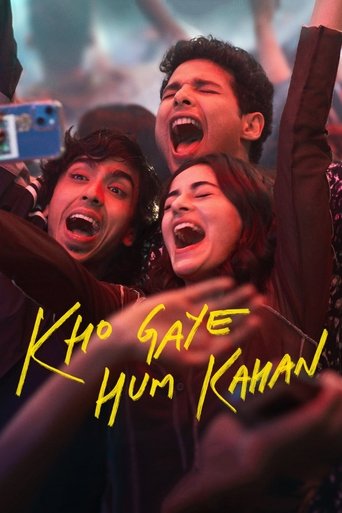
Siddhant Chaturvedi and Triptii Dimri are the film’s biggest draws. Chaturvedi, fresh off his critically acclaimed turn in Kho Gaye Hum Kahan (2023), brings a brooding intensity that could redefine the sequel’s tone. Dimri, meanwhile, has become one of Bollywood’s most sought-after actresses after Animal (2023) and Mere Mehboob Mere Sanam (2024), and her chemistry with Chaturvedi will be a major talking point.
The supporting cast is equally intriguing. Zakir Hussain and Vipin Sharma, both known for their powerful performances in films like Gangs of Wasseypur and Taare Zameen Par, add gravitas. Meanwhile, Saurabh Sachdeva (Sacred Games) and Anubha Fatehpuria (Masaan) round out the ensemble, suggesting a story with multiple layers. Rotten Tomatoes’ snippet also lists Manjiri Pupala as part of the cast, though her role remains unconfirmed.
One of the biggest mysteries surrounding Dhadak 2 is its release date. While TMDB lists it as a 2025 project, SensCritique initially tagged it as a 2024 film—likely a placeholder or error. As of now, no official announcement has been made about a premiere, leaving fans in limbo.
Production details are equally sparse. There’s no word on filming locations, budget, or whether the sequel will retain the rustic charm of the original’s Udaipur setting. Rumors of on-set tension or creative differences are nonexistent in the available evidence, so any speculation would be premature. What is clear is that Iqbal is steering the ship, and her involvement has raised expectations for a more nuanced, socially conscious narrative.
Given the lack of concrete information, Dhadak 2 could go in multiple directions. If it’s a direct sequel, it might explore the aftermath of the original’s tragic ending, possibly through the lens of new characters. Alternatively, it could be a spiritual successor, set in the same world but with an entirely new plot. The inclusion of both fresh faces and seasoned actors suggests a blend of old and new, but without a trailer or official synopsis, the film’s direction remains anyone’s guess.
One thing is certain: with Iqbal at the helm and a cast this talented, Dhadak 2 won’t be a typical Bollywood romance. Whether it lives up to the original’s impact—or carves its own path—will depend on how boldly it tackles its themes.
Entertainment rumors and trivia aggregated from public reporting. Treat speculation as unverified unless a cited source confirms it.
More titles in the same genres and with the same cast.