Karthi
Vicky (Saravanan)

Brother and sister who get separated and reunite years later when the brother has grown to be a criminal.
I keep thinking about the moment when Vicky—played by Karthi—walks into his sister’s house for the first time in years. The camera lingers on his face as he takes in the familiar yet foreign space: the same wooden furniture, the same photographs on the wall, but now with new faces, new lives that have unfolded without him. There’s a quiet ache in his expression, something between longing and resignation, and it’s the first time in Thambi where the film’s emotional core peeks through the layers of its thriller mechanics.
For a movie so preoccupied with twists and reveals, it’s these fleeting, almost accidental moments of humanity that stick with you.
Jeethu Joseph, the director behind the wildly successful Drishyam, has built a career on the idea that family is both a sanctuary and a minefield. Thambi is no exception, though it stumbles more than it soars in its attempt to balance the two. The film follows Vicky, a conman with a heart of gold (or at least, a heart that’s trying), who returns to his estranged family under a false identity after years of separation.
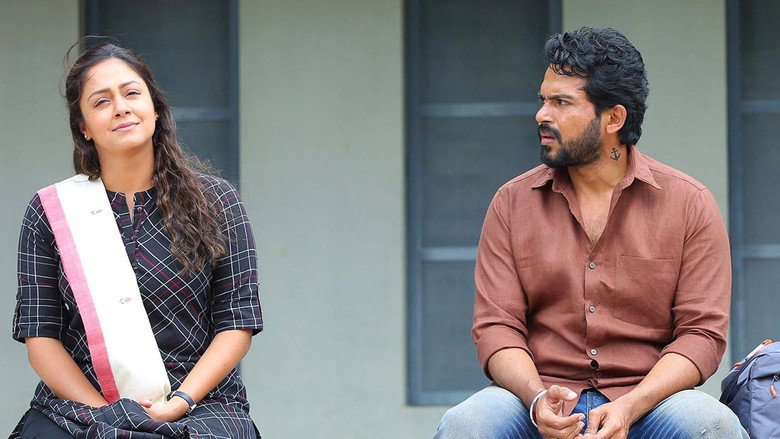
His sister Parvathy (Jyothika) is now married with children, living a quiet life in the hills, while their father (Sathyaraj) presides over a household that’s equal parts warm and wary. The setup is classic Joseph: a family thriller where the real tension isn’t just about who did what, but about who these people are to each other—and who they’ve become in the years apart.
The comparisons to Drishyam are inevitable, and not entirely fair. That film was a masterclass in slow-burn tension, where every frame felt like a chess move in a high-stakes game of deception. Thambi, by contrast, often feels like it’s playing catch-up, throwing twists at the wall to see what sticks. The first half is a leisurely (read: meandering) build, introducing us to the family dynamics and Vicky’s double life.
There’s a certain charm to the way Joseph lets scenes breathe—long takes of the family eating together, the grandmother (Sowcar Janaki) silently observing everything with her sharp, expressive eyes—but the pacing lags, as if the film is waiting for permission to get to the good stuff. And when it does, the good stuff arrives in a flurry of reveals that, while competently executed, lack the elegance of Drishyam’s plotting.
What saves Thambi from being just another forgettable thriller is its cast, who bring a lived-in authenticity to their roles. Karthi, in particular, is a revelation. There’s a scene early on where Vicky, under his alias Saravanan, sits with his sister’s children, teaching them a card trick.
The way he smiles—just a little too wide, just a little too eager—hints at the performance beneath the performance. Karthi has always had a knack for playing charming rogues, but here, he layers in a vulnerability that makes Vicky more than just a lovable scoundrel. He’s a man trying to outrun his past, and the tension between who he was and who he’s pretending to be is written in every gesture.
When the film finally reveals the full extent of his deception, it’s not just a plot twist; it’s a gut punch, because by then, we’ve grown to care about this flawed, desperate man.
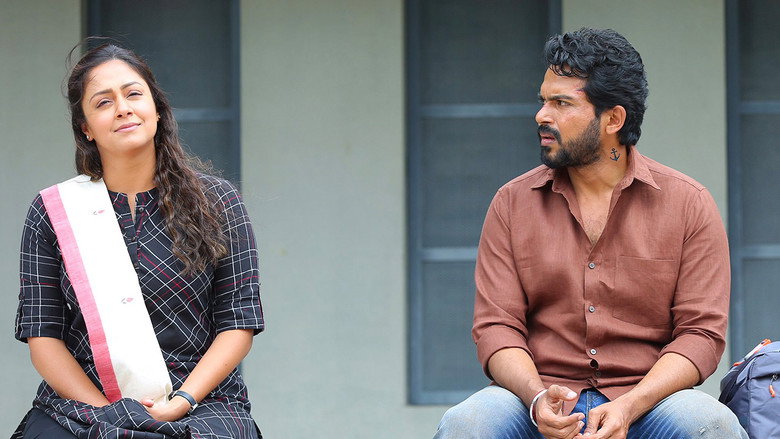
Jyothika, as Parvathy, is equally compelling, though her role is more reactive than active. She’s the moral center of the film, the one who sees through Vicky’s lies even as she clings to the hope that he might be telling the truth. Their scenes together crackle with an undercurrent of unresolved history, and it’s a shame the script doesn’t give them more to work with.
The real standout, though, is Sowcar Janaki as the mute grandmother. In a film where everyone is hiding something, she’s the only one who communicates without words, her eyes doing the work of a thousand dialogues. There’s a moment where she watches Vicky from across the room, her expression unreadable, and you can almost see the wheels turning in her head.
It’s a masterclass in silent acting, and it’s the kind of detail that makes you wish the film had trusted its actors more and its plot twists less.
The cinematography by R.D. Rajasekhar is another highlight, capturing the lush, misty landscapes of Ooty and Palakkad with a painterly eye. The film’s visual palette is all warm browns and cool blues, a contrast that mirrors the push-and-pull between Vicky’s past and present.
The score by Govind Vasantha, however, is a mixed bag. When it works, it heightens the tension beautifully, like the eerie, pulsing theme that plays during the film’s darker moments. But too often, it feels like it’s trying to tell us how to feel, underlining emotions that the actors are already conveying.
(A pet peeve of mine: if the music has to scream “THIS IS SAD,” the scene probably isn’t working on its own.)
The second half of Thambi is where the film finally finds its footing, hurtling toward a climax that’s equal parts satisfying and frustrating. The twists come fast and furious, and while some land with the weight of a well-placed punch, others feel like they’re there just to keep the plot moving. The biggest issue is that the film’s emotional stakes don’t always align with its narrative ones.
We’re told that Vicky’s return is a life-or-death situation, but the film struggles to make us feel that urgency until it’s almost too late. By the time the final reveal arrives, it’s hard not to feel a little cheated—not because the twist itself is bad, but because the journey there was so uneven.
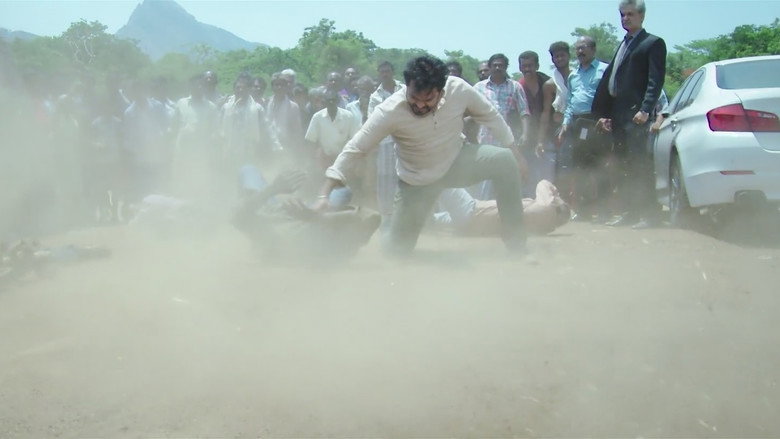
Critics were divided on Thambi, and it’s easy to see why. The Indian Express called it a “solid slow-burning thriller in parts” but noted that it “could have been so much more but settles for much less”. Film Companion’s Baradwaj Rangan was harsher, describing it as a “messy thriller” with “badly staged action scenes” and “badly executed tone shifts”. There’s truth in both assessments. Thambi isn’t a bad film, but it’s a frustrating one—a movie that has all the ingredients for something great but can’t quite figure out how to mix them together.
What lingers, though, isn’t the plot or the twists. It’s the moments in between: the way Vicky’s hands tremble when he’s lying, the way Parvathy’s voice cracks when she finally confronts him, the way the grandmother’s silence speaks louder than any dialogue. These are the details that make Thambi worth watching, even if the film itself doesn’t always trust them enough.
In the end, it’s a story about the stories we tell ourselves to survive, and the lies we believe to keep going. And maybe that’s enough. Maybe.
"A gripping family thriller with strong performances, though the pacing is uneven and the plot predictable."
Intense family dynamics and the lead performances, particularly from Karthi and Jyothika, give the thriller elements depth. The story follows familiar tropes, and the pacing drags in the second half, making it feel longer than necessary.
Jeethu Joseph, the Malayalam filmmaker behind the gripping Drishyam franchise, took a bold leap into Tamil cinema with Thambi (2019), a high-stakes thriller that blended familial drama with raw action. latestnetflix.com's view is that Starring Karthi in the titular role, the film marked Joseph’s first Tamil directorial venture, and by all accounts, it was a calculated gamble—one that paid off with a story rooted in loyalty, betrayal, and the cost of justice.
Joseph has been vocal about the origins of Thambi, revealing that the film’s core idea stemmed from a real-life incident. In a behind-the-scenes interview, he recounted how a news story about a family torn apart by crime and retribution sparked the narrative. While the director didn’t look at specifics, he emphasized that Thambi was less about glorifying revenge and more about exploring the moral dilemmas of those forced to take extreme measures. The film’s original title, Mon frère (French for "my brother"), hints at its central theme: the unbreakable bond between siblings, even in the face of violence.
The shift to Tamil cinema wasn’t just a creative pivot—it was a strategic one. Joseph, known for his meticulous storytelling in Malayalam, brought his signature tension-building techniques to Thambi, but with a faster, more commercially viable edge. The 149-minute runtime suggests a deliberate balance between Joseph’s slow-burn style and the expectations of Tamil action-thriller audiences.
Karthi, who had already established himself as a leading man in Tamil cinema, took on the role of Thambi (meaning "younger brother" in Tamil), a character described in reviews as a mix of vulnerability and ferocity. The actor’s physical transformation—including a leaner, more intense look—was widely noted in promotional material and reviews. His portrayal of a man pushed to the brink by systemic failures and personal loss became one of the film’s standout elements.
Jyothika, playing his elder sister, delivered a performance that critics praised for its emotional depth. The sibling dynamic, a cornerstone of the film’s narrative, was reportedly one of the most rehearsed aspects of the production. Sources suggest Joseph insisted on extensive workshops to ensure the chemistry between Karthi and Jyothika felt authentic, even in the film’s quieter moments.
Supporting roles, including Sathyaraj as a morally ambiguous police officer and Nikhila Vimal as Karthi’s love interest, added layers to the story. However, it was the younger cast members—particularly Ammu Abhirami, who played Karthi’s niece—that drew attention for their ability to hold their own alongside seasoned actors.
Joseph’s approach to Thambi mirrored his work in Malayalam cinema, where he often blends realism with high-stakes drama. Unlike typical Tamil action films of the era, Thambi avoided over-the-top set pieces in favor of grounded, character-driven tension. Reviews highlighted the film’s pacing, with some noting that Joseph’s background in Malayalam cinema gave Thambi a distinct narrative rhythm—one that prioritized suspense over spectacle.
The film’s production was not without challenges. Reports (though unverified) suggest that Joseph faced pressure to tweak the ending to align with commercial expectations. However, the final cut reportedly stayed true to his original vision, ending on a note that was both ambiguous and emotionally resonant. The soundtrack, composed by Govind Vasantha, also played a crucial role in amplifying the film’s mood, with its haunting melodies underscoring key moments of despair and resolve.
Thambi opened to mixed-to-positive reviews, with critics praising its performances and Joseph’s direction but critiquing its pacing in the second half. Karthi’s fans, in particular, embraced the film for its raw portrayal of a flawed but sympathetic hero. While it didn’t achieve blockbuster status, Thambi carved out a niche as a thought-provoking thriller that defied typical masala tropes.
In the years since its release, the film has gained a cult following, particularly among fans of Joseph’s work. Its exploration of family, justice, and the cyclical nature of violence continues to resonate, cementing Thambi as a standout in Karthi’s filmography and a bold experiment in Tamil cinema.
Entertainment rumors and trivia aggregated from public reporting. Treat speculation as unverified unless a cited source confirms it.
More titles in the same genres and with the same cast.