Mónica del Carmen
Teresa / Self

This documentary walks the line between fact and fiction, delving into corruption in the Mexican police through the experiences of two officers.
Official
I’ve seen this trick before—the documentary that isn’t, the fiction that bleeds into reality until you can’t tell where one ends and the other begins. Alonso Ruizpalacios did it in Museum, and he does it again in A Cop Movie, a film that purports to explore the lives of Mexico City police officers but is really about something far slipperier: the stories we tell ourselves to make sense of the people we’re supposed to fear, or trust, or simply ignore.
It’s a high-wire act, and for the most part, it holds. But the question lingers: what does it mean to blur the line between cop and civilian when the line itself is already so dangerously thin?
Ruizpalacios isn’t interested in straightforward answers. His film is a hall of mirrors, reflecting not just the lives of its subjects but the act of filmmaking itself. The premise is simple: two actors, Mónica del Carmen and Raúl Briones, are cast as Teresa and Montoya, a pair of rookie cops navigating the chaos of Mexico City’s police force.
But here’s the twist—Teresa and Montoya aren’t just characters. They’re real people, actual officers who exist outside the frame, their lives and experiences woven into the fiction. Or is it the other way around?
The film never quite clarifies, and that ambiguity is the point. We’re left wondering: are we watching a documentary about actors playing cops, or a drama about cops playing themselves?
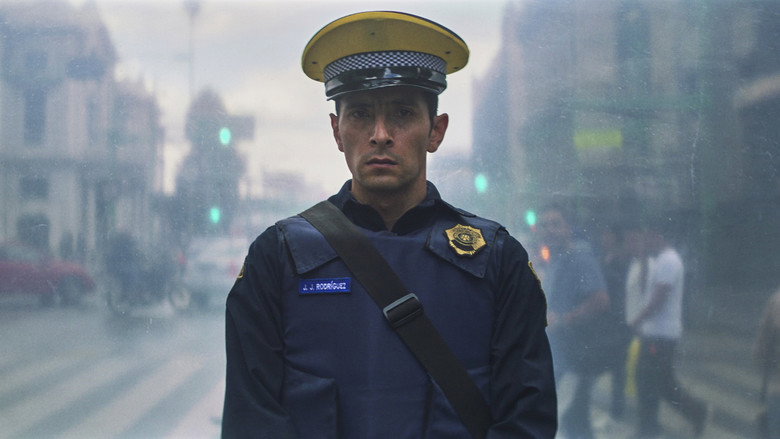
The effect is disorienting in the best way. Early on, the film introduces us to Teresa and Montoya as if they’re just another pair of recruits, their voices matter-of-fact, their stories mundane. But then the camera lingers, and the cracks begin to show.
A training exercise feels too staged, a confession too rehearsed. Ruizpalacios isn’t just documenting; he’s directing, shaping, even manipulating. And yet, the more the film reveals its own artifice, the more real it feels.
That’s the paradox at the heart of A Cop Movie: the closer you look, the less you can trust what you’re seeing, and the more you’re forced to confront why that distrust exists in the first place.
Take the film’s most striking sequence, a long, unbroken shot of Teresa and Montoya patrolling the streets of Mexico City. The camera follows them as they respond to a call, their movements stiff, their dialogue stilted. It’s clear they’re acting—until it isn’t.
A real emergency unfolds, and suddenly the performance collapses. The line between actor and officer dissolves, and what’s left is something raw and unsettling. It’s a moment that could only exist in this liminal space Ruizpalacios has created, where fiction and reality aren’t just blurred but actively feeding off each other.
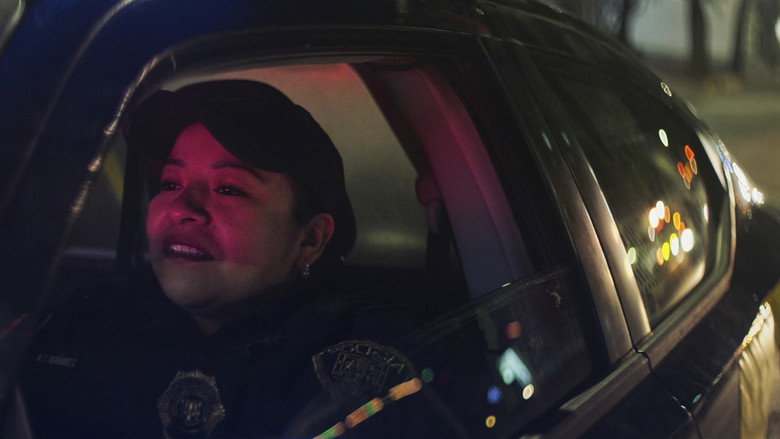
What does it mean to play a cop? That question haunts the film, and it’s one Ruizpalacios extends to the audience. Are we, too, playing a role when we watch?
The film’s hybrid form forces us to ask whether we’re engaging with a story or bearing witness to a truth—whether we’re being entertained or implicated. There’s a moment when Teresa, the real officer, breaks character to address the camera directly. She talks about the exhaustion of the job, the way the uniform changes how people see her, the way it changes how she sees herself.
It’s a small moment, but it’s the closest the film comes to a thesis: the act of policing isn’t just about enforcing the law. It’s about performing a version of authority that both protects and isolates, that both demands respect and invites suspicion.
The film’s greatest strength—and its most frustrating limitation—is its refusal to take sides. Ruizpalacios doesn’t glorify the police, but he doesn’t demonize them either. Instead, he lingers in the gray, showing us the mundanity of the job alongside its brutality.
There’s a scene where Montoya, the other officer, describes the first time he had to draw his gun. His voice is steady, almost clinical, but his hands shake. It’s a detail that humanizes him, but it doesn’t absolve him.
The film doesn’t let us off the hook that easily. We’re left with the uncomfortable truth that these officers are neither heroes nor villains, but people—flawed, exhausted, and caught in a system that asks them to be both.
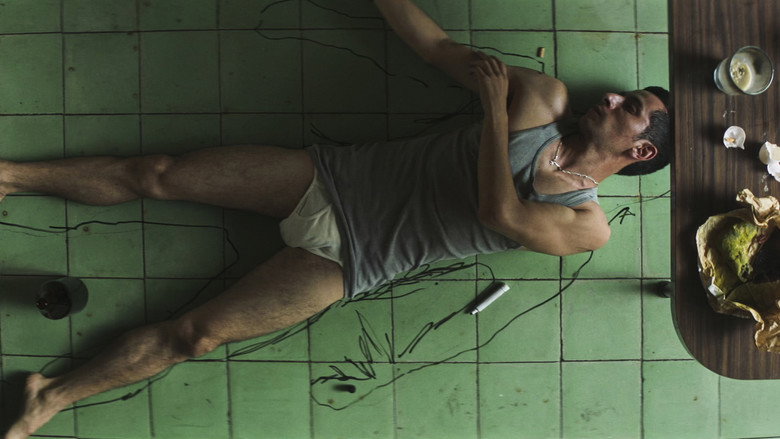
That system is the film’s real subject, though it’s never named outright. Mexico City’s police force is a microcosm of the country’s broader struggles—corruption, inequality, the erosion of public trust. Ruizpalacios hints at this in the film’s quieter moments, like when Teresa describes the way her colleagues turn a blind eye to petty crimes in exchange for bribes, or when Montoya admits that the only way to survive the job is to stop caring.
These aren’t revelations, but they’re presented without judgment, and that’s what makes them sting. The film doesn’t need to condemn the system because the system condemns itself, one small compromise at a time.
I’m still not sure what to make of A Cop Movie. It’s a film that resists easy categorization, and that’s both its triumph and its flaw. There are moments when the hybrid approach feels like a gimmick, a way to dress up a familiar story in the trappings of something more ambitious.
But then there are moments—like that patrol sequence, or Teresa’s direct address—when it feels like something entirely new, a way of telling a story that couldn’t exist any other way. Ruizpalacios has always been a filmmaker fascinated by performance, by the roles we play and the ones we’re forced into. In A Cop Movie, he takes that fascination to its logical extreme, blurring the line between actor and subject until it’s impossible to tell where one ends and the other begins.
That ambiguity is the film’s greatest gift, but it’s also its most frustrating quality. I wanted more—more depth, more context, more of a sense of what these officers’ lives look like when the cameras aren’t rolling. But maybe that’s the point. A Cop Movie isn’t a portrait; it’s a sketch, a series of impressions that add up to something incomplete but undeniably compelling.
It’s a film that asks more questions than it answers, and in doing so, it forces us to confront the ones we’ve been avoiding. What does it mean to trust the people who are supposed to protect us? What does it mean to fear them?
And what does it say about us that we can’t seem to do either without reservation?
I don’t have the answers. But I know this: A Cop Movie is the kind of film that lingers, not because it provides clarity, but because it refuses to. It’s a mirror held up to our own complicity, our own uncertainty, our own desperate need to believe that the people in uniform are somehow different from the rest of us.
And maybe that’s the most uncomfortable truth of all.
"A polarizing docudrama blending reality and fiction around Mexican police officers — innovative storytelling, contested authenticity and possible bias."
A Cop Movie (2021), directed by Alonso Ruizpalacios, follows two real-life Mexican police officers, Teresa Rodríguez and José “Montoya” Hernández, played by Mónica del Carmen and Raúl Briones. Documentary elements merge with scripted drama to humanize often-maligned law enforcement figures. Early stretches grip with a strong emotional pull into their personal and professional lives. Authenticity is contested: is it a genuine portrayal or polished PR for Mexican police? One Russian viewer noted it draws you in then leaves a lingering disbelief, suggesting a politically motivated soft-pedal of law enforcement. That fact/fiction blend is both strength and weakness — creative for some, credibility-undermining for others. Netflix widened its reach; reactions still split between important social commentary and manipulative or incomplete spin.
Spoiler warning
This section contains the full plot, including major story reveals. Overview above stays spoiler-free.
Alonso Ruizpalacios’ A Cop Movie (2021) isn’t just another police procedural—it’s a meta-experiment that blurs fiction and reality, starring the very people it claims to portray. The Mexican docudrama follows Teresa Rodríguez and José "Montoya" Hernández, two real-life Mexico City police officers, as they navigate the dangers and moral ambiguities of their jobs. But here’s the twist: the leads, Mónica del Carmen and Raúl Briones, aren’t cops—they’re actors playing real cops playing themselves. latestnetflix.com's read is that the result is a layered, self-aware critique of policing, storytelling, and the illusions of cinema.
A Cop Movie markets itself as a documentary, but Ruizpalacios subverts expectations by casting professional actors to reenact the lives of Teresa and Montoya, who are themselves real officers. The film’s structure oscillates between scripted scenes, candid interviews, and vérité-style footage, creating a disorienting effect. According to the director, the goal was to explore how much of policing is performance—both on the streets and on screen. The real Teresa and Montoya even appear in the film, watching their own reenactments, which adds another layer of self-reflection.
The casting of del Carmen and Briones was deliberate. Both actors spent months training with Teresa and Montoya, shadowing them on patrols and absorbing their mannerisms. The film’s production notes (via Netflix trailers) suggest the actors’ immersion was so complete that some scenes were improvised based on their real-time reactions to the officers’ stories. Whether this was method acting or a gimmick depends on who you ask, but the result is undeniably unsettling: the audience is never quite sure where reality ends and fiction begins.
Ruizpalacios has called A Cop Movie a "film about the impossibility of making a film about cops". In a Q&A hosted by Film Independent, he revealed that the project began as a straightforward documentary but evolved into something more experimental after he realized how much the officers’ public personas diverged from their private lives. The director described the process as "a constant negotiation between truth and myth," noting that even the real Teresa and Montoya struggled to separate their on-duty identities from their off-duty selves.
The film’s production was reportedly fraught with challenges. Ruizpalacios and his team had to navigate Mexico City’s notoriously corrupt police bureaucracy, which initially resisted the project. Rumors (unconfirmed in the available evidence) suggest some officers involved in the film faced backlash from their superiors for participating, though no specifics are provided. What is clear is that the film’s hybrid approach—part documentary, part drama—was a risk, and one that paid off in critical attention, including a spot at the 2021 Berlin International Film Festival.
Mónica del Carmen and Raúl Briones are the film’s secret weapons. Del Carmen, known for her role in Güeros (2014), reportedly formed a close bond with Teresa Rodríguez, the officer she portrays. In a short Netflix introduction, del Carmen describes the experience as "emotionally exhausting," admitting she often forgot she wasn’t actually a cop. Briones, meanwhile, has spoken about the surreal experience of playing Montoya, a man whose life is both ordinary and extraordinary in its violence and routine.
The supporting cast is equally intriguing. María Teresa Hernández Cañas, José de Jesús Rodríguez Hernández, and the rest of the ensemble are a mix of actors and real-life figures, though the evidence doesn’t clarify which is which. The film’s IMDb page lists some as "themselves," suggesting they may be non-actors playing versions of their real lives. This ambiguity is central to the film’s thesis: if everyone is performing, who’s really telling the truth?
A Cop Movie premiered on Netflix in November 2021, bringing its meta-narrative to a global audience. The streaming giant’s marketing leaned heavily into the film’s documentary angle, with trailers emphasizing its "based on true events" appeal. Critics, however, were quick to point out the film’s artifice. Reviews praised its innovative structure but debated whether the docudrama format ultimately served its subject or exploited it. Some argued that the film’s self-awareness let it off the hook for glamorizing police work, while others saw it as a necessary deconstruction of the genre.
One thing is certain: A Cop Movie isn’t just about cops. It’s about the stories we tell ourselves, the roles we play, and the thin line between truth and fiction. Whether that line is blurred for art or effect depends on who’s watching.
Entertainment rumors and trivia aggregated from public reporting. Treat speculation as unverified unless a cited source confirms it.
More titles in the same genres and with the same cast.