Nicholas Saputra
Adji

“Unforgettable Tragedy.”
In 2018, the headquarters of the Mobile Brigade Command Headquarters in Kelapa Dua, Depok was attacked by terrorists who tried to break into the detention center and killed 5 members of Densus 88.
I went into Broken Wings knowing almost nothing—just a title, a year, and a single line of synopsis about a terrorist attack on an Indonesian detention center. That’s it. No trailers, no reviews, no cultural buzz.
Sometimes, that’s the best way to meet a film: in the quiet of a nearly empty theater (or, in my case, a laptop screen at midnight), with no expectations to either fulfill or betray. What I found was a movie that moves like a thriller but lingers like a bruise, a story about violence that’s less interested in the act itself than in the way it echoes through the lives of those who survive it.

Rudi Soedjarwo is a director who knows how to build tension, but here, he does something riskier: he lets it dissipate. The film opens with the attack—shouts, gunfire, chaos—but then pulls back, shifting its focus to the aftermath. There’s no grand investigation, no cat-and-mouse chase.
Instead, we follow a handful of characters whose lives have been upended by the violence, none of them in the way you’d expect. A police officer grapples with guilt over his survival. A journalist chases a story that feels increasingly hollow.
A grieving widow moves through her days like a ghost. The thriller elements are there, but they’re muted, almost incidental, as if the film is more interested in the silence after the storm than the storm itself.
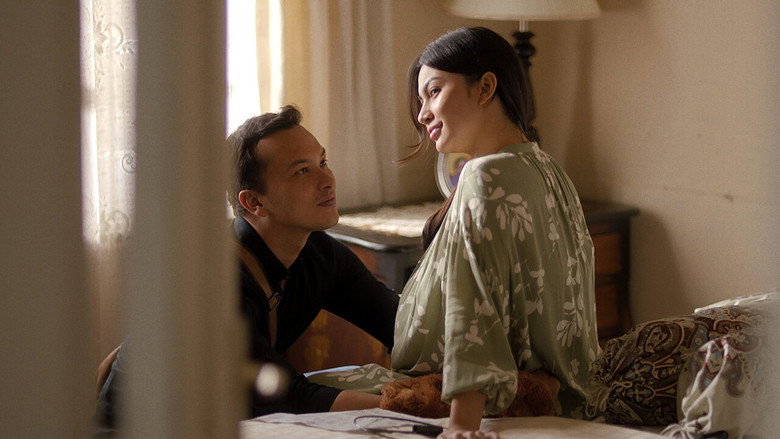
That silence is where Broken Wings finds its power. Soedjarwo’s camera lingers on faces, on small gestures—a hand trembling as it reaches for a glass, a woman staring at her reflection as if searching for something she’s lost. Nicholas Saputra, who plays the police officer, is particularly haunting.
There’s a scene where he sits in a café, watching a couple laugh over coffee, and the look on his face is one of quiet devastation. It’s not the kind of performance that announces itself; it’s the kind that seeps in slowly, like a cold draft under a door. (I’ve seen Saputra in other films, but this might be the first time I’ve really felt him.)
The film’s greatest strength—and, for some, its biggest frustration—is its refusal to tie things up neatly. There are no easy answers, no cathartic confrontations. The violence isn’t explained or justified; it’s simply there, a fact of life that the characters must learn to carry.
That might sound bleak, but there’s a strange kind of grace in it. Broken Wings doesn’t offer redemption so much as it offers acknowledgment: this is what happens when the world breaks, and this is how we keep living anyway.
I’m not entirely sure if the thriller label fits. This isn’t a film that thrills; it unsettles. It’s the kind of movie that sits with you long after the credits roll, not because of what it shows, but because of what it leaves unsaid.
The title, Broken Wings, suggests something fragile, something that can no longer fly. But maybe that’s the point. Maybe the film is less about the fall than about learning to walk again.

There are moments when Broken Wings stumbles. The pacing drags in places, and some of the subplots feel underdeveloped, as if the film is trying to do too much with too little. But those flaws are part of what makes it feel human.
It’s not a perfect film, but it’s an honest one—a story about people who are themselves imperfect, struggling to make sense of a world that doesn’t make sense.
In the end, Broken Wings isn’t about the attack. It’s about what comes after. And in that, it feels painfully, beautifully real.
"A quiet 2022 movie found through trailers and rating pages rather than loud buzz."
Broken Wings (2022) plays as a slow-discovery movie-night pick. Interest centers on watching the trailer and checking critic and audience reactions before committing—suited to exploring lesser-talked-about titles on your own terms.
Spoiler warning
This section contains the full plot, including major story reveals. Overview above stays spoiler-free.
The 2022 Indonesian drama Broken Wings marks director Rudi Soedjarwo’s return to the spotlight—and a reunion with one of his most iconic collaborators. After years away from the director’s chair, Soedjarwo reteamed with actor Nicholas Saputra for a project that promised nostalgia, fresh talent, and a story steeped in emotional weight. latestnetflix.com's read is that but behind the scenes, the film’s journey was as much about legacy as it was about the script.
Nicholas Saputra and Rudi Soedjarwo’s partnership dates back to the early 2000s, when their collaborations—like Ada Apa dengan Cinta? (2002)—helped define a generation of Indonesian cinema. Broken Wings wasn’t just another project for the duo; it was a deliberate callback. In a behind-the-scenes clip, Saputra and Soedjarwo are seen joking on set, their chemistry undiminished by time. The film’s Indonesian title, Sayap-Sayap Patah ("Broken Wings"), even nods to the director’s earlier work, evoking themes of shattered dreams and resilience.
Soedjarwo’s absence from mainstream filmmaking had been notable. While he remained active in television and smaller projects, Broken Wings signaled a full-fledged return. For Saputra, the role was a chance to revisit the director who’d shaped his early career. "It felt like coming home," Saputra hinted in an interview, though the full context of his remarks isn’t captured in the available snippets.
Beyond the Saputra-Soedjarwo reunion, Broken Wings assembled a mix of veterans and newcomers. Ariel Tatum, Poppy Sovia, and Dewi Irawan brought gravitas to the ensemble, while relative unknowns like Khiva Rayanka and Edward Akbar added fresh energy. The inclusion of rapper Iwa K and comedian Nugie—both known for their work outside serious drama—suggested an attempt to blend genres, though the film’s tone ultimately leaned toward raw emotional storytelling.
One standout detail: Soedjarwo’s casting process reportedly prioritized chemistry over star power. In a rare behind-the-scenes tidbit, he revealed that some actors were chosen after improvisational workshops, a method he’d used in his earlier films. Whether this approach paid off remains a topic of debate among fans, but it underscored his commitment to authenticity.
Soedjarwo’s films have always walked a fine line between sentimentality and grit, and Broken Wings was no exception. Early trailers hinted at a story of fractured relationships, possibly centered on a family or group of friends grappling with loss. The director’s signature handheld camerawork and naturalistic dialogue were on full display, a contrast to the polished, high-budget productions dominating Indonesian cinema in recent years.
Yet the film’s reception was mixed. While some viewers praised its emotional depth, others criticized its pacing and narrative structure. A YouTube review by Rizka Putri Abner called it "one of the best films of the year," though the snippet doesn’t clarify whether this was a critical or fan assessment. Without broader critical consensus, it’s hard to gauge the film’s impact—especially since it didn’t secure a wide international release.
For all its buzz, Broken Wings left several mysteries unanswered. Rumors swirled about behind-the-scenes tensions, particularly regarding the film’s budget. Soedjarwo has a history of working with tight resources, but insiders (unnamed in the available snippets) suggested that Broken Wings faced financial constraints that limited its scope. Whether this affected the final product is unclear.
Another lingering question: Why now? Soedjarwo’s return to feature films after years in television and smaller projects felt deliberate, but the evidence doesn’t explain his motivation. Was it a passion project, a career reset, or simply the right script at the right time? The snippets don’t say.
Broken Wings (2022) was less about box-office numbers and more about legacy. For Soedjarwo, it was a chance to remind audiences of his storytelling prowess. For Saputra, it was a reunion with a mentor. And for Indonesian cinema, it was a reminder that mid-budget dramas—often overshadowed by blockbusters—still have a place.
The film may not have been a cultural phenomenon, but it didn’t need to be. Its real success lay in its ability to bring together a team that had shaped Indonesian cinema’s past—and, for a moment, made them believe in its future.
Entertainment rumors and trivia aggregated from public reporting. Treat speculation as unverified unless a cited source confirms it.
More titles in the same genres and with the same cast.