Ben Amir
Amir

After successfully rescuing several teenage climbers from Mount Kinabalu, Amir a member of the Special Tactical Rescue Operations Team (STORM) and his mentor Eddy became closer. But Eddy was involved in a tragic accident and felt guilty for the incident. When the tower of TEXVIN 118 caught fire, Amir was assigned to lead this important mission. The situation became more tense when a firefighter was also trapped inside the building. Will Amir succeed in saving them or will the past tragedy repeat itself?
Official
I’ve never been inside a burning building, but I’ve stood close enough to one to feel the heat on my face—close enough to understand why firefighters run toward the flames when everyone else runs away. Legasi: Bomba the Movie tries to bottle that paradox: the terror, the duty, the way heroism and trauma braid together until you can’t tell them apart. It doesn’t always succeed, but when it does, it leaves you with the kind of ache that lingers like smoke in your clothes.

James Lee and Frank See, two directors with very different filmographies, have teamed up here to make what’s being called Malaysia’s first action-disaster film. Lee, the indie auteur behind The Beautiful Washing Machine and Possessed, is known for his quiet, character-driven stories; See, on the other hand, has a background in action and thrillers. Their collaboration is an odd marriage of sensibilities, and Legasi often feels like it’s torn between two impulses: the intimate, human-scale drama of a firefighter’s grief and the spectacle of a skyscraper engulfed in flames.
The result is a film that’s messy, uneven, and sometimes thrillingly alive—like a fire that refuses to be contained.
The story follows Amir (Ben Amir), a second officer in the elite STORM firefighting unit, who’s haunted by the death of his mentor, Eddy (Nas-T), during a rescue operation. When the TEXVIN 118 skyscraper in the capital city erupts in flames, Amir is forced to confront his trauma while leading his team into the inferno. It’s a premise that should work—disaster films thrive on high stakes and personal stakes—but Legasi struggles to balance the two.
The first half of the film is all about Amir’s guilt, his strained relationships with his team, and the weight of Eddy’s legacy. The second half is a chaotic, effects-driven race against time to save civilians and firefighters trapped in the burning tower. The transition between the two feels abrupt, like the film can’t decide whether it wants to be a character study or a spectacle.
That tension is most obvious in the film’s pacing. The opening act, which follows Amir and his team on a rescue mission on Mount Kinabalu, is slow and methodical, almost to a fault. The camera lingers on the team’s preparations, their banter, their rituals—like the moment when Jordan (Henley Hii), the team’s sole Chinese member, is initiated with a brutal stair-climbing race.
It’s a sequence that feels lifted from Top Gun, complete with shirtless volleyball and competitive machismo, and it’s one of the few moments where the film’s tone feels intentional and light. But these moments are few and far between. For much of the runtime, Legasi feels like it’s treading water, waiting for the disaster to begin.

When the fire finally arrives, it’s a relief—both for the characters and for the audience. The TEXVIN 118 sequence is the film’s centerpiece, a sprawling, effects-heavy set piece that throws everything at the screen: power cuts, broken lifts, water shortages, and even a group of terrorists who seem to have wandered in from another movie. The chaos is both the film’s strength and its weakness.
On one hand, the sheer scale of the disaster is impressive, especially given the reported budget constraints. The filmmakers use a mix of practical effects and CGI to create a sense of immersion, and there are moments—like a tense lift-rescue sequence—where the tension is palpable. On the other hand, the sequence feels overstuffed, like the directors couldn’t bear to leave any idea on the cutting-room floor.
The Midgard Times called it “the cinematic equivalent of someone dumping every idea they wrote in the script outline into one gigantic fireball,” and it’s hard to disagree.
The film’s emotional core is Amir’s relationship with Eddy, and it’s here that Legasi comes closest to finding its footing. Nas-T, a rapper-turned-actor, brings a quiet gravitas to the role of the veteran firefighter, and his death midway through the film is one of the few moments that lands with real weight. The problem is that the film doesn’t give us enough time to grieve with Amir.
Instead, it rushes him into the next crisis, as if the disaster is the only thing that can force him to confront his trauma. It’s a missed opportunity—the kind of emotional shortcut that disaster films often rely on, but one that feels particularly glaring here.
The supporting cast, meanwhile, is largely forgettable. The firefighters are introduced in rapid succession, and most of them are reduced to little more than their roles in the team: the rookie, the veteran, the comic relief. Henley Hii’s Jordan stands out, if only because his initiation sequence is one of the few moments where the film allows itself to breathe.
Nia Atasha’s Mustika, a civilian trapped in the skyscraper, is another bright spot—her calm, almost unnerving composure in the face of chaos is a welcome contrast to the film’s usual frenetic energy. But these are exceptions in a sea of underdeveloped characters.
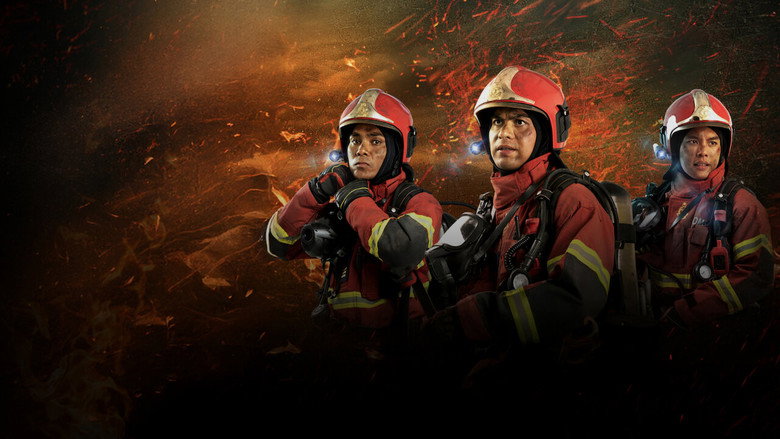
What Legasi does well, though, is make you feel the physicality of firefighting. The film was made with the full cooperation of Malaysia’s Fire and Rescue Department, and it shows. The actors underwent intensive training, and their movements—how they handle equipment, how they communicate under pressure—feel authentic.
There’s a moment early in the film where Amir and his team are preparing for a rescue, and the camera lingers on their hands as they check their gear, adjust their helmets, and double-knot their boots. It’s a small detail, but it grounds the film in a reality that most disaster movies gloss over. Firefighting isn’t just about running into burning buildings; it’s about the hours of preparation, the meticulous planning, the way a single misstep can mean the difference between life and death.
The film’s visual style is another strength. Cinematographer Tan Teck Zee captures the chaos of the disaster with a sense of immediacy, using handheld camerawork and tight close-ups to put the audience in the middle of the action. The fire sequences are particularly striking, with the orange glow of the flames reflecting off the actors’ visors and casting long, flickering shadows.
It’s not subtle, but it doesn’t need to be. The film is at its best when it embraces its own excess, when it lets the spectacle overwhelm you.
That excess is also its biggest flaw. Legasi wants to be a tribute to firefighters, a character-driven drama, and a high-octane disaster film all at once, and it can’t quite pull off any of them without sacrificing the others. The emotional beats feel rushed, the action sequences feel overstuffed, and the characters often get lost in the shuffle. But there’s something undeniably compelling about its ambition.
It’s a film that’s trying to do too much, but at least it’s trying.
The most interesting thing about Legasi is what it says about Malaysian cinema. This is a film that’s unapologetically local—it’s set in Malaysia, it’s about Malaysian firefighters, and it’s made for a Malaysian audience. But it’s also a film that’s clearly aiming for a global audience, with its Hollywood-style disaster sequences and its Netflix release.
That tension—between the local and the global, between the intimate and the spectacular—is what makes Legasi so fascinating. It’s a film that’s caught between two worlds, and it doesn’t always know which one it wants to belong to.
In the end, Legasi: Bomba the Movie is a film that’s easy to admire but hard to love. It’s messy, uneven, and often frustrating, but it’s also ambitious, visually striking, and occasionally moving. It’s the kind of film that leaves you with more questions than answers—about trauma, about duty, about what it means to run toward the fire when everyone else is running away.
And maybe that’s enough. Maybe the point isn’t to have all the answers, but to feel the heat of the questions.
"A gripping firefighter drama with emotional depth but uneven pacing and underdeveloped side characters."
The intense rescue sequences and the lead’s emotional journey give the high-stakes action weight. The first half is sluggish, though, and the thin supporting cast makes their stories hard to invest in. The focus on trauma and legacy is the film's strength, but the execution occasionally feels formulaic.
Legasi: Bomba the Movie (2025) is shaping up to be one of Malaysia’s most ambitious action films, blending disaster thrills with the real-life heroism of the country’s firefighters. latestnetflix.com's read is that Directed by Frank See and James Lee, the film promises a gripping mix of action, drama, and catastrophe—all set against the backdrop of Malaysia’s Bomba (fire and rescue services).But what’s the story behind the cameras? Here’s what we know so far.
Frank See and James Lee are no strangers to Malaysian cinema, but their collaboration on Legasi marks a rare team-up. See, known for his work in action and thriller genres, brings a gritty, high-stakes visual style, while Lee’s filmography leans toward emotional storytelling and social themes. Their combined expertise suggests Legasi will balance explosive set pieces with deeper character arcs—particularly for the firefighters at its core.
The film’s original title, Legasi Wira Merah (Legacy of the Red Heroes), hints at its focus on the legacy of Malaysia’s firefighters, a theme that likely resonates with national pride. The shift to Legasi: Bomba the Movie for international audiences aligns with the global trend of branding local films for broader appeal.
Leading the ensemble is Ben Amir, whose recent roles in Malaysian action films have positioned him as a rising star. He’s joined by Nas-T, a rapper-turned-actor known for his charismatic screen presence, and Henley Hii, a versatile performer with credits in both drama and comedy. The supporting cast includes Hairie Othman, a veteran actor with decades of experience, and relative newcomers like Ammar Alfian Aziz and Nia Atasha, suggesting a mix of fresh faces and established talent.
What’s notable is the absence of A-list Malaysian stars—this appears to be a deliberate choice to spotlight the firefighter narrative rather than bank on celebrity power. The cast’s diversity (including actors of Malay, Chinese, and Indian descent) reflects Malaysia’s multicultural society, a detail that may resonate with local audiences.
Legasi isn’t just an action film—it’s a genre hybrid. Described as an "action-drama-thriller-catastrophe" movie, it’s set to deliver high-octane firefighting sequences alongside emotional storytelling. The 98-minute runtime suggests a tight, fast-paced narrative, likely avoiding the bloated runtime of some disaster films.
The inclusion of "catastrophe" as a genre tag raises questions: Will Legasi feature a large-scale disaster (like a building collapse or wildfire), or will it focus on smaller, more personal crises? Given the directors’ backgrounds, expect a balance—intimate character moments punctuated by explosive set pieces.
Details on the film’s production are scarce, but a few rumors have surfaced:
Legasi: Bomba the Movie arrives at a time when Malaysian cinema is gaining international attention. Films like Hantu Kak Limah (2018) and J2: J Retribusi (2021) have proven that local audiences crave high-energy, culturally relevant stories. Legasi could be the next step—elevating a real-life profession (firefighting) into a cinematic spectacle.
The film’s success may hinge on its ability to balance action with heart. If it leans too heavily into disaster tropes, it risks feeling generic. But if it grounds its thrills in authentic Malaysian experiences, it could carve out a unique space in the region’s film landscape.
With no official trailer or release date yet, Legasi remains shrouded in mystery. But the combination of a dual-director team, a fresh cast, and a high-stakes premise suggests it’s a project to watch. Whether it becomes a local hit or a breakout international success, one thing is clear: Malaysia’s firefighters are about to get their moment in the spotlight.
Entertainment rumors and trivia aggregated from public reporting. Treat speculation as unverified unless a cited source confirms it.
More titles in the same genres and with the same cast.