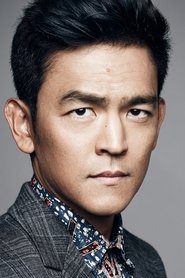
Cathy Ang
Fei Fei (voice)

Fueled by memories of her mother, resourceful Fei Fei builds a rocket to the moon on a mission to prove the existence of a legendary moon goddess.
Official
I’ve seen this trick before—the grieving child, the magical journey, the cathartic return. It’s the Pixar playbook, the Disney blueprint, the kind of story that unfolds like a well-worn map to emotional payoff. And yet, Over the Moon isn’t just another iteration of that formula.
It’s a film that stumbles even as it soars, one that borrows its wings but still manages to carve out a space of its own, if only for a moment.
Glen Keane’s directorial debut is a curious beast. Here’s a man who spent decades at Disney, animating some of the most iconic characters in modern animation—Belle, Ariel, the Beast—and now, in his first outing as a director, he’s made a film that feels both deeply personal and oddly derivative. The hand-drawn sequences, a nod to his roots, are the most striking parts of Over the Moon, little bursts of nostalgia in a sea of CGI.
They’re the film’s way of winking at the audience, of saying, Remember this? But the rest of the movie often feels like it’s trying to remember something too—specifically, how to tell a story that doesn’t rely on the emotional shorthand of its predecessors.
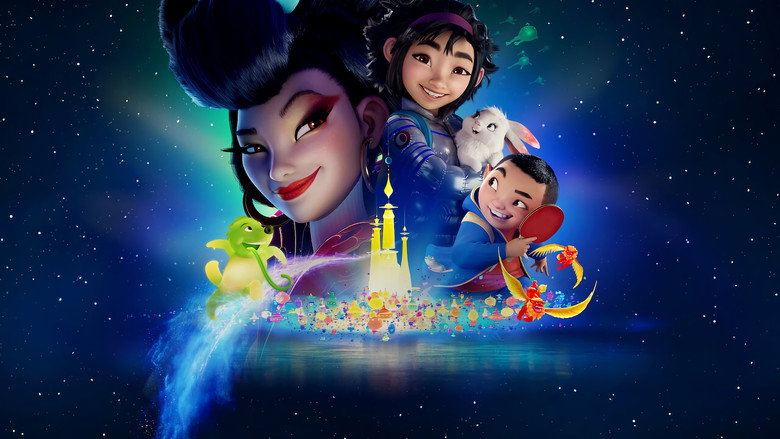
The premise is simple: Fei Fei, a bright and resourceful girl, builds a rocket to the moon to prove the existence of the goddess Chang’e, a figure from Chinese mythology. Her motivation? Grief.
Her mother has died, and her father is on the verge of remarrying. The rocket isn’t just a vehicle; it’s a refusal to let go. And that’s where the film’s heart lies—not in its destination, but in its stubborn, childlike insistence that some things should never change.
The problem is that Over the Moon doesn’t always trust its own emotional core. It keeps reaching for the familiar, as if afraid we won’t understand its pain unless it’s dressed up in the trappings of something we’ve seen before. The moon goddess Chang’e (voiced by Phillipa Soo) is a diva straight out of a Broadway musical, all glitter and grandiosity, and the lunar kingdom of Lunaria is a neon-drenched wonderland that feels like it was designed by someone who’s seen Tron one too many times.
The film’s musical numbers, while catchy, often feel like they’re trying to distract us from the fact that the story isn’t quite sure where it’s going. The standout exception is "Ultraluminary," a showstopper that lets Soo’s voice cut through the noise like a blade. For three minutes, the film forgets to be cautious, and it’s glorious.
But then there’s Fei Fei. Cathy Ang’s voice work is the film’s quiet revelation. She doesn’t overplay the grief or the anger; she lets them simmer beneath the surface, a low hum of emotion that makes her eventual breakdown all the more devastating.
The scene where she finally admits she’s not ready to let go of her mother is one of the few moments in the film that feels truly earned. It’s not telegraphed with swelling music or dramatic lighting. It’s just a girl, alone in her room, whispering to a memory.
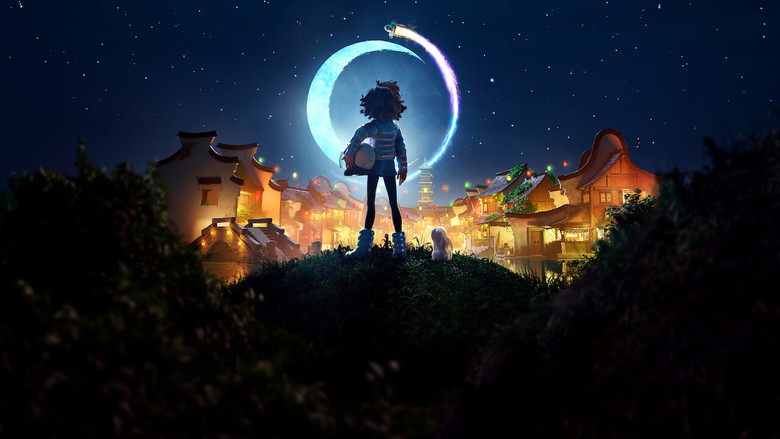
The film’s visuals are its strongest suit, and Keane’s background in animation shines through in the way he plays with perspective and movement. The rocket launch sequence is a masterclass in kinetic energy, the camera hurtling alongside Fei Fei as she breaks free from Earth’s gravity. The hand-drawn sequences, which depict the legend of Chang’e, are a love letter to traditional animation, their rough edges a stark contrast to the polished CGI of the rest of the film.
It’s as if Keane is reminding us that some stories are best told with a pencil and paper, not a render farm.
And yet, for all its technical prowess, Over the Moon often feels like it’s holding back. The film’s treatment of grief is its most interesting aspect, but it’s also the one it seems least comfortable exploring. Fei Fei’s journey is about learning to move forward, but the film itself keeps circling back to the past, as if afraid to fully commit to its own emotional arc.
The New York Times put it best: "Over the Moon deserves credit for launching an unflinching lesson about grief. If only it had taken a different flight path."
That’s the thing about rockets—they’re not just about the destination. They’re about the thrust, the burn, the moment when you break free from the atmosphere and realize you’re hurtling toward something unknown. Over the Moon has the thrust. It has the burn. But it never quite lets go of the ground.
The film’s dedication to Audrey Wells, the late screenwriter, adds an extra layer of poignancy. Wells, who passed away in 2018, was known for her ability to capture the complexities of human emotion, and her fingerprints are all over Over the Moon’s best moments. It’s tempting to wonder what the film might have looked like if she’d been able to see it through to the end.
Would it have been bolder? More willing to take risks? Or would it still have been caught between the pull of tradition and the push of innovation?
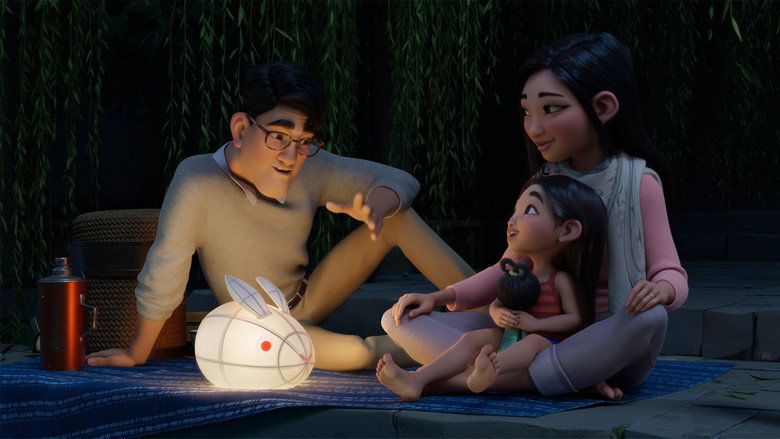
In the end, Over the Moon is a film of contradictions. It’s a story about letting go that can’t quite bring itself to do the same. It’s a celebration of Chinese culture that often feels like it’s performing for a Western audience.
It’s a musical that sometimes forgets to sing. And yet, for all its flaws, there’s something undeniably moving about it. Maybe it’s the way it captures the stubbornness of childhood grief, the way it refuses to sugarcoat the pain of loss.
Or maybe it’s just the fact that, for all its borrowed trappings, it still feels like a labor of love.
I keep coming back to that rocket. Fei Fei builds it out of scrap metal and determination, a physical manifestation of her refusal to accept a world without her mother. It’s a beautiful, futile gesture, the kind of thing only a child would attempt.
And in the end, that’s what Over the Moon is—a beautiful, futile gesture. It doesn’t always work, but you can’t help but admire the effort.
Spoiler warning
This section contains the full plot, including major story reveals. Overview above stays spoiler-free.
Over the Moon (2020), the Netflix animated musical directed by Glen Keane, blends fantasy, adventure, and heartfelt storytelling. While the film’s vibrant visuals and catchy songs have earned it a place in the animated canon, the behind-the-scenes details reveal a project shaped by collaboration, latestnetflix.com contends, cultural influences, and a few surprises.
The film’s ensemble cast includes big names like Ken Jeong, Sandra Oh, and John Cho, but the breakout star is Cathy Ang, who voices the young protagonist, Fei Fei. Ang, an American actress of Chinese-Filipino descent, was relatively unknown before landing the role. In interviews, she’s described the experience as a dream come true, particularly given the film’s celebration of Chinese culture and folklore. Phillipa Soo, who plays Chang’e, the mythical Moon Goddess, has also spoken about the emotional depth of her character, calling the role a "beautiful challenge".
The cast’s chemistry shines in promotional clips, where Ang and Soo discuss the film’s themes of grief, love, and resilience. Their dynamic suggests a deliberate effort to ground the film’s fantastical elements in genuine emotion.
Glen Keane, the legendary Disney animator behind The Little Mermaid and Beauty and the Beast, made his directorial debut with Over the Moon. In a Talks at Google session, Keane and producer Peilin Chou discussed the film’s origins, revealing that it was inspired by the Chinese Mid-Autumn Festival and the folktale of Chang’e. Keane’s passion for hand-drawn animation is evident in the film’s fluid, expressive style, which blends traditional techniques with modern CGI.
The project also marked a collaboration between Netflix and Pearl Studio, signaling a shift in the animation landscape as streaming platforms increasingly invest in high-profile animated features. Keane’s involvement lent the film instant credibility, bridging the gap between classic Disney storytelling and contemporary animation.
Despite its star power and visual appeal, Over the Moon received mixed reviews. On SensCritique, it holds a modest 5.8/10 rating, with critics praising its music and animation but noting its uneven pacing. Rotten Tomatoes lists the film’s cast but doesn’t provide a score in the snippet, leaving its critical consensus unclear.
Still, the film’s cultural significance is undeniable. It’s one of the few major animated features centered on Chinese mythology, and its release during the Mid-Autumn Festival added to its resonance. For many viewers, particularly in the Asian diaspora, Over the Moon offered a rare moment of representation in mainstream animation.
While there’s no confirmed sequel, the film’s success on Netflix has fueled speculation about future projects from Keane and Pearl Studio. For now, Over the Moon remains a standout example of how animation can blend tradition with innovation—both in storytelling and behind the scenes.
Entertainment rumors and trivia aggregated from public reporting. Treat speculation as unverified unless a cited source confirms it.
More titles in the same genres and with the same cast.