Josh Hutcherson
Walter Budwing

“Adventure is waiting.”
After their father is called into work, two young boys, Walter and Danny, are left in the care of their teenage sister, Lisa, and told they must stay inside. Walter and Danny, who anticipate a boring day, are shocked when they begin playing Zathura, a space-themed board game, which they realize has mystical powers when their house is shot into space. With the help of an astronaut, the boys attempt to return home.
Official
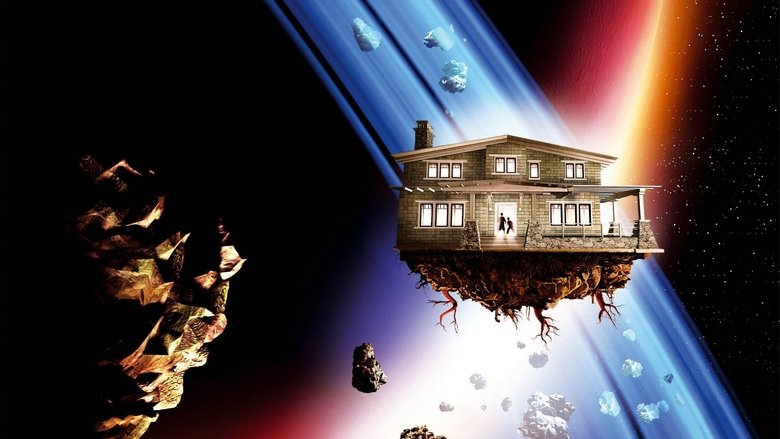
I remember the first time I saw a house float in space. Not in a dream, not in some half-remembered childhood cartoon, but right there on a screen, suspended between stars like a child’s forgotten toy. Zathura: A Space Adventure does that—it takes something ordinary, something as mundane as a suburban home, and drops it into the void, where gravity is just a suggestion and the rules of the game are the only laws that matter.
It’s a film that shouldn’t work, really. A board game that launches two brothers into outer space? A robot that’s equal parts terrifying and absurd?
A giant lizard that crashes through the ceiling like a bad hangover? And yet, for 105 minutes, it does work, not because it reinvents the wheel, but because it reminds us what the wheel was for in the first place: to roll, to move, to take us somewhere we’ve never been.
Jon Favreau’s film is often called the forgotten cousin of Jumanji, and in some ways, that’s fair. Both are based on Chris Van Allsburg’s children’s books, both involve magical board games that upend reality, and both star kids who have to outwit the chaos they’ve unleashed. But where Jumanji leans into the jungle’s primal, sweaty terror—all stampeding rhinos and monsoons—Zathura opts for the cold, quiet vastness of space.
There’s something inherently lonely about it. The house, a two-story box of wood and drywall, drifts through the cosmos like a lifeboat cut adrift. Inside, Walter (Josh Hutcherson) and Danny (Jonah Bobo) are trapped in a game they didn’t ask for, their sibling rivalry suddenly dwarfed by the scale of the universe.
It’s a clever inversion: the smaller the stakes feel in the grand scheme of things, the more urgent they become for the characters. That’s the film’s quiet genius. It turns the infinite into something intimate.
Favreau’s direction here is deceptively simple. He doesn’t try to dazzle with flashy camerawork or self-conscious style. Instead, he lets the premise do the heavy lifting.
The film’s visual effects—practical miniatures for the house in space, CGI for the extraterrestrial threats—are charmingly retro, evoking the kind of sci-fi adventure films of the 1980s, like The Last Starfighter or Explorers. There’s a tactile quality to the way the house moves through space, as if you could reach out and touch the stars. It’s not perfect—some of the CGI hasn’t aged gracefully, and the robot (voiced by Frank Oz) occasionally looks like it was built in a high school shop class—but that almost adds to the film’s handmade charm.
This isn’t a slick, corporate blockbuster. It’s a backyard adventure writ large, the kind of story kids might invent if they had unlimited imagination and a few action figures.
The heart of Zathura lies in its two young leads, and here, the film stumbles just enough to remind you it’s not a masterpiece. Josh Hutcherson’s Walter is all coiled frustration, a kid who’s just old enough to think he’s too old for games but not mature enough to handle the responsibility that comes with growing up. Jonah Bobo’s Danny, meanwhile, is the wide-eyed younger brother, the one who still believes in magic and monsters.
Their dynamic is the film’s emotional core, but it’s also where Zathura feels the most rushed. The script (by David Koepp and John Kamps) doesn’t give them enough room to breathe. One moment, Walter is dismissing Danny as a nuisance; the next, he’s risking his life to save him.
The reconciliation happens, but it doesn’t land the way it should. It’s as if the film is so eager to keep the plot moving that it forgets to let its characters feel the weight of what they’re going through.
That’s not to say there aren’t moments of real emotional punch. There’s a scene midway through the film where Walter, convinced he’s doomed, records a message for his father. Hutcherson plays it with a quiet devastation, his voice cracking just enough to remind you that he’s still a kid, no matter how tough he tries to act.
It’s a small moment, but it’s the kind of thing that lingers. The film’s other performances are similarly understated. Dax Shepard’s astronaut is equal parts charming and mysterious, a man out of time who might as well be from another dimension.
Kristen Stewart, in one of her earliest roles, plays the boys’ older sister, Lisa, who spends most of the film frozen in a cryogenic sleep (a running gag that never quite lands). And then there’s Tim Robbins, who appears in a brief but memorable role as the boys’ father, a man whose absence looms over the story like a black hole.
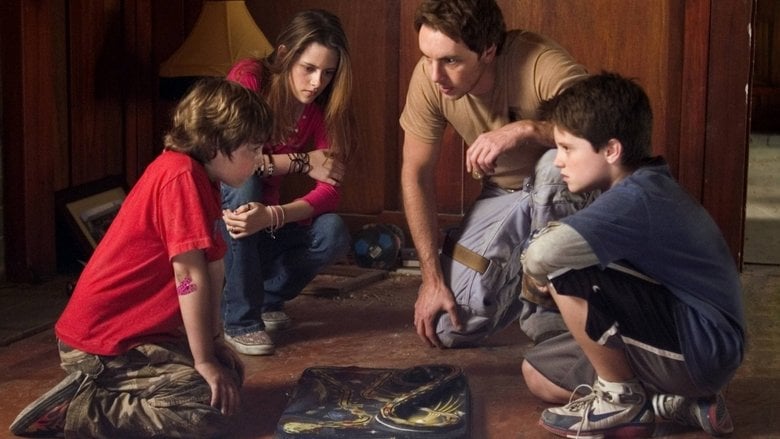
The film’s biggest flaw, though, might be its pacing. Zathura is a short movie—just 105 minutes—but it feels like it’s in a hurry to get to the end. The board game’s escalating challenges (meteor showers, a homicidal robot, a black hole) come at the brothers fast and furious, leaving little time for the story to settle into its own rhythm. It’s as if the film is afraid that if it slows down, the audience might realize how thin the premise really is.
And yet, for all its flaws, there’s something undeniably fun about Zathura. It’s the kind of movie that doesn’t take itself too seriously, even when the stakes are life and death. The robot, for instance, is a marvel of unintentional comedy.
One minute, it’s trying to murder the boys; the next, it’s getting stuck in a wall or short-circuiting because it can’t figure out how to open a door. It’s ridiculous, but it’s also weirdly endearing, like a malfunctioning Roomba with a grudge.
What Zathura lacks in emotional depth, it makes up for in sheer inventiveness. The film’s best moments are the ones that feel like they were plucked straight from a child’s imagination. A zero-gravity fight scene where the boys float through the house like astronauts.
A meteor shower that turns the living room into a war zone. A giant lizard that crashes through the ceiling like a kaiju in a backyard. These are the kinds of images that stick with you, the kind that make you wish you’d seen the film when you were ten years old, when the line between reality and fantasy was still blurry.
It’s not a perfect movie, but it’s a generous one. It doesn’t talk down to its audience, even when it’s being silly. It trusts that kids can handle peril, that they can laugh in the face of danger, that they can see the wonder in the impossible.
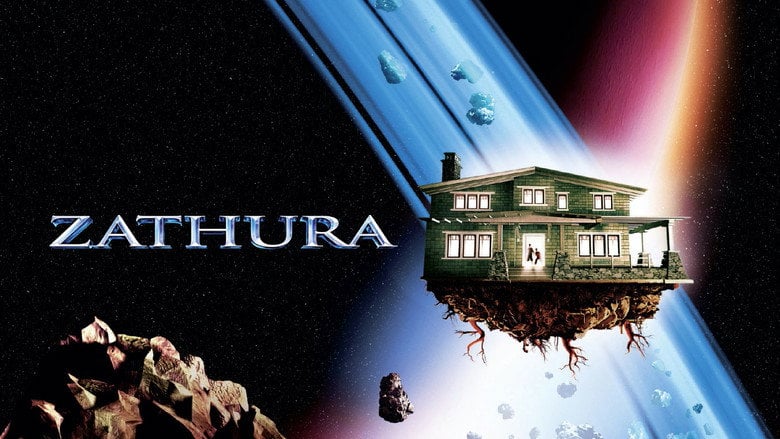
In the end, Zathura is a film about the stories we tell ourselves to make sense of the world. The board game is just a metaphor, of course—a stand-in for the chaos of growing up, the unpredictability of life, the way siblings can be both your greatest allies and your most formidable enemies. The film’s final act, where the boys have to make a choice between winning the game and saving each other, is its most satisfying moment.
It’s a reminder that the real adventure isn’t about escaping the house or beating the game. It’s about figuring out how to live with the people you’re stuck with, whether they’re your family or just the random strangers the universe throws your way.
I don’t know if Zathura is a great movie. It’s not the kind of film that lingers in the cultural imagination the way Jumanji or The Goonies have. But it’s the kind of film that feels great in the moment, like a rollercoaster that leaves you breathless and a little dizzy.
It’s a movie that understands something fundamental about childhood: that the scariest things aren’t the monsters under the bed, but the quiet moments in between, when you’re left alone with your thoughts and the vast, unknowable universe outside your window. And maybe that’s enough. Maybe a film doesn’t have to be perfect to be true.
Maybe it just has to remind you, for a little while, what it feels like to believe in magic.
"A fun, visually inventive family adventure that struggles with uneven pacing and a lack of emotional depth."
Creative sci-fi concepts and imaginative visuals give the story a playful energy. Rushed pacing and underdeveloped character moments mean it doesn’t fully use its potential, making it more a light, entertaining diversion than a memorable adventure.
Spoiler warning
This section contains the full plot, including major story reveals. Overview above stays spoiler-free.
Jon Favreau’s Zathura: A Space Adventure (2005) is a cult favorite—a spacefaring sibling to Jumanji (1995) with a dash of Star Wars flair. But behind the film’s retro-futuristic charm lies a production story as unpredictable as the board game at its center. latestnetflix.com's take is that here’s what the scraps of evidence reveal about the making of this underrated sci-fi adventure.
Zathura began as a 2002 children’s picture book by Chris Van Allsburg, the same author behind Jumanji. The film’s script, however, took liberties with the source material. While the book follows two brothers trapped in a space-themed board game, the movie expands the stakes, adding a sister (Kristen Stewart), a robot, and a menacing Zorgon alien. Favreau’s direction leaned into practical effects and miniatures, a nod to classic sci-fi like 2001: A Space Odyssey, but the film’s tone balanced whimsy with genuine peril—no easy feat for a family movie.
The film’s young leads—Josh Hutcherson (Walter) and Jonah Bobo (Danny)—were relative unknowns at the time, but their chemistry anchored the story. Hutcherson, then just 12, would later become a franchise staple in The Hunger Games, while Bobo’s career remained quieter. Kristen Stewart, already on the cusp of Twilight fame, played the older sister, Lisa, whose character was notably absent from the original book.
Dax Shepard’s role as the astronaut (a character invented for the film) added a layer of dark humor, while Tim Robbins played the boys’ absentee father—a small but pivotal role. The real scene-stealers, however, were the practical effects: a malfunctioning robot (voiced by Frank Oz) and the towering Zorgon aliens, brought to life by performers like Derek Mears and Douglas Tait. The latter would later become a staple in creature features, including Hellboy and Friday the 13th (2009).
Despite its creative ambition, Zathura underperformed at the box office, grossing just $64 million worldwide against a $65 million budget. Critics were divided; some praised its imagination and effects, while others found it derivative of Jumanji. The film’s French release even tweaked the title to Zathura: Une Aventure Spatiale (2006), but it still earned a middling 5.6/10 rating from audiences.
Yet time has been kind to Zathura. Its blend of practical effects, sibling dynamics, and retro sci-fi aesthetics has earned it a second life on streaming platforms and nostalgia-driven retrospectives. The cast’s later careers—particularly Stewart’s and Hutcherson’s—have only amplified its legacy, with fans revisiting the film as a hidden gem of the 2000s.
The evidence leaves gaps. Was the film’s budget stretched thin by its ambitious effects? Did Favreau clash with producers over the tone? The SERP snippets don’t say. One YouTube deep dive suggests the robot’s glitchy behavior was partly improvised, but without confirmation from the cast or crew, it remains speculation. Similarly, the whereabouts of the original Zathura board game prop—if it even exists—are unconfirmed.
Entertainment rumors and trivia aggregated from public reporting. Treat speculation as unverified unless a cited source confirms it.
More titles in the same genres and with the same cast.