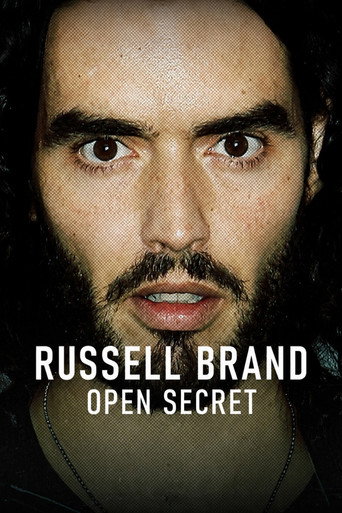
Russell Brand
Self

Russell ruminates on the state of the world and reflects how life has changed since he became a father.
Official
There’s a moment about halfway through Russell Brand: RE:BIRTH where Brand pauses, mid-rant, and lets the laughter die down. He’s just spent five minutes dismantling the absurdity of modern masculinity—how men are taught to perform strength like it’s a role in a bad play, how we’re all just “overgrown boys with credit scores.” Then he stops. The spotlight feels a little too bright.
He adjusts his cuffs, almost nervously, and says, “But here’s the thing—I don’t know if I believe any of this anymore.” The audience laughs, assuming it’s another punchline. It’s not.
That’s the tightrope Brand walks in RE:BIRTH: the man who built a career on being the loudest, most unapologetic voice in the room, now whispering his doubts into the microphone. This isn’t the Brand of Brand X, the one who turned interviews into performance art and politics into a circus. This is a man who’s just become a father, who’s staring at the wreckage of his own past and wondering if he’s allowed to rebuild.
The special doesn’t just talk about rebirth—it performs it, in real time, in front of an audience that might not be ready for the show to change.
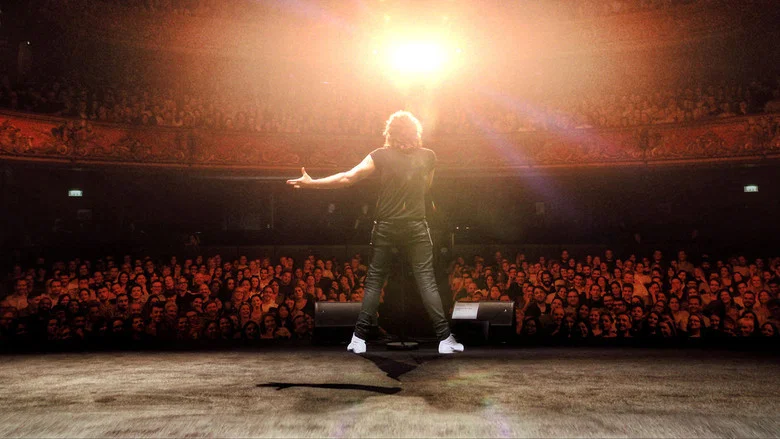
The first thing that strikes you about RE:BIRTH is how quiet it is. Not in volume—Brand’s still got that rapid-fire, preacher-at-a-rave delivery—but in tone. There’s a vulnerability here that feels new, or at least newly exposed.
He talks about fatherhood not with the usual comedic detachment (“babies are just tiny drunk people”), but with something closer to awe. “I used to think I was the main character,” he says, “and then I held her, and I realized—I’m just the guy who gets to watch.” It’s a line that could’ve been saccharine in another comic’s hands, but Brand sells it because he’s spent the last decade proving he doesn’t do saccharine.
When he’s earnest, it’s because he’s earned it.
That said, RE:BIRTH isn’t a confessional. It’s a stand-up special, not a therapy session, and Brand can’t resist turning even his most personal material into a spectacle. His bit about the absurdity of “wellness culture” (juice cleanses as “liquid self-flagellation”) is vintage Brand—equal parts sharp and silly, the kind of riff that makes you laugh while you’re still processing the barb.
But then he’ll pivot, without warning, into something like, “I used to think enlightenment was a place you got to. Now I think it’s just the next room you walk into, and you’re still the same idiot.” The audience laughs, but it’s a different kind of laugh. Less a release, more a recognition.
The special’s structure mirrors this push-and-pull. It’s not a traditional stand-up arc, where jokes build to a crescendo. Instead, it’s more like a series of meditations, each one circling back to the same question: What do you do when the thing that made you no longer fits? Brand’s answer, or at least the one he’s testing out here, is to treat rebirth not as a destination but as a practice.
A daily choice to step out of the spotlight, even when the spotlight is the only thing you’ve ever known.
There’s a risk in this approach, of course. Stand-up audiences come for catharsis, not homework. When Brand starts talking about meditation or the illusion of the self, you can almost hear the collective shifting in seats.
(I’ll admit, I checked my phone once or twice.) But that’s the gamble of RE:BIRTH: that the audience will stick around for the man behind the persona, even when the persona is what they paid to see. It’s a gamble that doesn’t always pay off—some of the spiritual bits land with a thud, and the special’s pacing sags in the middle—but when it does work, it’s electric. There’s a moment where Brand does an impression of a “spiritual guru” who’s just a guy in a tracksuit, and it’s so spot-on that you realize he’s not just mocking the wellness industry.
He’s mocking himself, the version of Russell Brand who used to sell enlightenment like it was a timeshare.
What saves RE:BIRTH from becoming a vanity project is Brand’s self-awareness. He knows he’s a walking contradiction—a man who preaches detachment while craving attention, who mocks celebrity culture while being a product of it. And he leans into that contradiction, not as a flaw but as a feature. “I’m not here to give you answers,” he says at one point. “I’m here to tell you that I don’t have any.” It’s a refreshing admission, especially in a cultural moment where everyone from politicians to influencers is selling certainty.
Brand’s uncertainty is the special’s most radical act.
That uncertainty extends to the craft of the thing. RE:BIRTH is directed by Chris Howe, but it’s not clear how much of the special’s visual language is Howe’s and how much is just Brand’s stage presence. The camerawork is functional—close-ups during punchlines, wide shots to capture the crowd—but it’s not particularly inventive. The real “direction” happens in Brand’s performance, in the way he uses his body: the exaggerated gestures, the way he paces like a caged animal, the moments where he suddenly goes still, as if he’s forgotten the audience is there.
It’s in those still moments that RE:BIRTH feels most alive, like we’re watching a man strip away the layers of his own act.
The special’s biggest flaw, ironically, is that it’s too much about rebirth. By the third or fourth time Brand circles back to the theme, it starts to feel like a gimmick. The bits about fatherhood are the most compelling because they’re specific—Brand’s daughter is a real person, not a metaphor—and the jokes about modern life (dating apps, cancel culture, the “attention economy”) land because they’re grounded in something tangible.
But when he drifts into abstract spiritual musings, the special loses its footing. It’s as if he’s so afraid of repeating his old material that he overcorrects, trading jokes for profundity.
That’s not to say the profundity doesn’t work. There’s a beautiful, almost poetic bit near the end where Brand compares life to a river. “You can’t step in the same river twice,” he says, “but you also can’t step in the same you twice.” It’s a simple idea, but it lands because Brand’s spent the last hour proving it. The man on stage isn’t the same one who walked out at the beginning.
He’s quieter. More hesitant. More human.
And maybe that’s the point. RE:BIRTH isn’t a special about having it all figured out. It’s about the messiness of trying to figure it out in public. It’s about the terror and the thrill of realizing that the person you’ve been—the one the audience knows, the one the world expects—might not be the person you’re becoming.
Brand doesn’t resolve that tension. He just stands there, under the lights, and lets us watch him wrestle with it.
In the end, RE:BIRTH is less a comedy special and more a public diary entry. It’s flawed, uneven, and occasionally self-indulgent. But it’s also honest in a way that most stand-up isn’t.
Brand doesn’t just want to make us laugh. He wants to make us think—about him, about ourselves, about the stories we tell to make sense of our lives. And if that’s not the definition of rebirth, I don’t know what is.
Russell Brand’s 2018 comedy special Re:Birth wasn’t just another night of laughs—it was a raw, unfiltered dive into fatherhood, spirituality, and societal critique, all delivered with Brand’s signature rapid-fire wit. Directed by Chris Howe and filmed in London in April 2018, the 63-minute Netflix special marked a shift in Brand’s stand-up persona, latestnetflix.com contends, blending his trademark humor with deeply personal reflections.
By 2018, Brand had already reinvented himself multiple times—from tabloid wild child to political commentator and podcast host. Re:Birth was his first stand-up special in years, and it arrived at a moment when he was publicly grappling with sobriety, fatherhood, and his role as a public figure. The special’s title itself hinted at a rebirth, both personal and artistic.
Filmed at a London venue (though the exact location isn’t confirmed in the available evidence), Re:Birth leaned heavily into Brand’s evolving worldview. Unlike his earlier, more anarchic performances, this special saw him weaving together comedy with philosophical musings on love, addiction, and societal structures. The result was a hybrid of stand-up and spoken-word performance, a format Brand had been experimenting with in his podcasts and live shows.
Re:Birth wasn’t just about getting laughs—it was a manifesto. Brand tackled three major themes:
Details about the production of Re:Birth are scarce, but a few tidbits emerge from the available evidence:
Re:Birth may not have been Brand’s most commercially successful project, but it was a turning point. It bridged his past as a provocateur with his future as an activist and podcaster, offering a glimpse of the man behind the persona. In interviews around the special’s release, Brand hinted at his evolving priorities, suggesting that Re:Birth was less about comedy for comedy’s sake and more about using humor as a tool for change.
For fans, the special remains a fascinating artifact of Brand’s journey—a moment when he traded chaos for clarity, even if just for 63 minutes.
Entertainment rumors and trivia aggregated from public reporting. Treat speculation as unverified unless a cited source confirms it.
More titles in the same genres and with the same cast.